
Review · PRAGUE
Prague Castle, St. Vitus Cathedral, Royal Palace, St. George’s Basilica
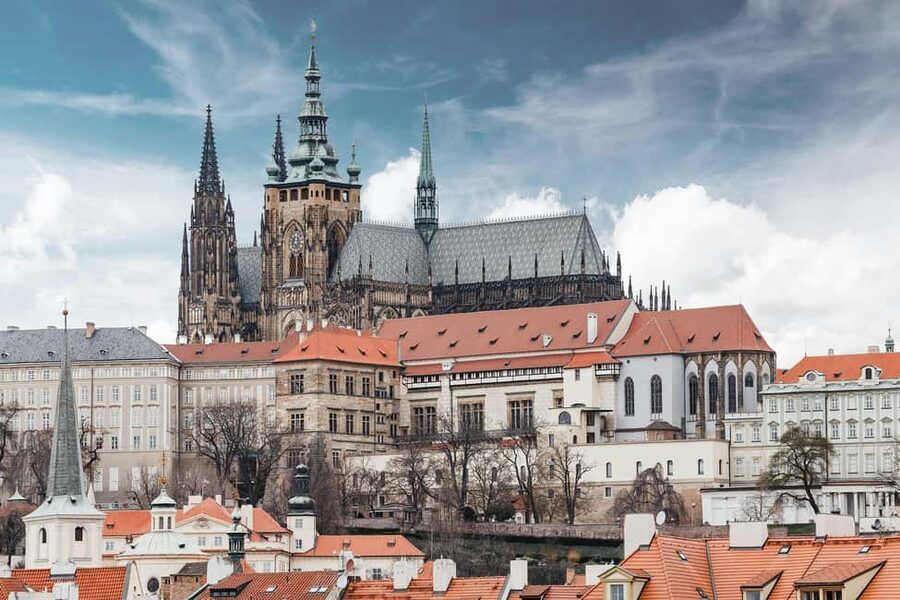
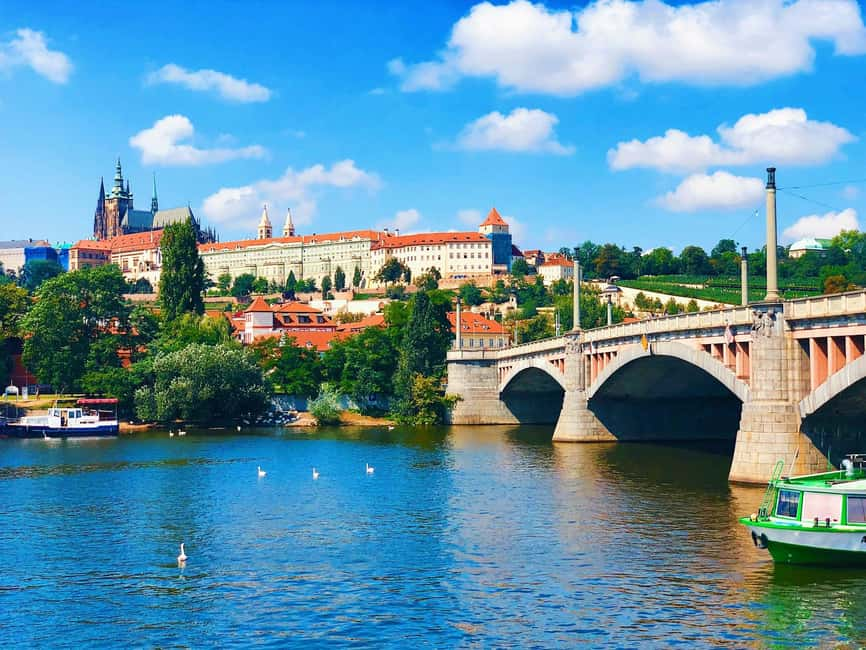
Prague Castle is more than one grand building. It is a whole historic district behind a wall, with royal rooms, a cathedral, a Romanesque basilica, narrow lanes, and superb views over Prague. I especially like the historian-led commentary and the efficient meeting point at the Pražský hrad tram stop, which saves you from guessing where to begin.
I also like that the route brings together four very different places: St. Vitus Cathedral for Gothic splendor, the Old Royal Palace for royal politics, St. George’s Basilica for early medieval Prague, and Golden Lane for a touch of legend and literary history. The main drawback is the price structure: the $43 tour fee does not include the admission ticket, and the amount of information may feel heavy if you prefer a light, casual walk.
Key points to know before booking
- A three-hour tour in German: Historian Robert Procházka leads the visit through the castle complex and its historic interiors.
- Four major stops included: You visit St. Vitus Cathedral, the Old Royal Palace, St. George’s Basilica, and Golden Lane.
- Admission is extra: Adults pay 18 EUR, while seniors aged 65 and older pay 14 EUR.
- A strong history focus: Expect detailed explanations about Bohemian kings, coronations, religious relics, royal conflict, and Prague’s political past.
- Excellent city views: The castle grounds offer broad views across Prague.
- Best for older children and adults: Children under 10 are not accepted, and the tour suits people who enjoy sustained historical detail.
Starting at the Pražský hrad tram stop
Your meeting point is unusually easy to identify. Take tram line 22 or 23 toward Bílá hora and get off at Pražský hrad, the Prague Castle stop. Robert Procházka waits there to meet the group.
That location matters. Prague Castle is spread across a large area, and arriving without a plan can cost you time before you even reach the first sight. Meeting at the tram stop gives you a clear starting point and puts you at the castle entrance without an unnecessary search through the city.
The tour lasts about three hours and is conducted in German. Some material may appear in its original language, so you should be comfortable following a German explanation of names, events, and architectural terms.
Robert is a historian, not simply a guide who points out attractive buildings. His style is detailed and serious, with plenty of context about Prague’s rulers and religious life. Several parts of the tour may be especially useful if you want to understand how the buildings connect to one another, rather than seeing the castle as a series of unrelated photo stops.
The tour ends at Golden Lane. That gives you a natural place to continue exploring independently, take photographs, or make your way back through the castle grounds.
More Royal Palace Tours around the world:
- Madrid: Royal Palace Fast-Access Admission Ticket
★ 4.6 · 13,856 reviews - Madrid: Royal Palace Expert Guided Tour with Skip-the-Line
★ 4.7 · 8,407 reviews - Amsterdam: Royal Palace Entry Ticket + Audio guide
★ 4.6 · 7,889 reviews
St. Vitus Cathedral and the story of Bohemian power
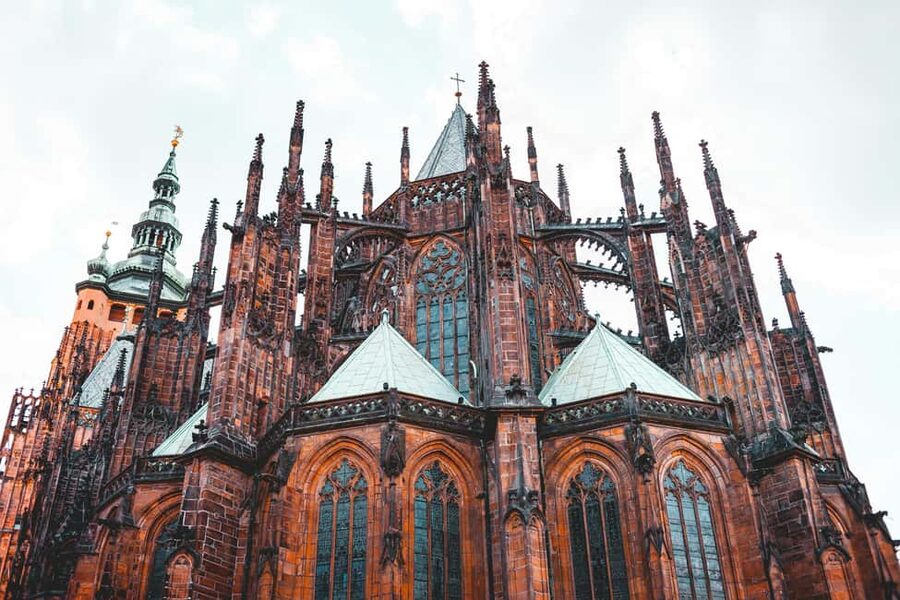
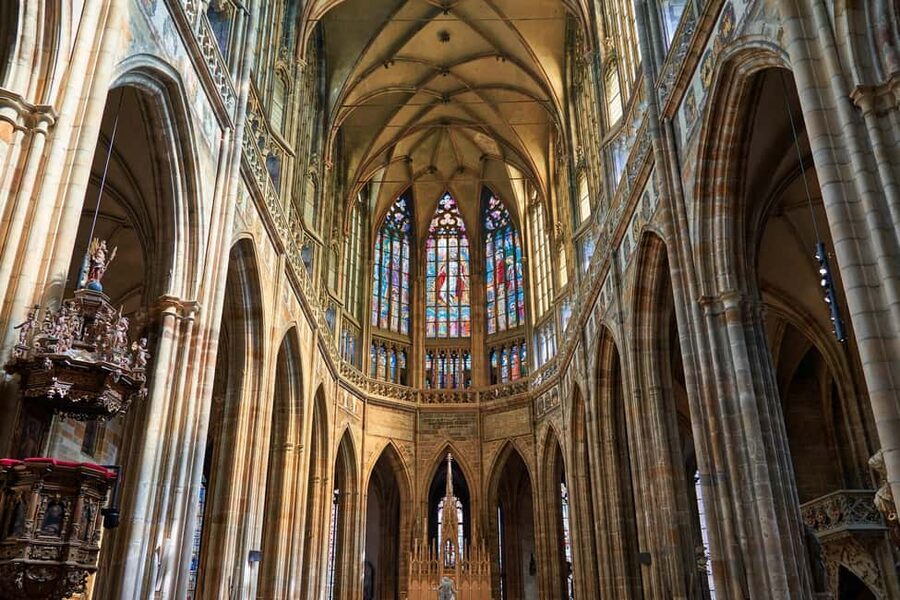
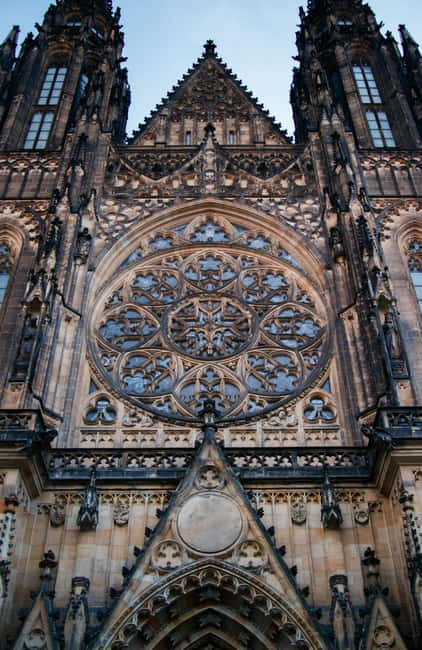
St. Vitus Cathedral is likely to be the visual high point of the tour. Its Gothic design carries the scale and drama you expect from a royal cathedral, but the details reward close attention: chapels, tombs, stained glass, stonework, and the strong vertical lines that pull your eyes upward.
The cathedral serves as the burial and coronation site of Bohemian kings. That makes it more than a place of worship. It is also a record of political power, royal ceremony, and national identity.
The building’s oldest predecessor was a Romanesque rotunda founded around 925. The present cathedral developed later, with its major Gothic work associated with the 14th century. A good guide can help you keep those layers separate, since Prague often places several centuries of architecture in the same view.
You will hear about important patron saints, including St. Wenceslas and St. Adalbert. St. Wenceslas has a particularly important place in Czech tradition, and the Wenceslas Chapel contains his remains in a Gothic shrine.
The chapel is decorated with semi-precious stones, giving it a more intimate and jewel-like feel than the vast main interior. A spiral staircase leads from the chapel toward the Crown Chamber, where the coronation insignia are kept. The tour explains this connection between sacred space and royal ceremony, though access to every restricted area is not promised.
I like this part of the route because it gives you several ways to read the cathedral. You can appreciate it as architecture, a church, a royal burial place, or a symbol of the Czech state. If you only have time to take photographs, you will miss much of what makes the building important.
The tradeoff is pace. St. Vitus Cathedral contains a lot to absorb, and Robert’s detailed approach may keep you looking at one feature longer than you might on a self-guided visit. That is a benefit for history-minded visitors, but it may feel slow if you want to race through the interiors.
The Old Royal Palace and Prague’s political drama
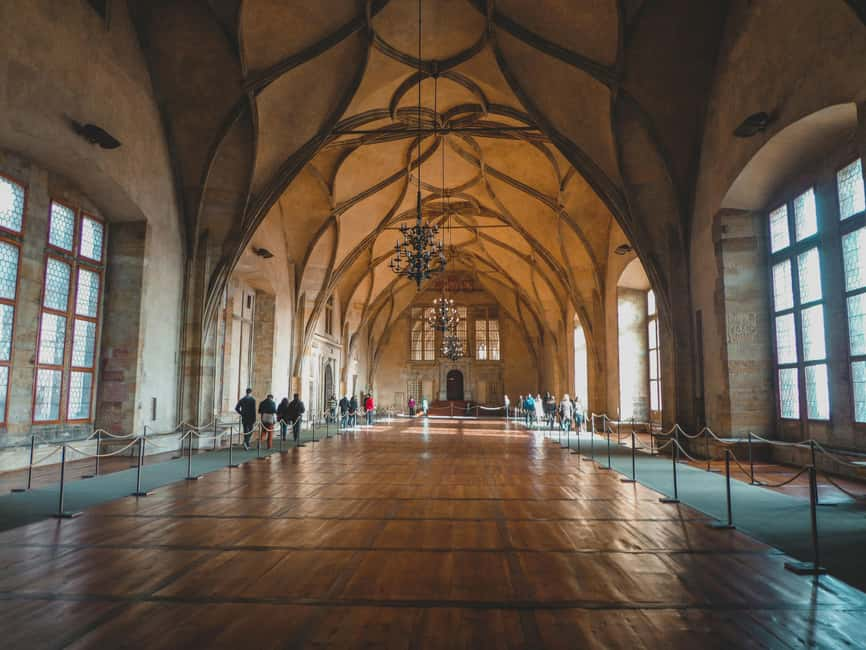
The Old Royal Palace shifts the focus from religion to government. Here you learn how rulers used the castle, how formal power was displayed, and how disputes inside Prague’s political system helped shape European history.
One of the major highlights is the large late Gothic throne room. It is described as the largest late Gothic throne room in Central Europe, and the scale helps explain how the palace functioned as a place for ceremony and authority.
The palace also connects to the famous Defenestrations of Prague. The State Chancellery was the site of the Third Defenestration of Prague, an event that helped set off the Thirty Years’ War. The story is memorable because the act itself was so dramatic: political opponents were thrown from a window.
This is the sort of moment where a historian’s explanation pays off. Without context, the event can sound like an odd piece of medieval theater. With the political and religious background in place, it becomes part of a much larger struggle that affected Central Europe for decades.
You will also see a replica of the Bohemian crown jewels. It is important to understand that you are viewing a replica, not the original regalia. Even so, it helps you picture the ceremony and symbolism attached to Bohemian kingship.
The palace is a good counterpoint to St. Vitus Cathedral. The cathedral shows how rulers presented themselves through religion and ceremony. The palace shows the arguments, decisions, and conflicts that took place behind the formal image.
St. George’s Basilica and Prague’s early medieval past
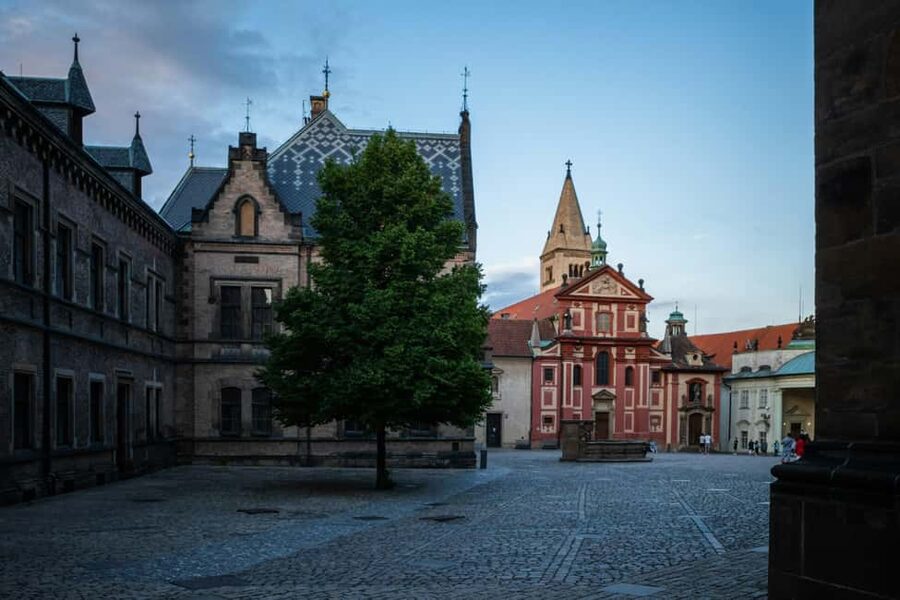
St. George’s Basilica is much older in character than the Gothic cathedral. The 10th-century building has a Romanesque feel and offers a useful change of scale after the grand spaces of St. Vitus and the Old Royal Palace.
The basilica contains the tomb of St. Ludmila, the grandmother of St. Wenceslas. Her story is tied to the early Christian history of Bohemia and to the complicated relationships within the ruling family.
According to the account presented on the tour, St. Ludmila was strangled by Viking warriors acting on behalf of her daughter-in-law. That detail can sound almost startling beside the calm stone interior, but it gives the basilica a direct connection to dynastic rivalry, religious change, and the hazards of royal family life.
I like this stop because it prevents the castle visit from becoming a parade of enormous monuments. St. George’s Basilica is more restrained, and its age is easier to appreciate when Robert explains how it relates to later buildings around it.
It is also a useful place to think about continuity. Prague Castle was not built all at once as a single planned attraction. It developed over centuries, with each period adding its own style, purpose, and political meaning.
More palaces to tour around the world:
- Venice: Doge’s Palace Reserved Entry Ticket
★ 4.6 · 42,716 reviews - Paris: Versailles Palace and Gardens Full Access Ticket
★ 4.6 · 41,579 reviews - Granada: Alhambra & Nasrid Palaces Tour with Tickets
★ 4.7 · 19,801 reviews - Sintra: Pena Palace and Park Entrance Ticket
★ 4.2 · 17,410 reviews
Golden Lane, alchemists, and Franz Kafka
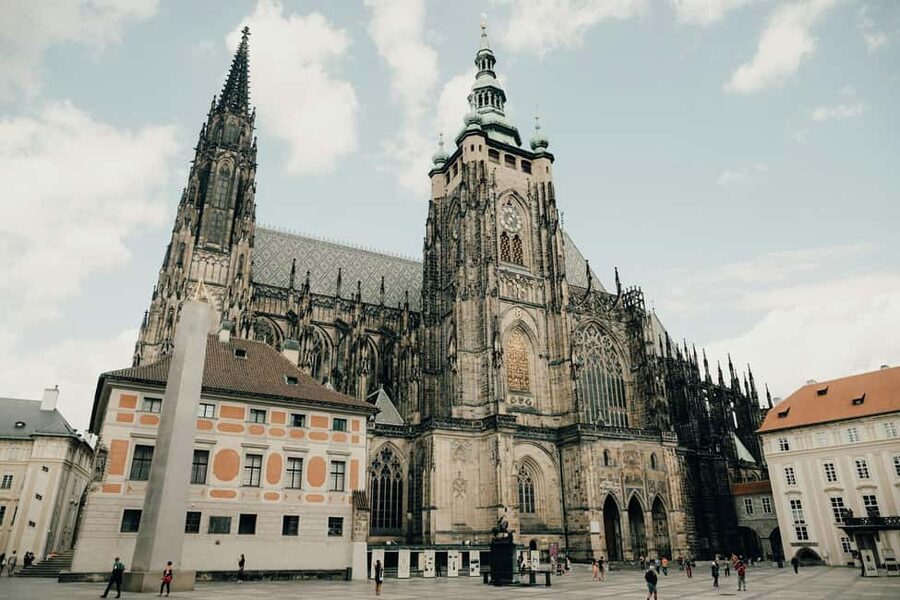
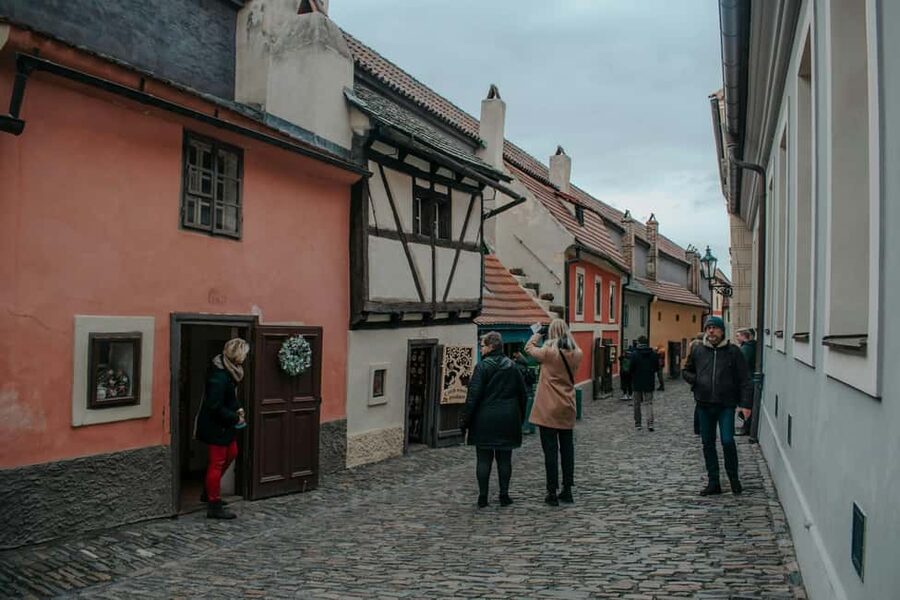
Golden Lane is the most picturesque part of the route. Its small houses create a sharp contrast with the cathedral and palace. The lane is associated with the period of Emperor Rudolf II, whose court became famous for its interest in science, occult studies, art, and unusual experiments.
The tour connects Golden Lane with alchemists who searched for an elixir of life and tried to turn lead into gold. You should treat these stories as part of the lane’s legend and historical atmosphere rather than as proof that every small house was an alchemist’s laboratory.
The lane also has a literary connection. Franz Kafka lived in one of the little houses. That fact gives the setting an extra layer, especially if you already know his work or want to connect Prague’s architecture with its writers.
Golden Lane is a good final stop because it is visually compact and easy to remember. After three hours of churches, royal rooms, dates, and political events, the tiny buildings offer a simpler closing scene.
It can also be the busiest-feeling part of the route, depending on conditions. The narrow lane leaves less room to spread out, and its small interiors may not hold everyone comfortably at once. The tour ends here, so you can take your time afterward instead of feeling rushed to follow the guide to another sight.
What the $43 fee really covers
The $43 price pays for the three-hour guided tour in German and the historian’s service through the castle complex and interiors. It does not include admission to the four main sites.
Plan on an additional 18 EUR for an adult ticket or 14 EUR for a senior aged 65 or older. The guide takes you to the castle cashier and helps arrange the admission. You can pay by card at the counter or hand the amount in euros to the guide, who can obtain the ticket for you.
That arrangement adds practical value because you do not have to work out the ticket purchase alone. The guide also uses a counter intended for guides, which can reduce the wait compared with a standard ticket line.
Still, include the admission cost when comparing the tour with other castle options. The total is not simply $43. The value depends on how much you want a structured historical explanation in German.
For me, the fee makes the most sense if you would otherwise spend time trying to connect the buildings and dates yourself. A self-guided visit can cover the same interiors, but it will not automatically explain why the cathedral, royal palace, basilica, and Golden Lane belong to the same story.
The high rating of 4.9 from 21 ratings fits the strongest feature of the experience: the guide’s personal attention. Some tours are delivered to large groups with a fixed script. Here, the group may be small enough for Robert to answer questions and adjust his explanation. In some cases, he has led the tour for only one family or one couple.
That small-group possibility is not guaranteed, so I would not book solely on the assumption that you will receive a private tour. But the format appears well suited to questions, and Robert’s German is described as clear and easy to follow.
Who will enjoy this tour most
I would choose this tour if you like history presented with dates, people, causes, and consequences. You should have at least a small interest in Prague’s past, since the amount of information can feel dense if you prefer only a quick introduction.
It is particularly suitable for:
- Adults who want a serious explanation of Prague Castle
- German-speaking visitors who prefer a live guide
- Couples or families with older children
- People interested in Gothic, Renaissance, and Baroque architecture
- Visitors who want help handling the castle admission process
- Anyone who wants to understand the link between royal power and religious tradition
The age rule is clear: children under 10 cannot join. Older children may be accepted, but the tour’s detailed style is better suited to teenagers and adults. One family with adult children found the experience especially successful, which makes sense given the subject matter and pace.
You should also dress warmly. The castle interiors can be cold, even when the weather outside is mild. A warm layer will make it easier to concentrate on the guide instead of thinking about your fingers.
Language, pace, and the amount of information
The tour is offered in German, and the guide’s clear speaking style is an important part of the experience. If you understand German well, you can expect detailed explanations rather than a short list of dates and names.
Robert’s approach is especially strong for people who ask questions. He is described as patient and willing to respond to everything from basic points to more specific historical issues. That makes the tour feel more like a guided conversation when the group is small.
The possible weakness is the same quality that attracts history fans. You may receive so many details that the tour feels full. If your ideal castle visit is mostly walking, photographing, and listening to a few short stories, this may be more information than you want.
I would not call that a flaw in the tour itself. It is a question of matching the style to your interests. Read the experience as a compact history lesson with architecture around it, not as a casual stroll with occasional commentary.
Practical details that affect your day
The three-hour duration is long enough to cover the major interiors without turning the visit into an all-day commitment. Allow extra time before or after if you want to explore more of the castle grounds on your own.
Start by confirming the tram direction. Lines 22 and 23 should be taken toward Bílá hora, and you should leave the tram at Pražský hrad. This is the specific stop listed for the meeting point.
The tour ends at Golden Lane, not back at the original tram stop. That is useful because you finish near one of the most atmospheric parts of the complex, but you should remember that your return journey begins from the end point.
Cancellation is flexible up to 24 hours before the start for a full refund. You can also reserve now and pay later, which helps if your Prague plans are still changing.
Should you book the Prague Castle historian tour?
Book it if you want Prague Castle explained by a historian, in German, with enough time to connect its major buildings and political stories. Robert Procházka’s detailed approach is the main reason to choose this experience, especially if you value clear answers and a guide who can adapt to a small group.
Skip it if you want a quick visit, dislike extended historical commentary, or need the lowest possible total cost. Remember to add the 18 EUR adult admission, or 14 EUR for seniors, to the $43 tour fee.
For the right audience, this is a strong way to see the castle. You get Gothic grandeur at St. Vitus, royal ceremony and political conflict in the Old Royal Palace, early medieval atmosphere at St. George’s Basilica, and the compact charm of Golden Lane, all tied together by one guide rather than left as four disconnected sights.
FAQ
Where does the tour meet?
The meeting point is at the Pražský hrad, or Prague Castle, tram stop. Take tram line 22 or 23 toward Bílá hora.
Who leads the tour?
Historian Robert Procházka leads the tour.
What language is the tour conducted in?
The live tour is conducted in German. Some content may be shown in its original language.
How long does the tour last?
The tour lasts three hours.
Which places are visited?
The route includes St. Vitus Cathedral, the Old Royal Palace, St. George’s Basilica, and Golden Lane.
Is admission included in the tour price?
No. Admission costs 18 EUR for adults and 14 EUR for seniors aged 65 and older. The guide helps you purchase the ticket at the castle cashier.
Can children join the tour?
Children under 10 are not permitted. The tour is best suited to older children and adults who are comfortable with detailed historical information.
Fresh palace tours around the world
- Bangkok Private Grand Palace Emerald Buddha and Reclining Buddha★ 4.5 · 2 reviews
- Bangkok Markets, Palaces and Temples Excursion★ 5.0 · 8 reviews
- Bangkok Two Temple Tour: Wat Pho, Emerald Buddha & Grand Palace★ 5.0 · 4 reviews
- Bangkok Royal Road – Top 3 Major Monuments (Grand Palace, Wat Pho, Wat arun)★ 4.5 · 111 reviews
- Bangkok Grand Palace and Emerald Buddha Tour★ 4.0 · 91 reviews
- Bangkok’s Landmarks Tour : GrandPalace WatTraimit WatPho WatArun★ 5.0 · 8 reviews
- Private Tour: Grand Palace,Wat Phra Kaew, Museum&Cooking Class★ 5.0 · 7 reviews
- Bangkok Grand Palace & Emerald Buddha Flexible Entry with Audio★ 3.5 · 3 reviews
Royal Palace Tours: the shortlist.
Royal Palace Expert Guided Tour with Skip-the-Line
Read our review →
Dubai To Abu Dhabi: Grand Mosque, Royal Palace & Etihad Towers
Read our review →
Madrid Essential: Historic Center, Plaza Mayor & Royal Palace
Read our review →
Abu Dhabi Day-Trip Grand Mosque, Royal Palace & Lunch
Read our review →
Louvre Entry & Etihad Tower/Royal Palace Options
Read our review →This visit also appears in