
Review · COPENHAGEN
Copenhagen: Christiansborg Palace Entry Ticket
Christiansborg Palace gives you an unusual look at Denmark’s center of power: one ticket takes you from royal reception rooms and the grand Great Hall to working stables, a historic kitchen, and ruins beneath the palace. I love the mix of polished royal rooms and everyday royal machinery, especially the chance to see the white horses in the Royal Stables. I also like that you explore at your own pace rather than being pushed through with a group.
The main drawback is that the five areas are spread around the palace grounds, so this is not one simple indoor route. Some sections may close before the official 5 p.m. closing time, and official state events can force a change or cancellation.
Key points at a glance
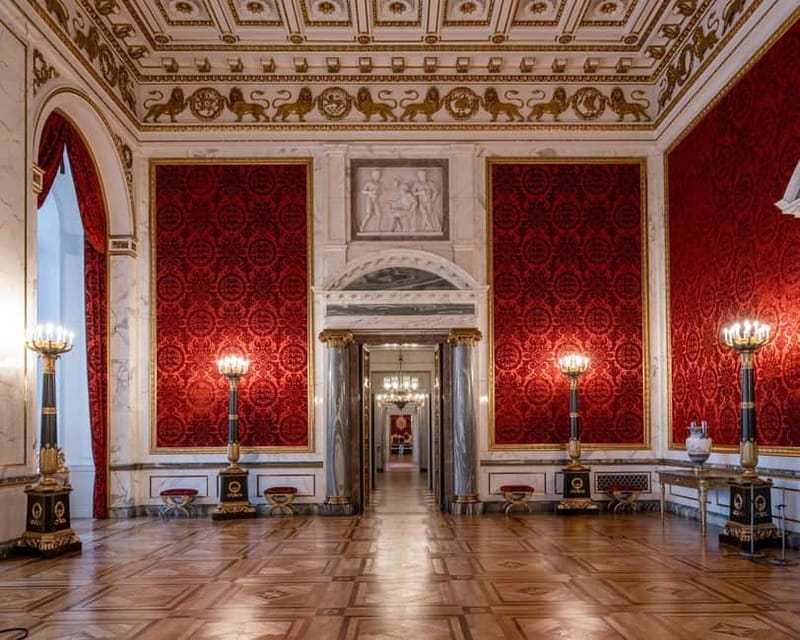
- One ticket covers five palace sights: Visit the Royal Reception Rooms, Royal Stables, Royal Kitchen, ruins, and Chapel.
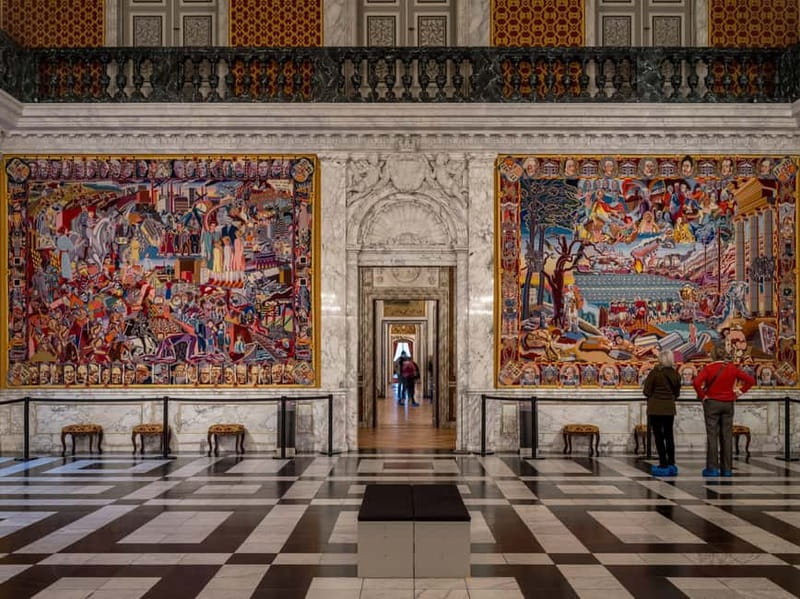
- The Great Hall is the visual high point: See the grand room and the Queen’s large woven wall hangings.
- The ruins reach back 800 years: Look beneath the present palace at earlier buildings on Slotsholmen.
- Real royal horses live here: The stables add a practical, working side to the palace visit.
- You set the pace: There is no guided tour included, and a concise audio app can provide extra context.
- Plan before 4:30 p.m.: Last entry is at 4:30, but some areas can close earlier.
Why Christiansborg is more than a palace tour
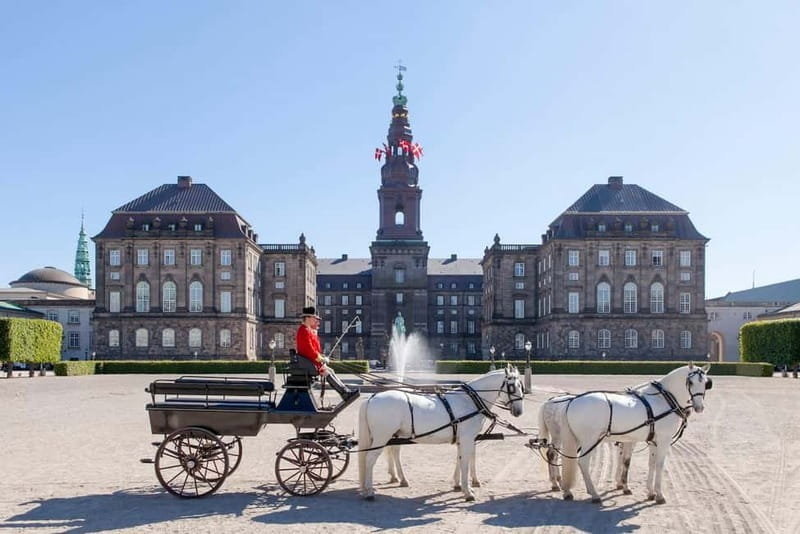
Christiansborg Palace is not simply a grand home left behind by royalty. It remains part of Denmark’s working government, with the Folketing, Prime Minister, High Court, and Royal Reception Rooms all connected to the complex.
That gives the visit a useful sense of place. You are not just looking at old furniture and formal rooms. You are seeing the site where Denmark has exercised political power since the early 1400s, while royal ceremonies still take place here.
The present palace is the third Christiansborg. The first was built between 1734 and 1745 and burned in 1794. A second palace was completed in 1828, then destroyed by fire in 1884. The current building was constructed from 1907 to 1928, with Frederik VIII laying the cornerstone and Christian X opening it.
Those repeated fires explain why the palace experience moves between periods. The royal rooms present ceremony and modern monarchy, while the ruins take you much farther back. The result is a visit with more range than the exterior alone suggests.
More Palace Entry Tickets in the world:
- Venice: Doge’s Palace Reserved Entry Ticket
★ 4.6 · 42,716 reviews - Sintra: Pena Palace and Park Entrance Ticket
★ 4.2 · 17,410 reviews - Granada: Alhambra and Nasrid Palaces Entry Ticket
★ 4.6 · 15,130 reviews
Start with the Royal Reception Rooms and Great Hall
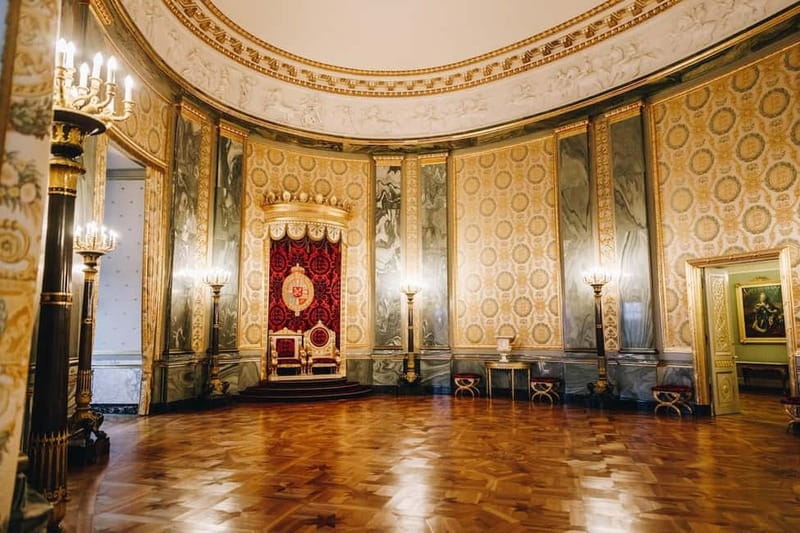
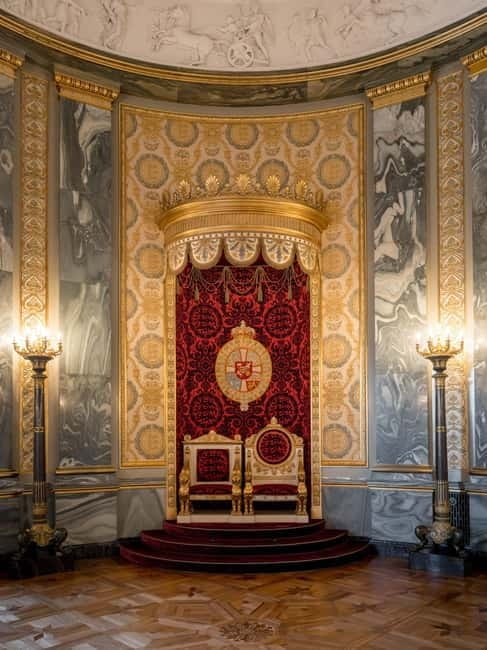
Begin with the Royal Reception Rooms, the most formal part of the palace. These are the rooms used for major royal events, audiences, and state functions, so the emphasis is on ceremony rather than private family life.
The Great Hall is the showpiece. Give yourself time to look up, across, and along the walls rather than simply walking through. The scale and decoration make clear how Denmark presents itself on important occasions.
The Queen’s Tapestries are another major feature. They provide a sweeping visual account of Danish history and royal tradition, and they are among the details that make the reception rooms memorable. If you like architecture, decorative art, or court ceremony, this section deserves the most time.
Photography is allowed in the rooms, which is useful because the interiors are full of details worth remembering. Keep your camera work considerate, though. A palace is still an active official building, not just a museum set.
The rooms are beautiful, but they can feel formal and somewhat restrained if your main interest is daily royal life. That is why I recommend pairing them with the kitchen and stables. The contrast helps you understand how the palace functioned behind the grand ceremonies.
See the palace at work in the Royal Stables
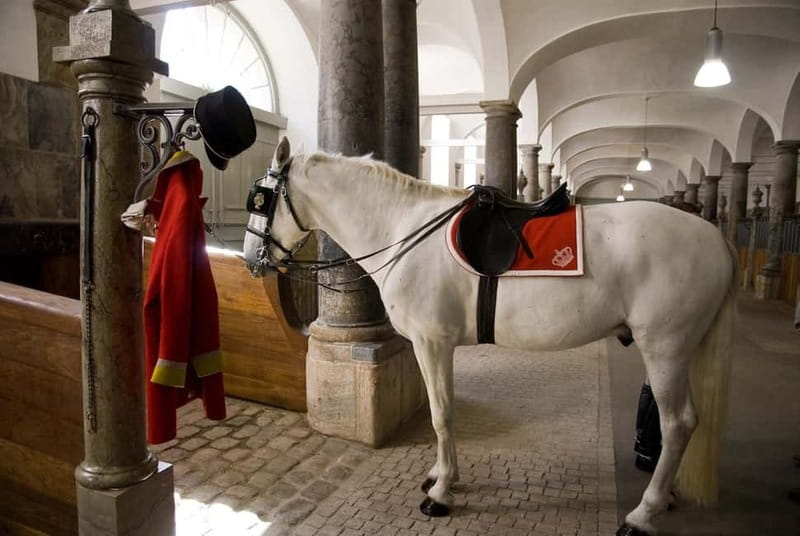
The Royal Stables bring the visit down to practical level. Here you can see where the royal horses are kept, and the experience can feel more immediate than the grand reception rooms.
The white horses are a particular highlight. Seeing real royal horses gives the palace a living connection to tradition, rather than leaving you with only preserved rooms and historic objects.
This section is especially good for families and for anyone who finds ceremonial rooms a little distant. It also adds a rare working element to a palace visit. You are not just seeing where royal events happen, but part of the transport and care system connected with those events.
Allow enough time to find the entrance. The palace areas are located in different parts of the grounds, and the stables are not simply reached by following one interior hallway from the reception rooms. Staff can point you in the right direction, and signs around the grounds help, but expect a little walking and orientation.
Step into the Royal Kitchen
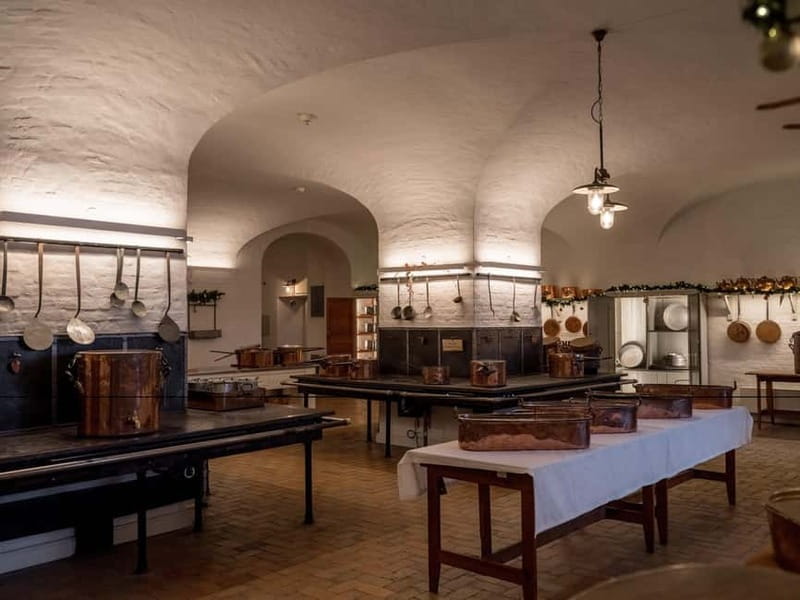
The Royal Kitchen offers a different view of palace life. Instead of focusing on public ceremony, it shows the work required to support it.
This is one of the best stops for understanding the scale behind royal entertaining. Formal dinners and receptions require planning, equipment, staff, and space, and the kitchen makes that practical side easier to picture.
The kitchen also breaks up the visit nicely. After the polished rooms, you get a more functional setting. I would not rush through it, even if you are mainly interested in the royal apartments. It helps turn the palace from a collection of beautiful rooms into a working institution.
The supplied ticket covers the Royal Kitchen, but the route is self-guided. You can spend five minutes here or much longer, depending on your interest. That freedom is useful because the palace offers several different kinds of history in one visit.
More palaces to tour around the world:
- Paris: Versailles Palace and Gardens Full Access Ticket
★ 4.6 · 41,579 reviews - Granada: Alhambra & Nasrid Palaces Tour with Tickets
★ 4.7 · 19,801 reviews - Madrid: Royal Palace Fast-Access Admission Ticket
★ 4.6 · 13,856 reviews - Doge’s Palace & St. Mark’s Basilica with Terrace Access Tour
★ 4.7 · 10,697 reviews
Go below ground to the 800-year-old ruins
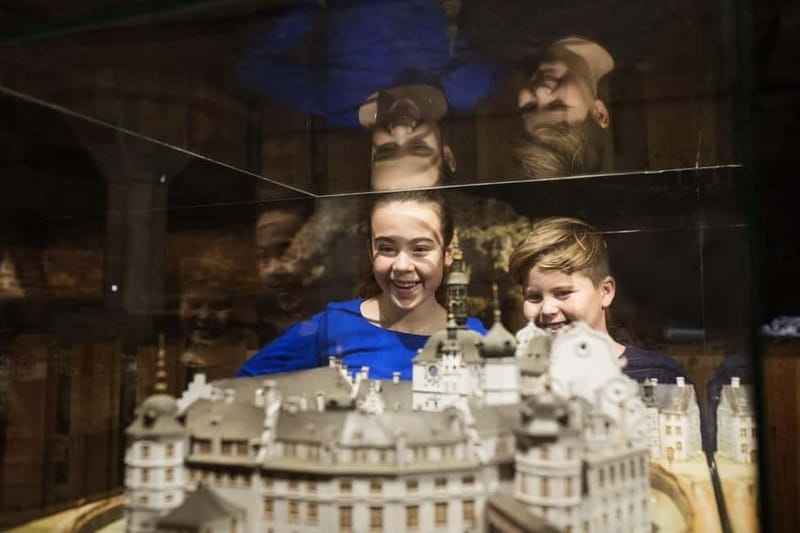
The ruins beneath Christiansborg are the most important stop for understanding the site’s long timeline. Here you can see remains from earlier buildings, including the medieval foundations beneath the present palace.
This underground section changes the mood completely. The reception rooms look forward to royal ceremony and official life; the ruins take you back to the earlier buildings that occupied Slotsholmen.
For me, this is what gives the ticket its strongest value. You are not paying only to see one palace interior. You are also getting a record of the buildings that came before it, including the old Copenhagen Castle demolished under Christian VI.
The ruins may appeal most to adults and older children who enjoy seeing physical evidence of the past. They are less glossy than the reception rooms, but that is precisely their strength. Stone foundations and preserved remains make the palace’s long development easier to grasp.
Add Christiansborg Chapel if you visit on Sunday
The Palace Chapel is free to enter and open on Sundays. It is not part of the paid palace ticket in the same way as the other areas, but it adds another layer to the complex.
If your schedule allows, check the chapel on Sunday and treat it as a separate stop. The available information does not specify its full opening schedule beyond Sunday access, so do not assume it will be open on another day.
The Chapel is a good addition for visitors interested in royal ceremonies and religious settings. If you are visiting on a weekday, focus your time on the four paid areas that are clearly included, then check current on-site information for Chapel access.
How the one-day ticket works
The ticket is valid for one day, giving you room to spread the visit around your Copenhagen plans. That matters because Christiansborg is not one quick room-to-room attraction. You need to move between separate entrances and sections.
Last entry is at 4:30 p.m., and the palace closes at 5 p.m. Do not arrive late in the afternoon and expect to see everything comfortably. One area can close around 4 p.m., even though the main palace remains open until 5.
I would plan to arrive with enough time for all the sections you care about. If you mainly want the Great Hall and reception rooms, a shorter visit may work. If you want the stables, kitchen, ruins, and Chapel as well, give the complex a larger part of your day.
A useful detail from one late-arriving visit is that staff helped validate a ticket for the next day. Treat this as a kindness, not a standard guarantee. Your safest plan is still to use the ticket within its stated one-day validity.
Price and value at $35
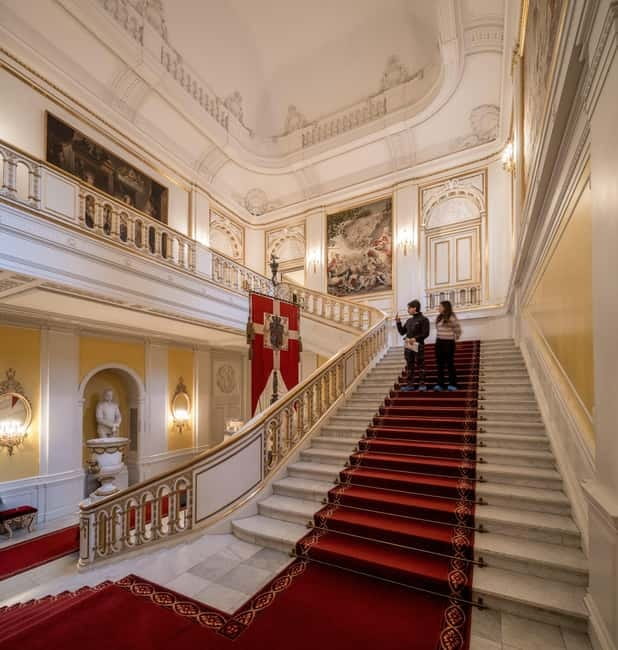
At $35 per person, this is not a cheap single-room admission. It becomes better value when you use the full ticket, since it includes the Royal Reception Rooms, Great Hall, Queen’s Tapestries, Royal Kitchen, Royal Stables, and underground ruins.
The price makes the most sense for visitors who want variety. If you only want a quick look at a royal interior, a smaller attraction may suit you better. If you enjoy architecture, monarchy, archaeology, horses, and political history, the all-area ticket gives you several distinct experiences for one admission.
The self-guided format also helps with value. You can linger in the Great Hall, move quickly through a section that interests you less, and return your attention to the rooms or ruins that matter most to you. There is no included guided tour, so the experience depends on your willingness to read the explanations or use the audio app if available.
The audio app is described as concise and educational. That is a good fit here. You get useful background without being tied to a long group presentation.
Practical limits you should know before booking
This is an active palace. State visits, audiences, and official events can change or cancel a booking. That is an important tradeoff: the building’s continuing role in Danish public life makes it special, but it also means access is not as predictable as at a standard museum.
Do not bring food or drinks inside. Baby strollers, baby carriages, luggage, large bags, and backpacks are not allowed. Pets are not allowed either, though assistance dogs are permitted.
These restrictions can shape your day, especially if you are visiting with a baby or carrying luggage between accommodations. Plan to arrive without bulky items, and check your arrangements before setting out.
The booking offers free cancellation up to 24 hours in advance, and you can reserve now and pay later. That flexibility is useful when your Copenhagen schedule is still changing, particularly because official events can affect access.
The experience is listed as a small group limited to nine participants, but the ticket itself is not a guided group tour. Expect to explore independently once inside rather than follow a named guide. No guide name is provided, and the included service is entry, not personal guiding.
Who will enjoy Christiansborg most
I would recommend Christiansborg to you if you like visits that combine several subjects rather than presenting one narrow collection. The palace works particularly well for:
- People interested in Danish monarchy and state ceremony
- Architecture and decorative arts fans
- Families who will enjoy the horses and varied stops
- History-minded visitors who want to see medieval remains
- Independent explorers who prefer setting their own pace
- Repeat Copenhagen visitors looking for more than the city’s streets and canals
You may want to choose another attraction if you need a fully guided experience, dislike walking between separate sections, or have luggage and bulky equipment with you.
The palace also suits a mixed-interest group. One person can focus on royal rooms, another on the ruins, and another on the stables. Because all are covered by the same ticket, nobody has to commit to one kind of history for the whole visit.
My suggested way to see it
I would start with the Royal Reception Rooms while you are fresh. Take time in the Great Hall and study the Queen’s Tapestries instead of treating them as a quick photo stop.
Next, find the Royal Kitchen and Royal Stables. The route requires walking around the grounds, so use the signs and ask staff for directions when needed. The stables are worth prioritizing if the horses are a major reason for your visit.
Finish with the ruins, especially if you like archaeology and the story of how one building replaced another. If you are visiting on Sunday, add the Chapel when it is open.
Keep an eye on closing times throughout the day. The palace closes at 5 p.m., last entry is 4:30 p.m., and some sections can close earlier. A relaxed morning or early afternoon visit is a safer choice than trying to fit everything into the final hour.
Should you book Christiansborg Palace?
Book it if you want a broad, self-guided look at Danish royal and political history, and plan to visit more than the Great Hall. The combination of reception rooms, horses, kitchen, chapel access, and 800-year-old ruins gives the $35 ticket solid value.
Skip it if you want a short, guided tour with a fixed story and no walking between sections. For most visitors with half a day or a full day available, though, Christiansborg offers one of Copenhagen’s more varied indoor history visits. Just arrive early enough to use the whole ticket and be ready for an active palace, not a quiet museum.
FAQ
How long is the Christiansborg Palace ticket valid?
The ticket is valid for one day.
What does the palace ticket include?
It includes access to the Royal Reception Rooms, the Great Hall, the Queen’s Tapestries, the Royal Kitchen, the Royal Stables, and the ruins beneath Christiansborg Palace.
Is the Palace Chapel included?
The Palace Chapel is free to enter and open on Sundays. The supplied information does not state that it is part of the paid ticket in the same way as the other palace areas.
Is a guided tour included?
No. A guided tour is not included. The experience is self-guided, and an audio app is available according to the activity information.
What time is the last entry?
Last entry is at 4:30 p.m. The palace closes at 5 p.m.
Can I visit all the areas from one indoor route?
No. The different areas are located in separate parts of the palace grounds, so you need to walk between entrances. Signs and staff can help you find each section.
Can I bring a backpack or large bag?
No. Backpacks, luggage, and large bags are not allowed.
Are food and drinks allowed inside?
No. Food and drinks are not allowed.
Can an official event change my visit?
Yes. Christiansborg is an active palace used for state visits, audiences, and other official events. Access may be changed or a booking may be canceled because of such an event.
Fresh palace tours around the world
- Bangkok Private Grand Palace Emerald Buddha and Reclining Buddha★ 4.5 · 2 reviews
- Bangkok Markets, Palaces and Temples Excursion★ 5.0 · 8 reviews
- Bangkok Two Temple Tour: Wat Pho, Emerald Buddha & Grand Palace★ 5.0 · 4 reviews
- Bangkok Royal Road – Top 3 Major Monuments (Grand Palace, Wat Pho, Wat arun)★ 4.5 · 111 reviews
- Bangkok Grand Palace and Emerald Buddha Tour★ 4.0 · 91 reviews
- Bangkok’s Landmarks Tour : GrandPalace WatTraimit WatPho WatArun★ 5.0 · 8 reviews
- Private Tour: Grand Palace,Wat Phra Kaew, Museum&Cooking Class★ 5.0 · 7 reviews
- Bangkok Grand Palace & Emerald Buddha Flexible Entry with Audio★ 3.5 · 3 reviews
Palace Entry Tickets: the shortlist.


Buckingham Palace: The State Rooms Entrance Ticket
Read our review →
Prague Castle and Lobkowicz Palace Entry Tickets
Read our review →This visit also appears in