
Review · MEXICO CITY
Must-see Buildings & Palaces of Mexico City
Mexico City’s grandest buildings are packed into a walkable slice of Centro Histórico, and this tour gives you a useful introduction to that architectural feast. I especially like the Diego Rivera and Siqueiros murals inside Palacio de Bellas Artes and the chance to see the ornate Palacio Postal, a place many people walk past without entering. Guides such as Adhara, Leonardo, Yair, and Carlo have been praised for making art and architecture easy to understand.
The tour also includes the National Museum of Art and the Banco de México museum, so you get painting, architecture, money, and national identity in one outing. The main caution is pacing: some departures finish early, and a few guides have spent so much time on the Bellas Artes murals that other stops received less attention. Meeting the group can also take effort at the busy Bellas Artes starting point.
Key points to know before you book
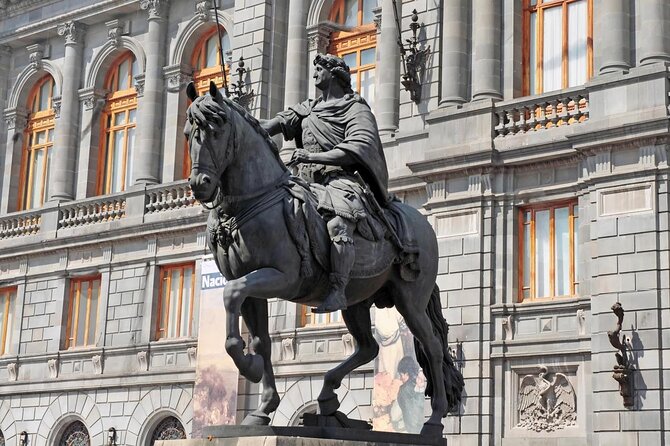
- Four major cultural stops: Visit MUNAL, the Banco de México museum, Palacio Postal, and Palacio de Bellas Artes.
- The murals are a major highlight: Diego Rivera and David Alfaro Siqueiros receive detailed attention inside Bellas Artes.
- Small group size: The tour accepts no more than 15 people, though the quality of the experience still depends on the guide and group pace.
- English-language guiding: The tour is offered in English, with several guides praised for clear explanations and friendly conversation.
- Central walking route: You begin near Palacio de Bellas Artes and finish near Banco de México on Avenida 5 de Mayo.
- Allow for changes: MUNAL or the Banco de México museum may be inaccessible for reasons beyond the operator’s control.
Why these Mexico City buildings belong together
This is not a tour of one palace. It is a concentrated look at how Mexico City presents itself through art, money, government, commerce, and public culture.
The buildings sit close together in Centro Histórico, but each one tells a different story. MUNAL gives you a long view of Mexican art from the 16th through the 20th century. The Banco de México museum explains the country’s currency and financial system. Palacio Postal is pure architectural theater, while Bellas Artes brings together music, theater, painting, sculpture, and some of Mexico’s most important murals.
I like this mix because it keeps the four hours from becoming a parade of similar rooms. You move from serious museum galleries to a gilded post office, then to a cultural palace filled with politically charged artwork.
The tour is listed at about four hours and costs $49 per person. That is a fair price if your guide provides the detailed explanations that make the buildings meaningful. You are not simply paying to walk past facades. The value rests in understanding what you are seeing, especially in Bellas Artes and MUNAL.
Still, the value is less certain if your group moves quickly or if access changes. One departure ended in under three hours, and another missed the Banco de México museum and Alameda because of a demonstration and a closure. I would book this for the guide’s interpretation, not as a guarantee that every listed interior will be available on every date.
More palaces to tour around the world:
- Venice: Doge’s Palace Reserved Entry Ticket
★ 4.6 · 42,716 reviews - Paris: Versailles Palace and Gardens Full Access Ticket
★ 4.6 · 41,579 reviews - Granada: Alhambra & Nasrid Palaces Tour with Tickets
★ 4.7 · 19,801 reviews
Starting beside Palacio de Bellas Artes
The published meeting point is at Palacio de Bellas Artes, on Avenida Juárez in Centro Histórico. This is a busy public area, so you should arrive early and allow time to locate the guide.
The meeting point has caused avoidable stress. The area in front of Bellas Artes is large, with other tour groups and plenty of pedestrians. At least one departure was difficult to find because the guide’s sign was small and not held high. If you cannot locate the group, calling the operator may be necessary.
This is one part of the tour that could be handled better. The information gives you the building and street, but in front of Bellas Artes is not especially precise. Look for the tour representative rather than assuming the first group you see is yours, and keep the guide’s name available. Guides who have led this route include Ruben, Adhara, Leonardo, Carlo, Yair, Yahir, and Geovana.
The route is near public transportation, which helps if you are staying elsewhere in Mexico City. The group limit is 15, a reasonable size for moving through museums without creating a large crowd.
MUNAL: Mexico’s art story in one palace
The Museo Nacional de Arte, usually called MUNAL, is scheduled for about one hour, with admission included. The building itself is part of the attraction. You are entering a former Spanish-era palace, not a plain gallery box.
Inside, the collection covers Mexican art from the 1500s through the 1900s. That time span matters. Instead of seeing a single artistic period, you get a broad sense of how Mexican painting changed across centuries.
A good guide can help you focus. MUNAL contains enough work to overwhelm you if you wander without a plan, especially when you have only an hour. One well-received approach has been to identify key pieces, explain their place in Mexican art, and then give you a few minutes to look around on your own.
That balance is important. I want context, but I also want time to stand in front of the paintings without someone talking continuously. Adhara was particularly praised for doing both: she explained the important works and allowed time for independent viewing.
The possible drawback is uneven timing. Some departures have spent longer at Bellas Artes murals and less time at MUNAL. If Mexican painting is your main interest, pay attention to the pace and ask your guide for a few minutes to see the rooms that appeal to you.
The operator also notes that MUNAL may be inaccessible for reasons of force majeure. If the museum is closed or unavailable, the route may change. This is worth keeping in mind if MUNAL is the one stop you most want to see.
The Banco de México museum and the story of the peso
The Banco de México museum offers a different kind of stop. Rather than focusing on paintings or decorative architecture, it explains the origins of Mexico’s currency and the development of the nation’s economic system.
The museum occupies an older building with its own atmosphere, and the visit gives you a look at the birthplace of the Mexican peso. That makes it a useful counterpoint to MUNAL. After seeing how Mexico expressed itself through art, you see how the country organized commerce and money.
This stop is likely to appeal most if you enjoy practical history. You will not simply be looking at an attractive interior. You will be considering how currency supports daily life and national identity.
The main issue is access. One outing could not visit this museum because it was closed, and another departure omitted it because a demonstration affected the route. The operator did not always provide advance notice of such changes, so do not treat this stop as absolutely guaranteed.
The published end point is Banco de México Fábrica de Billetes at Avenida 5 de Mayo 2. That can be confusing because the route also names the Banco de México museum as a stop. Check the meeting and finishing details before you set out, especially if you have another appointment afterward.
Same royal city, another way in:
- Sintra: Pena Palace and Park Entrance Ticket
★ 4.2 · 17,410 reviews - Granada: Alhambra and Nasrid Palaces Entry Ticket
★ 4.6 · 15,130 reviews - Madrid: Royal Palace Fast-Access Admission Ticket
★ 4.6 · 13,856 reviews - Doge’s Palace & St. Mark’s Basilica with Terrace Access Tour
★ 4.7 · 10,697 reviews
Palacio Postal: a glorious detour from ordinary mail
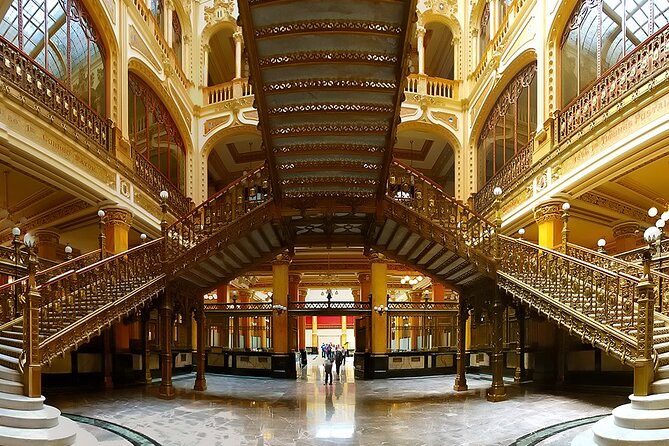
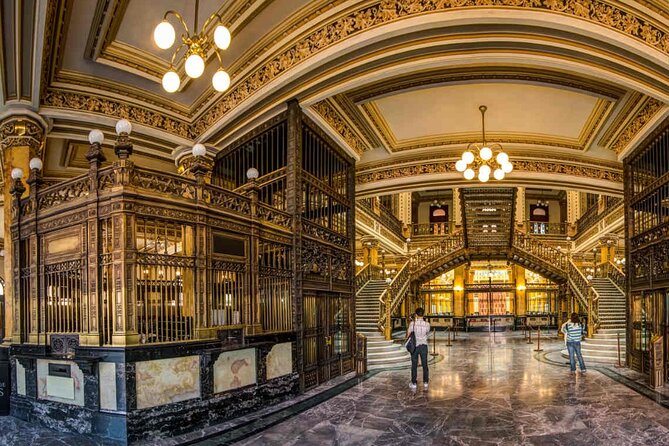
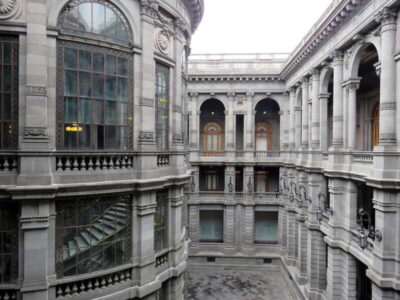
Palacio Postal is the Main Post Office of Mexico City, but it looks nothing like an ordinary post office. Its imperial decoration and blend of architectural styles make it one of the city center’s most enjoyable surprises.
The interior is known for its gold-plated details, and the tour presents the building as the old Correo Mayor. Even if you have no interest in sending a letter, this is a place worth entering for the craftsmanship and theatrical design.
I like Palacio Postal because it shows how beauty once entered everyday public life. This was not built only for ceremonies or wealthy residents. It was a working civic building, designed to make an ordinary service feel important.
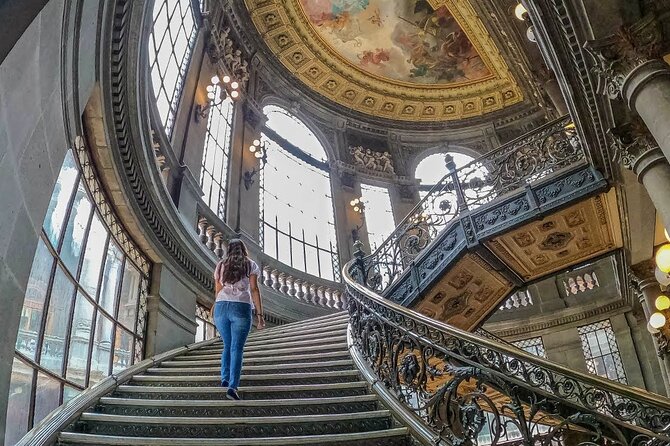
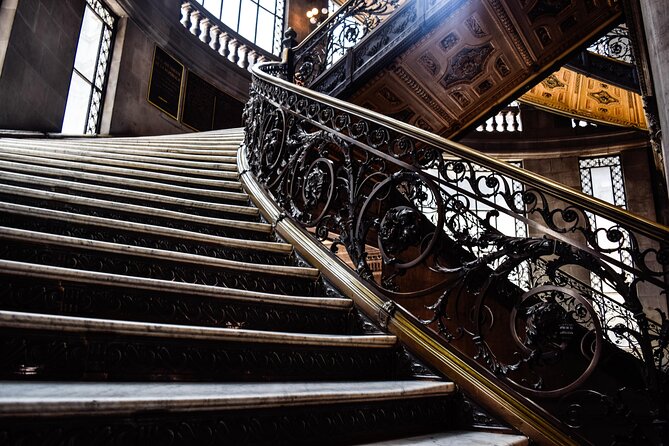
Here, the guide’s explanation adds useful context. Look closely at the metalwork, staircases, decorative surfaces, and the way the interior is composed. You are not just looking at gold. You are seeing an institution present itself as modern, powerful, and worthy of public trust.
One important limitation should be clear: access to all interiors is not guaranteed in the same way on every departure. One family later visited parts of the post office on its own because the tour did not include the interior access they expected. Ask your guide exactly what can be entered that day before assuming the full building is part of the visit.
Palacio de Bellas Artes and Mexico’s mural drama
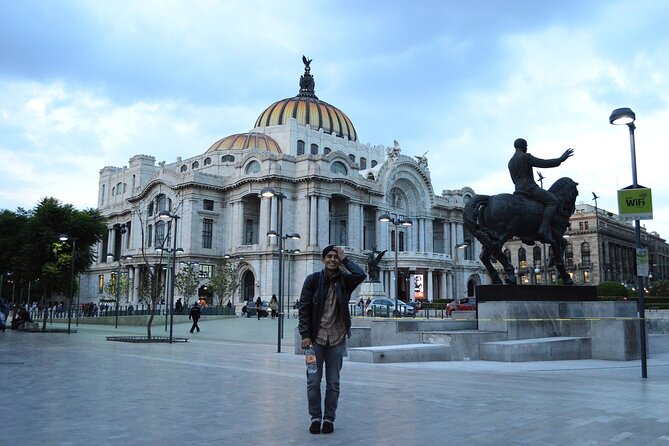
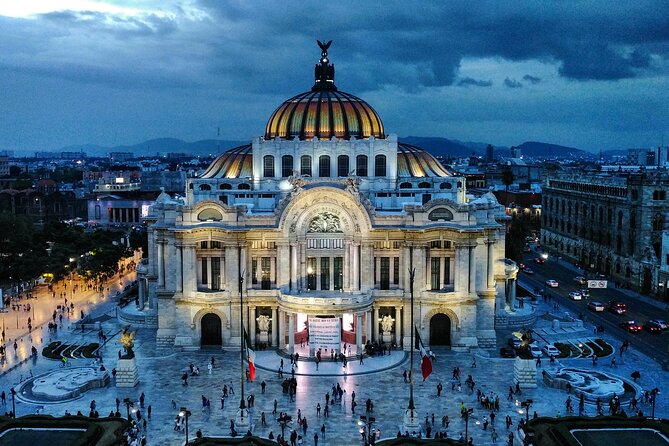
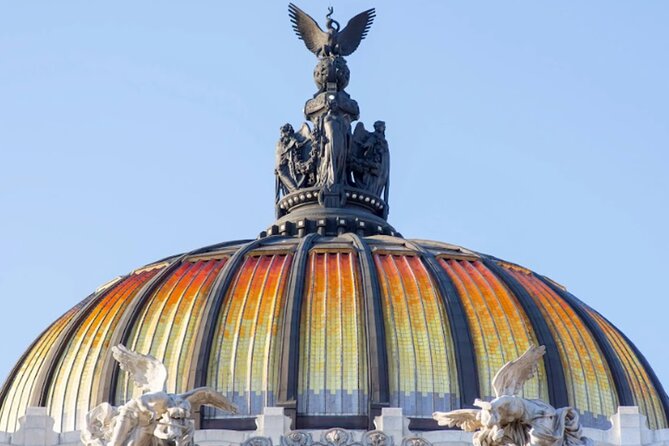
Palacio de Bellas Artes is the emotional center of this route. Its white marble exterior, bronze entrance details, and monumental scale make it easy to admire from outside. The interior is even more rewarding if you care about Mexican art.
The murals are the main reason to take the tour rather than simply photograph the building. Diego Rivera’s work receives detailed explanation, including the political and cultural ideas behind the images. Siqueiros is also represented, with murals that can feel forceful, intense, and visually unruly.
You will get more from these works if someone explains what you are looking at. The murals are not just large wall paintings. They reflect arguments about class, power, revolution, national identity, and the role of art in public life. A good guide gives you enough background to see why the images caused debate and why they still matter.
This is where several guides have earned the strongest praise. Adhara was singled out for her grasp of architecture and art, while Leonardo was praised for making the building’s history and murals easy to follow. Yair was described as friendly and thorough, and Carlo was noted for his enthusiasm for Mexico City’s art and buildings. Geovana also received credit for excellent English and useful background about the city and country.
The risk is that the Bellas Artes portion can take over the tour. Some people loved the detailed mural discussion. Others felt the guide spent too much time there and rushed the remaining buildings. If you prefer a quick overview of many sites, tell your guide early. If murals are your priority, this focus may be exactly what you want.
Another point needs clarification before you book. The advertised visit includes Palacio de Bellas Artes, but the exact interior access can vary. A past group had to return later to enter parts of the theater and other interiors independently. The murals may be the main included attraction, but do not assume every room is open to the guided group.
Alameda Central, a useful after-tour walk
The route passes by Alameda Central, Mexico City’s oldest park and the oldest park in the Americas according to the tour description. It was inspired by Seville’s Alameda de Hércules and includes fountains, sculptures, and paths with quieter corners.
The park is not presented as a full guided stop. Think of it as a place to explore after the tour ends. That is a good arrangement because Alameda works well at your own pace. You can stroll, sit, take photographs, or continue through Centro Histórico without being tied to a group.
You should not rely on this portion as guaranteed. A demonstration once prevented the group from visiting the park. If you want time there, check conditions on the day and return when the area is accessible.
Timing, language, and the guide’s role
Four hours is enough to introduce the district, but it is not enough for a slow museum visit at every stop. You are making a trade: a guide gives you orientation and interpretation, while independent visits give you more time with individual rooms.
The tour is offered in English. One review described a bilingual departure as slow because explanations were repeated in English and Spanish, but that may not apply to every group. The listed language is English, so confirm the language arrangement if clear, uninterrupted English commentary is important to you.
Guide quality matters a great deal here. The route includes sites that are easy to admire without understanding. You need someone who can explain why the murals are controversial, how the buildings fit into Mexico City’s development, and which details deserve your attention.
Several guides have been praised for strong English, personal warmth, and clear explanations. Others have been criticized for rushing. I would ask questions as you go. A responsive guide can often adjust the balance between mural detail, architecture, and independent viewing.
The tour accepts up to 15 people. That is small enough for conversation, though it is not a private tour by default. A private departure has also been praised for its personal feel, but you should confirm the option and price when booking if that matters to you.
Who will get the most from this tour
I would choose this experience if you are visiting Mexico City for the first time and want a solid introduction to Centro Histórico’s major cultural buildings. It works particularly well for people who like art but want someone to explain the political and historical background.
It also suits you if you enjoy architecture. Palacio Postal and Bellas Artes offer different kinds of visual pleasure, while MUNAL lets you compare the design of a former palace with the art displayed inside.
Families can enjoy the variety, but the four-hour schedule may feel long for young children, especially if the guide spends extended time on murals. Most people can participate, and the route is near public transportation, but you should be ready to walk between central sites and remain with the group.
You may prefer independent sightseeing if you want to linger in every museum, enter every available room, or move at your own pace. You could visit the major buildings yourself, but you would need to arrange admission and supply your own explanations. The tour earns its price when the guide is strong.
Should you book Must-see Buildings & Palaces of Mexico City?
Book it if you want a guided introduction to art, architecture, and public buildings in the center of Mexico City. At $49, the price is reasonable for four hours of admission-supported sightseeing, especially when your guide is as effective as Adhara, Leonardo, Yair, Carlo, or Geovana.
Go in with flexible expectations. Museum access can change, the group may move faster than you like, and the starting point can be hard to identify. If you want the best result, arrive early, keep the operator’s contact details handy, ask about the exact interiors included, and tell the guide which stop matters most to you.
I would especially recommend it to first-time visitors and anyone drawn to the Bellas Artes murals. I would be more cautious if MUNAL or the Banco de México museum is your single must-see, since closures and route changes have occurred. Free cancellation is available up to 24 hours before the start time, so that option gives you some protection if your plans change.
FAQ
How long does the tour last?
The tour is advertised at approximately four hours. Some departures have finished earlier, including one that ended in under three hours, so the actual timing can vary.
How much does the tour cost?
The listed price is $49 per person. Group discounts are available.
What language is the tour offered in?
The tour is offered in English. Some departures may include bilingual explanations, so confirm the language arrangement if that is important to you.
Where does the tour start?
The published starting point is Palacio de Bellas Artes on Avenida Juárez in Centro Histórico, Mexico City.
Where does the tour finish?
The published end point is Banco de México Fábrica de Billetes at Avenida 5 de Mayo 2 in Centro Histórico.
What sites are included?
The route includes Museo Nacional de Arte, Museo Banco de México, Palacio Postal, and Palacio de Bellas Artes. It also passes by Alameda Central, which you can visit after the tour.
Can the tour be canceled for a full refund?
Yes. You can cancel at least 24 hours before the experience start time for a full refund. Cancellations or changes made less than 24 hours before the start time are not accepted for a refund.
Fresh palace tours around the world
- Bangkok Private Grand Palace Emerald Buddha and Reclining Buddha★ 4.5 · 2 reviews
- Bangkok Markets, Palaces and Temples Excursion★ 5.0 · 8 reviews
- Bangkok Two Temple Tour: Wat Pho, Emerald Buddha & Grand Palace★ 5.0 · 4 reviews
- Bangkok Royal Road – Top 3 Major Monuments (Grand Palace, Wat Pho, Wat arun)★ 4.5 · 111 reviews
- Bangkok Grand Palace and Emerald Buddha Tour★ 4.0 · 91 reviews
- Bangkok’s Landmarks Tour : GrandPalace WatTraimit WatPho WatArun★ 5.0 · 8 reviews
- Private Tour: Grand Palace,Wat Phra Kaew, Museum&Cooking Class★ 5.0 · 7 reviews
- Bangkok Grand Palace & Emerald Buddha Flexible Entry with Audio★ 3.5 · 3 reviews
Mexico Palace Tours: the shortlist.

Enjoy the Folkloric Ballet at the Palacio de Bellas Artes
Read our review →
Mexico City: A Day in the Colonial Era Through its Palaces
Read our review →This visit also appears in