
Review · MADRID
Private guided tour Royal Palace & Royal Collections Gallery
Madrid’s Royal Palace tour becomes far more meaningful when paired with the Royal Collections Gallery. Instead of seeing grand rooms and famous objects as separate sights, your private guide connects them to the rulers who commissioned, used, and displayed them. You’ll move from royal apartments and ceremony rooms to paintings, armor, tapestries, and decorative arts in one four-hour visit.
I like the private format, which gives you room to ask questions and set the pace. I also like the range of objects, from more than 300-year-old Stradivarius instruments to Charles V’s battle armor and Juan de Flandes’ Polyptych of Isabel la Católica. The main consideration is price: at $169 per person, this is a serious investment, especially for a solo visitor or couple.
Key points at a glance
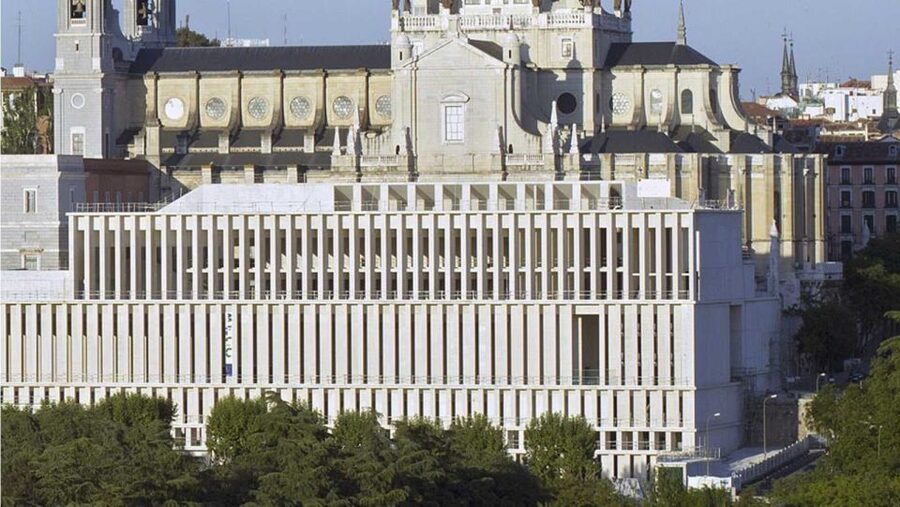
- Two major royal sights in one morning: Visit the Royal Palace and the Royal Collections Gallery with one guide and one connected story.
- A private guide makes the difference: English and Spanish tours let you ask questions, linger over details, and adjust the pace within the four-hour schedule.
- The palace is about more than grand rooms: See the main staircase, royal apartments, Gala Dining Room, Porcelain Room, Royal Chapel, and Throne Room.
- The gallery adds exceptional objects: Look for works by El Greco, Caravaggio, Velázquez, Tiepolo, and Goya, along with armor, sculpture, furniture, tapestries, and royal carriages.
- Good support for visitors with mobility needs: The experience is wheelchair accessible, and guide Eva has been praised for finding practical ways to keep a visitor involved.
- Simple meeting point: Begin at Isabel II Square, also called Ópera Square, and finish back at the same place.
Why this pairing works so well in Madrid
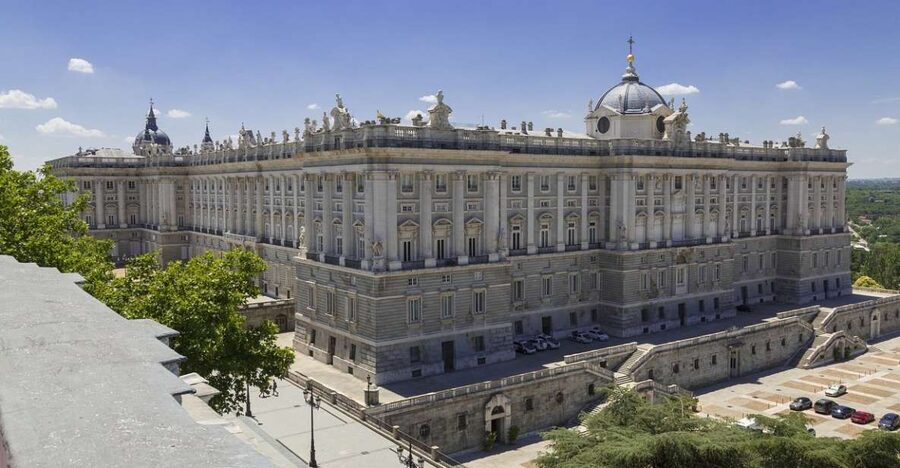
Many palace visits give you impressive rooms but little sense of how the monarchy functioned. Many art museums show beautiful objects without making their royal purpose clear. This tour joins the two sides.
At the Royal Palace, you see the setting for state ceremonies, official meetings, royal meals, worship, and daily life. At the Royal Collections Gallery, you see the objects that helped define royal power and taste. A painting, suit of armor, or piece of furniture carries more weight when you understand the people who owned it and the occasions when it was used.
That connection is the strongest reason to book a guided visit instead of simply walking through on your own. The palace has more than 2,500 rooms, and the gallery contains more than 650 important works. You cannot see everything in four hours. A good guide helps you spend your limited time on the rooms and objects that best explain Spain’s monarchy.
Because the group is private, your guide can answer questions that a large group may not have time for. If you want more art, you can ask about painters such as Velázquez or Goya. If royal ceremony interests you more, you can focus on the Throne Room, state apartments, and Gala Dining Room.
More Private Palace Tours in Madrid
- Madrid Royal Palace and Prado Museum Private Tour with Transfers
★ 5.0 · 185 reviews - Madrid: Royal Palace tour – semi private or private
★ 4.9 · 182 reviews - Royal Palace of Madrid Guided Tour Small Group or Private
★ 4.7 · 130 reviews
Meeting at Ópera Square
The tour begins at Isabel II Square, better known as Ópera Square. This is a practical central meeting point for a visit to the palace, and the activity ends back there after the gallery.
You should allow enough time to reach the square before the scheduled start. The supplied information does not specify a particular meeting time, so you need to check available departures when booking. The total visit lasts four hours, which makes this a substantial half-day activity rather than a quick palace stop.
The private format is especially useful at the start. You do not need to spend the visit trying to keep track of a large group. Your guide can establish the plan, explain how the two sights fit together, and lead you through the palace and gallery with a clear sense of direction.
The experience is offered in English or Spanish. If your group includes both languages, guide Eva has shown that switching between English and Spanish can work well. She was praised for speaking clear English and moving comfortably between the two languages for an English and Spanish-speaking couple.
Entering the Royal Palace through the great staircase
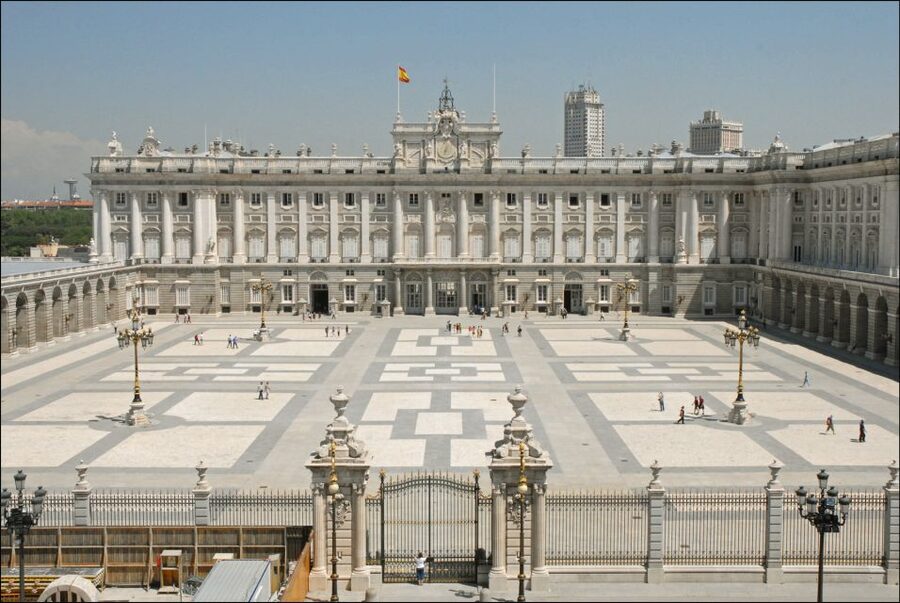
The first major impression is the palace itself. This is not a small royal residence with a handful of preserved rooms. It has more than 2,500 rooms, although your visit focuses on the principal spaces rather than attempting to cover the entire building.
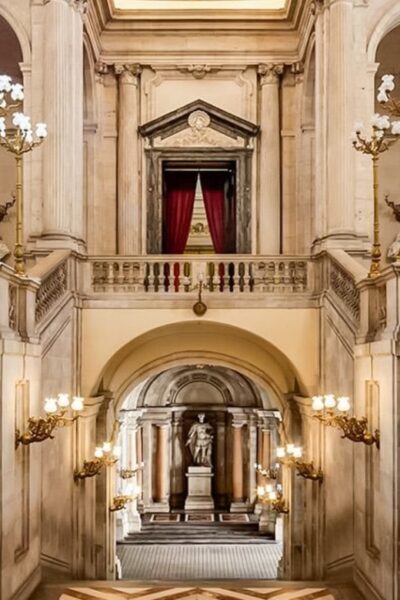
The great main staircase leads from the entrance toward the King’s apartments. It gives you an immediate sense of ceremony and rank. A royal palace is designed to make movement feel important, and even the route from one room to another was part of the message.
Your guide can help you read the palace as a working institution, not simply as an attractive historic interior. The building is still used for state ceremonies and solemn events. One of the apartments is used for international meetings between King Felipe VI and visiting foreign leaders, connecting the historic rooms with present-day public life.
That modern use adds a useful layer to the visit. You are not only looking at rooms preserved from a distant age. Some spaces remain part of Spain’s official ceremonial setting.
Royal apartments and the formal side of palace life

From the staircase, the tour moves through major rooms connected with the royal household. You’ll see areas associated with the King and Queen, including more private rooms and spaces used for formal occasions.
The contrast between private and public areas is worth noticing. Royal life was not only banquets and official portraits. It also involved a carefully organized household, with private rooms placed close to rooms designed for political meetings and public display.
The Great Gala Dining Room is one of the clearest examples of royal scale. It can accommodate 144 diners. That number tells you more than a list of furniture or decorations could. State dining was an event with political value, and the room was designed to handle ceremony, rank, and large official gatherings.
You should not expect the guide to show every room in the palace. The tour focuses on the principal spaces, so the value comes from the explanation and selection. If you want an exhaustive architectural survey, four hours shared between two sites will not provide it. If you want the most important rooms placed in context, the route makes good sense.
More Private Palace Tours in Spain
- Skip the Line Royal Palace Madrid Tour Semi-Private 8ppl max
★ 5.0 · 51 reviews - Royal Palace of Madrid: Private tour with entrance included
★ 4.6 · 15 reviews - Madrid: VIP Private visit to Royal Palace and Prado Museum
★ 5.0 · 14 reviews - Madrid: Royal Palace Private Tour with Tickets
★ 4.7 · 13 reviews
The Stradivarius instruments and royal decorative arts

The palace collection includes Stradivarius musical instruments more than 300 years old. Even if you are not a serious music enthusiast, these objects help show the level of luxury expected at court. They were not merely useful instruments. They were also signs of taste, wealth, and access to exceptional European craftsmanship.
The palace also contains precious embroidered wall hangings produced at the Santa Bárbara tapestry factory in Madrid. These works belong to the decorative side of royal life, where rooms were shaped by textiles, pattern, color, and labor as much as by architecture.
Your guide’s role matters here. Decorative arts can be easy to pass without understanding what you are seeing. A brief explanation of how these objects functioned inside the palace can turn a quick glance into one of the more memorable parts of the visit.
The wording of the tour promises some of the palace’s most important rooms and works rather than every object on display. You should think of the visit as a guided highlights route, with enough time to understand the major rooms instead of rushing through dozens of spaces.
The Porcelain Room and Royal Chapel

The Porcelain Room offers a change from the grand stone and formal state rooms. Its appeal lies in the detail of the decoration and the way a specialized interior can reveal royal taste. This is the kind of room that benefits from having someone point out what to notice, since the overall effect can be easy to absorb without seeing the individual work involved.
The Royal Chapel provides another shift in mood. Its frescoes by Corrado Giaquinto give the room a strong visual focus and show how religious art formed part of palace life. The chapel was not an isolated church visit. It belonged to the royal residence and helped connect monarchy, ceremony, and faith.
These rooms also break up the palace route. After large apartments and formal dining spaces, the chapel and Porcelain Room offer more concentrated interiors. I like that the tour includes both types of space, since they show different sides of court culture.
The Throne Room and Tiepolo’s ceiling

The Throne Room is planned as the final palace stop, and it is a fitting choice. The room is built for ceremony, with its throne setting and large-scale decoration. Its fresco by Giovanni Battista Tiepolo draws your eyes upward and gives the space a grand visual finish.
This is a room where a guide can help you understand how art and architecture worked together. The painting was not added simply to make the ceiling attractive. In a royal setting, images, scale, and placement all helped communicate authority.
The Throne Room can also be one of the busiest parts of a palace visit. A private guide cannot control how many other people are present, and the provided information does not promise a quiet or empty room. Still, a private group makes it easier to pause briefly, ask a question, and move on when you are ready.
From palace rooms to the Royal Collections Gallery

The second half takes you to the new Royal Collections Gallery, described as Spain’s most important museum project in decades. Its purpose is different from that of the palace. Rather than showing the setting of royal life, it brings together objects connected with the Spanish Crown in a modern museum environment.
The scale is substantial: more than 650 works. You may see paintings, sculptures, armor, embroidered wall hangings, decorative arts, and royal carriages. The range is one of the gallery’s biggest strengths, but it also makes a guided route valuable. Without a plan, it would be easy to spend too long in the first rooms and lose time before reaching the pieces you most want to see.
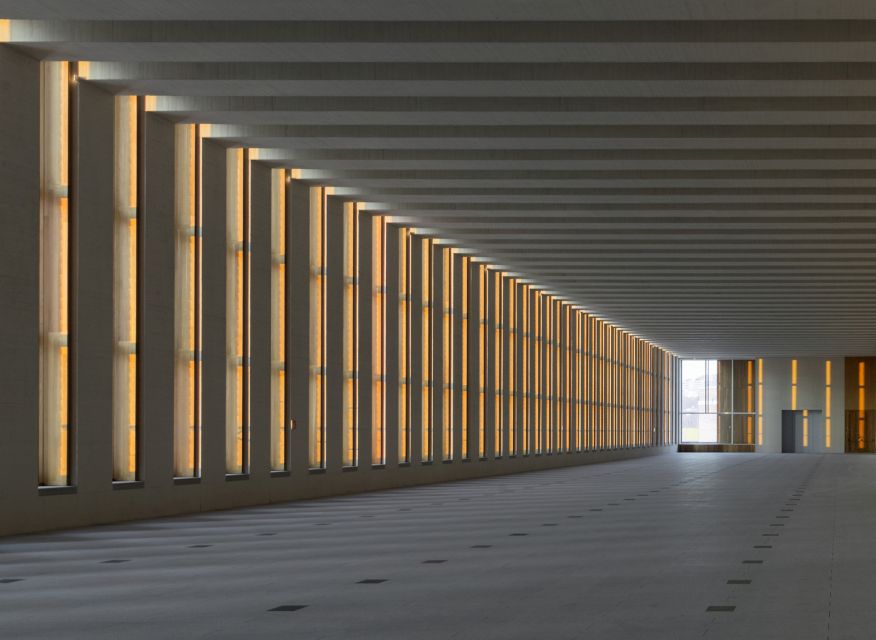
The building is presented as part of the experience. You are not only visiting a collection in an old palace wing. You are following a cultural story through a newer museum setting. The change in architecture can help you notice the difference between a residence built for royal ceremony and a gallery built for public understanding.
Juan de Flandes and Isabel la Católica
One of the gallery’s important works is the Polyptych of Isabel la Católica by Juan de Flandes. A polyptych is a multi-panel painting, and the format itself rewards a slower look. Instead of treating it as one flat image, you can study how the separate panels work together.
The title connects the work directly with Isabel la Católica, one of Spain’s most important monarchs. That makes the piece useful for understanding how art, devotion, and royal identity could overlap.
This is a good example of why you may want a guide even if you already know something about Spanish art. Your guide can help place the work within the larger royal collection and explain why it matters in this setting. The gallery has many major names, but the goal is not simply to point at famous artists. It is to show how the works relate to Spain’s royal story.
Charles V’s armor from the Battle of Mühlberg
The armor and helmet used by Charles V at the Battle of Mühlberg provide a very different kind of encounter. Paintings can idealize a ruler, while armor gives you a direct sense of the physical demands and symbolism of power.
Seeing the equipment associated with a specific battle helps make Charles V more concrete. You are looking at objects linked to a ruler who took part in military campaigns, not only a portrait on a wall.
This stop should appeal to visitors who prefer historical objects to paintings. The armor also broadens the gallery experience. You are not limited to court portraits and religious art. Weapons, clothing, and ceremonial objects can explain royal life in a more physical way.
El Greco, Caravaggio, Velázquez, Tiepolo, and Goya
The gallery includes works by major figures such as El Greco, Caravaggio, Velázquez, Tiepolo, and Goya. The value here is variety. You can compare very different approaches to painting while seeing how all of them became part of royal collecting and display.
If you already have favorite artists, tell your guide early. A private visit gives you a better chance to spend a little more time on the painters that interest you most. If you are less familiar with Spanish art, the guide can help you avoid treating the gallery as a parade of famous names with no connection between them.
The collection also reaches beyond painting. Sculptures, armor, decorative arts, wall hangings, and royal carriages keep the visit from feeling like a standard picture gallery. That broad mix is useful for families and mixed-interest groups, since not everyone needs to be drawn to the same type of object.
What $169 per person buys you
The price is $169 per person. That is not a bargain admission ticket, and I would not recommend choosing this tour solely for the convenience of skipping the ticket line.
The value comes from three things: a private guide, admission to both sights, and a four-hour route connecting them. You are paying for interpretation as much as access. The palace and gallery are large enough that a poorly planned visit could leave you tired and unsure what you actually saw.
For a couple or small private group with a strong interest in Spanish monarchy, art, or architecture, the price can be reasonable. You get a focused visit and the freedom to ask questions. It can also suit a group with different interests because the guide can balance rooms, paintings, armor, and decorative arts.
For a solo visitor, the cost per person is harder to justify. You may prefer a standard admission ticket and your own route if you enjoy reading labels and moving independently. The tour is best value when the guide’s explanations and private attention are central to what you want.
The activity includes tickets to the Royal Palace and Royal Collections Gallery, so you do not need to add separate admission costs for those two stops. It also offers free cancellation up to 24 hours before the visit and reserve-now, pay-later booking, which gives you some flexibility when arranging a Madrid schedule.
Accessibility and the pace of the visit
The tour is wheelchair accessible. That matters in a four-hour activity covering two major cultural sites, where fatigue and route planning can affect the day as much as the art.
Guide Eva was praised for taking a visitor’s mobility needs seriously and finding ways for that person to take part fully. That does not replace checking your own requirements before booking, but it is a useful sign that the private format can allow for practical adjustments.
The schedule is still four hours, so you should consider your energy level. The exact amount of walking or sitting is not specified. If you have particular mobility concerns, raise them with the provider when arranging the visit so the guide can plan accordingly.
Who should book this private palace tour
I would choose this experience if you want the main royal sights explained rather than simply photographed. It suits first-time visitors who want a clear introduction to the Spanish monarchy, art lovers interested in several major painters, and families or couples who prefer a private guide to a large group.
It also works well for mixed groups. One person can focus on royal ceremony, another on paintings, and another on armor or carriages. The broad collection gives the guide several ways to keep the visit engaging.
I would think twice if you prefer to explore at your own speed or mainly want to see one specific painting. Four hours is a long guided visit, and the cost is high for anyone who does not expect to use the guide’s time and attention.
Should you book it?
Book this tour if you want Madrid’s Royal Palace and Royal Collections Gallery to make sense as one story. The strongest features are the private guide, the carefully chosen palace rooms, and the unusual mix of art, armor, instruments, chapel decoration, and royal furnishings.
The price is the main obstacle. If $169 per person fits your budget, this is a strong choice for a focused half-day visit, especially if you value clear English or Spanish guidance, private questions, and help with mobility needs. If you are happy to read labels and plan your own route, independent admission may offer better value.
FAQ
How long does the tour last?
The tour lasts four hours.
Where does the tour begin?
It begins at Isabel II Square, also known as Ópera Square.
Where does the tour end?
The activity ends back at the meeting point in Isabel II Square.
Is the tour private?
Yes. The experience is arranged for a private group.
Which languages are available?
The live guide is available in English and Spanish.
Are the entrance tickets included?
Yes. The price includes a ticket for the Royal Palace and a ticket for the Royal Collections Gallery.
Does the tour include skip-the-line access?
Yes. Skip-the-ticket-line access is included.
Is the experience wheelchair accessible?
Yes. The activity is wheelchair accessible.
Can I cancel for a full refund?
Yes. You can cancel up to 24 hours in advance for a full refund.
More palace museums around Madrid
- Royal Palace & Prado Museum Skip the Line Guided Tour
★ 4.5 · 1,347 reviews - Madrid: Prado Museum and the Royal Palace Guided Tour
★ 4.6 · 688 reviews - Madrid in a Day Tour:Royal Palace, Historic Center & Prado Museum
★ 5.0 · 628 reviews - Madrid: Royal Palace, Prado Museum & Historic Center Tour
★ 4.6 · 50 reviews
More Royal Palace Tours around Madrid
- Madrid: Royal Palace Fast-Access Admission Ticket
★ 4.6 · 13,856 reviews - Madrid: Royal Palace Expert Guided Tour with Skip-the-Line
★ 4.7 · 8,407 reviews - Madrid Essential: Historic Center, Plaza Mayor & Royal Palace
★ 5.0 · 6,416 reviews - Madrid: Royal Palace Skip-the-line Guided Tour
★ 4.9 · 3,146 reviews
Fresh palace tours around Madrid
- Madrid: Royal Palace Guided Tour with Entry Ticket★ 5.0 · 58 reviews
- The Royal Palace of Madrid: Small Group Guided Tour★ 3.2 · 6 reviews
- The Most Complete Tour of Madrid: Austrias, Cathedral, Palace – Local Guides★ 4.2 · 41 reviews
- Madrid: Royal Palace and Almudena Cathedral Small-Group Tour★ 4.6 · 219 reviews
- Tour of the historic Royal Palace of Madrid★ 5.0 · 2 reviews
- Private Visit to the Royal Palace and Walking Tour of Madrid★ 5.0 · 4 reviews
- Royal Palace of Madrid Skip-the-Line and Retiro Park Tour★ 4.5 · 78 reviews
- Madrid: 4-Hour Bus Tour with Royal Palace Admission★ 3.9 · 52 reviews
Royal Palace Tours: the shortlist.
Royal Palace Expert Guided Tour with Skip-the-Line
Read our review →
Dubai To Abu Dhabi: Grand Mosque, Royal Palace & Etihad Towers
Read our review →
Madrid Essential: Historic Center, Plaza Mayor & Royal Palace
Read our review →

Abu Dhabi Day-Trip Grand Mosque, Royal Palace & Lunch
Read our review →