
Review · ROME
Rome: Barberini Palace Guided Tour
Rome’s Barberini Palace gives you something many museum visits lack: art and architecture in the same frame. You move from Raphael and Caravaggio to Bernini, Borromini, and Pietro da Cortona while standing inside the grand home of the Barberini family, one of Rome’s most powerful patrons.
I especially like the way the tour connects paintings to politics and religion, rather than treating each work as an isolated object. I also like the chance to see Pietro da Cortona’s Divina Provvidenza ceiling, a huge Baroque showpiece that can be easy to miss if you visit without guidance. The main consideration is that the tour is not suitable for wheelchair users or people with mobility impairments, and several important rooms and paintings have temporary closure dates.
Key points to know before you book
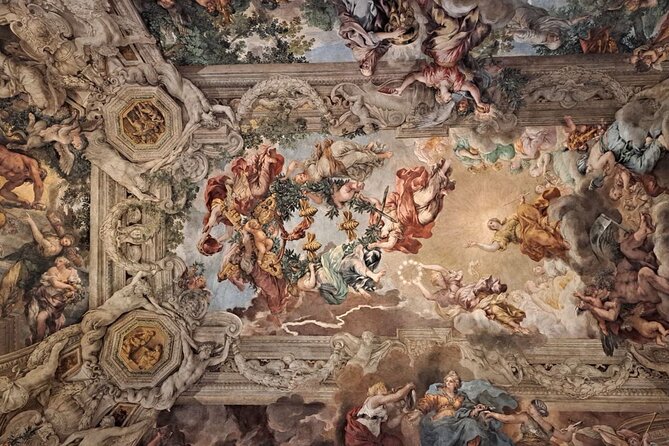
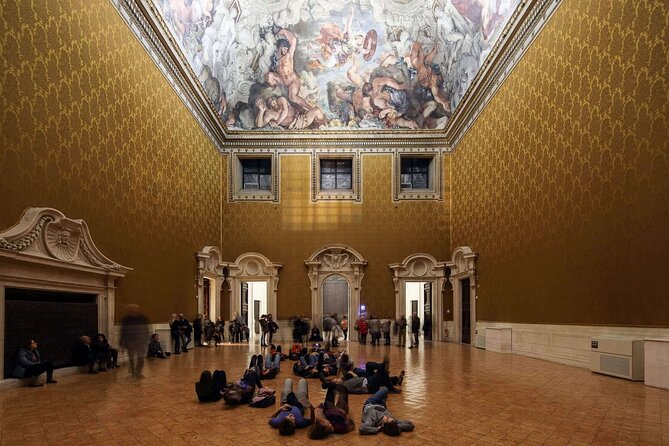
- Pietro da Cortona’s ceiling is a major highlight: Look up as you enter the grand central hall for one of Rome’s great Baroque spectacles.
- Raphael’s La Fornarina is part of the collection: The famous portrait gives the tour a strong Renaissance focus alongside its Baroque art.
- Caravaggio’s Judith has a temporary absence: It is scheduled to be away from September 4, 2025, through January 31, 2026.
- The Barberini family shaped Rome’s art world: Your guide explains how family power, papal politics, and artistic commissions met here.
- The visit lasts two hours: That is enough time for context without turning the museum into an all-day commitment.
- The meeting point is inside the palace garden: Find the fountain on Via delle Quattro Fontane and look for the blue Doooing Experience flag.
Why Barberini Palace deserves a place on your Rome schedule
The Barberini Palace is not simply a container for paintings. It was built for a family whose influence reached into Rome’s government, church, and cultural life. That makes the setting part of the story.
The Barberini family rose to great power in the 17th century, most notably through Maffeo Barberini, who became Pope Urban VIII. Art was not a side interest for the family. It helped express status, religious authority, and political reach. A guided visit can make those connections clear in a way that a label beside a painting rarely can.
I find this especially useful in Rome, where grand art often served a purpose beyond decoration. A ceiling might praise divine order. A portrait might strengthen a family’s public image. A dramatic biblical scene might reflect the emotional force of the Counter-Reformation. The guide’s job here is to tie those threads together without leaving you to decode every symbol alone.
The palace also gives you a change of pace from Rome’s most crowded museums. You are still seeing major names, but the focus is narrower and more manageable than the Vatican Museums. In two hours, you can get a solid introduction to Renaissance and Baroque art without spending half the day crossing enormous galleries.
More palaces to tour around Rome:
- Rome: Opera Concert at Palazzo Poli – Fontana di Trevi
★ 4.7 · 1,026 reviews - Rome: Colonna Palace Entry Ticket
★ 4.8 · 609 reviews - The Great Opera Arias Concert at Palazzo Poli – Trevi Fountain
★ 5.0 · 533 reviews
Meeting the guide by the garden fountain
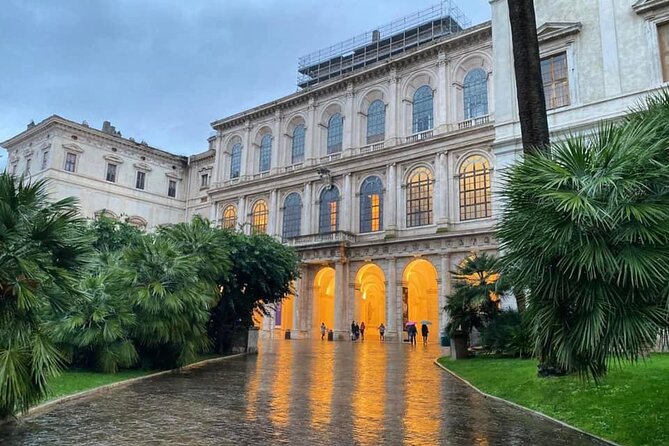
The meeting point is inside the garden of Palazzo Barberini, around the fountain at Via delle Quattro Fontane, 13. Look for a staff member holding a blue flag marked Doooing Experience.
Give yourself enough time to find the garden entrance. The meeting point is not described as the palace exterior in general, but specifically as the area around the fountain inside the garden. If you arrive at the last minute, that small distinction matters.
The tour is offered in English, Italian, and Spanish. The group can contain up to 20 people, so you should expect a shared visit rather than a private conversation with the guide. A group of that size is still workable inside a museum, but your position near a painting or architectural feature may vary.
Guides named Zenda and Federica have led this experience. Zenda has been noted for linking art and architecture to their historical periods, while Federica has been described as lively, attentive, and clear when explaining both the palace and its collection. Your assigned guide may be different, but these examples give you a sense of the intended approach.
The Barberini family and the palace setting
The first part of the tour sets up the Barberini family’s role. This context matters because the palace’s art collection is not random. It reflects the interests and ambitions of a family closely tied to papal Rome.
You will hear about the way political and religious changes shaped the works on display. That framing helps explain why Baroque art often feels so theatrical. The goal was not only to make a beautiful image. It was also to persuade, impress, and communicate power.
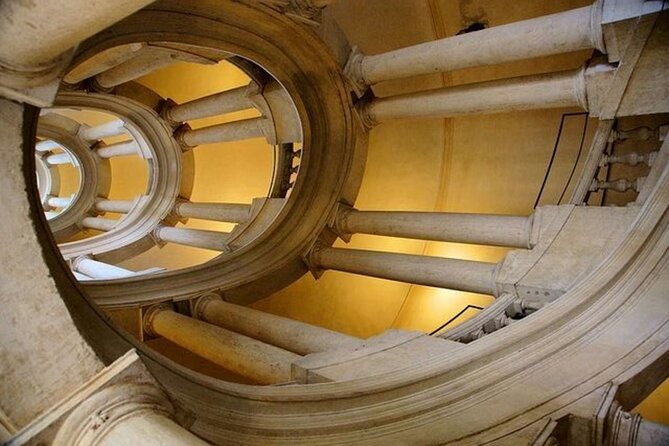
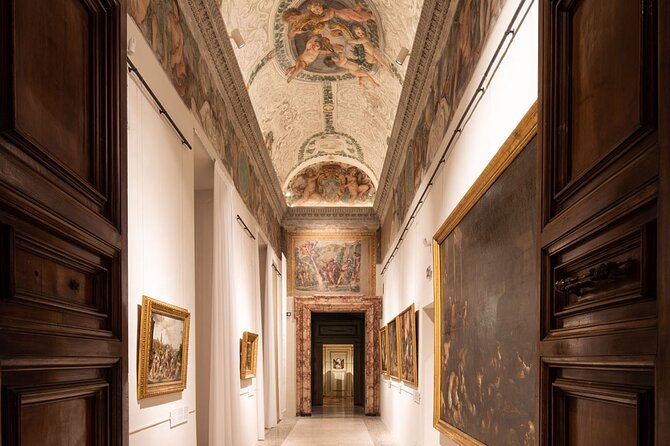
The architecture tells a similar story. Bernini and Borromini both contributed to the palace, and their names alone make the building worth a visit. Their approaches were very different, which gives your guide a useful contrast to explain.
Bernini’s work often feels open, confident, and grand. Borromini was more restless and inventive, with a taste for complex shapes and unusual spatial effects. Seeing their contributions in the same building lets you compare two great Roman architects without crossing the city.
This is one of the tour’s strongest features for anyone who enjoys buildings as much as paintings. You are not merely walking from one framed canvas to the next. The room proportions, stairways, decoration, and ceiling all help explain how Baroque Rome wanted to be seen.
Raphael’s La Fornarina and the Renaissance collection
Raphael’s La Fornarina is one of the essential stops. The painting is an intimate portrait of a woman, and its direct gaze gives it an unusual personal force. Even if you know Raphael mainly for his Vatican frescoes, this work shows a more private side of his art.
Your guide can help you look beyond the painting’s fame. Notice the sitter’s pose, expression, clothing, and the way Raphael balances ideal beauty with a sense of individual presence. The work belongs to an earlier artistic language than the dramatic Baroque pieces elsewhere in the palace, so it creates an important comparison.
The collection also includes works by Holbein and Tintoretto. Their presence broadens the visit beyond a simple Raphael and Caravaggio greatest hits tour. Holbein’s precise portrait tradition and Tintoretto’s energetic Venetian style give you more ways to see how European painting developed.
I would pay close attention here if you enjoy portraiture. The palace allows you to compare different ideas of personality, status, and beauty across several artists and periods. You do not need to arrive with a background in art history. The guide’s explanations are meant to provide the setting and visual clues you need.
Same royal city, another way in:
- Rome: Palazzo Barberini Galleria Corsini Ticket & Audioguide
★ 3.9 · 322 reviews - Rome: Vittoriano with Rooftop & Palazzo Venezia Hosted Entry
★ 4.2 · 306 reviews - Rome: Colonna Palace Guided Tour
★ 4.9 · 70 reviews - Rome: Palazzo Venezia Reserved Entrance with Museum
★ 4.2 · 52 reviews
Caravaggio’s Judith and a date-sensitive warning
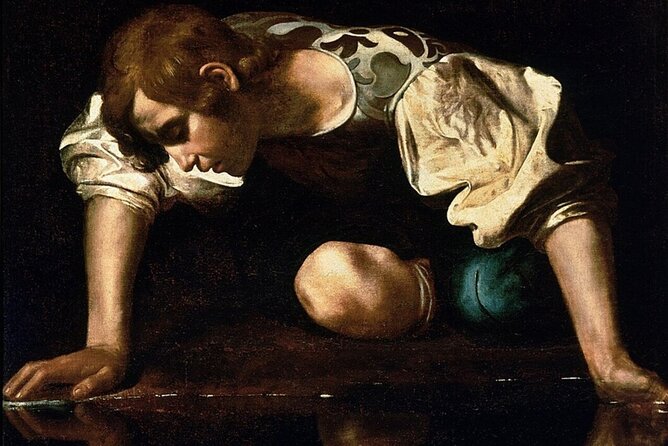
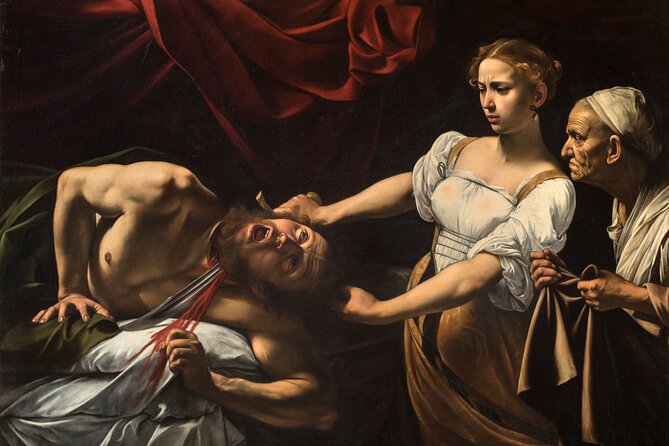
Caravaggio’s Judith Slaying Holofernes is one of the collection’s most dramatic works when it is on display. The scene captures Judith at the moment she beheads the Assyrian general Holofernes, using stark light, close action, and intense expressions to make the biblical story feel immediate.
This is not a quiet, decorative painting. Caravaggio brings the viewer close to the violence and human reaction. The contrast between Judith’s determination, the servant’s involvement, and Holofernes’s shock gives the scene its gripping force.
You need to check the date before booking specifically to see it. The painting is scheduled to leave the palace from September 4, 2025, until January 31, 2026, for an exhibition at the KAM Art Museum in Fort Worth, Texas. The supplied tour information also warns that it will not be available during this period.
That absence does not cancel the value of the visit. Raphael, Pietro da Cortona, Bernini, Borromini, Holbein, and Tintoretto remain important reasons to go. Still, if Caravaggio is your main reason for choosing Barberini Palace, plan around the loan period rather than assuming the painting will be there.
Pietro da Cortona’s Divina Provvidenza ceiling
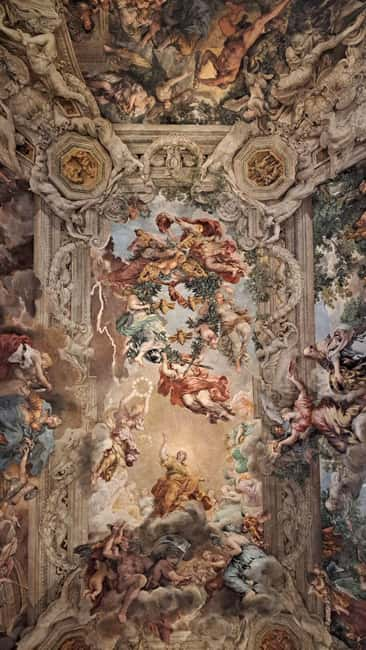
The ceiling fresco by Pietro da Cortona is the palace’s great visual payoff. Known as Divina Provvidenza, it fills the ceiling with the movement and theatrical energy associated with mature Roman Baroque art.
This is the point where I would stop rushing and simply look up. The scale can be hard to absorb at first. Figures, clouds, architecture, and allegorical imagery combine into a scene meant to overwhelm the viewer. It is not subtle, and that is precisely the point.
Your guide helps translate the crowded composition. Without explanation, you might notice the color, motion, and illusionistic effect but miss the political message connected to the Barberini family. With context, the fresco becomes more than an impressive ceiling. It becomes a public statement about order, divine favor, and family power.
Bring comfortable shoes and expect to spend time standing. The tour lasts two hours, and much of that time is likely spent listening in galleries and rooms. The palace is not suited to people with mobility impairments or wheelchair users, so consider that limitation before booking.
Bernini, Borromini, and the Baroque argument in stone
Bernini and Borromini are often taught as rivals, and Barberini Palace gives you a chance to consider their work in the same setting. The tour explains their architectural contributions and shows how their ideas shaped the building.
For you, the value is not just seeing two famous names on a museum description. The guide can point out how structure, decoration, and movement guide your eye through the palace. In Baroque architecture, walls and ceilings often seem to push beyond their physical limits. That effect becomes easier to appreciate when someone identifies the details in front of you.
The palace also helps you see that painting and architecture were working together. A dramatic ceiling needs a room that frames it. A grand staircase or hall supports the message of wealth and authority. The result is a complete visual program rather than a collection of unrelated masterpieces.
If you usually prefer paintings to buildings, do not skip this part. It gives you a better understanding of why Rome’s Baroque style can feel so theatrical. If architecture is your main interest, the paintings still matter because they show how the palace’s rooms were meant to function as a whole.
Temporary closures and special exhibitions
The palace experience changes over time, so read the current dates carefully. The 18th-century rooms are scheduled to close to the public beginning August 26, 2025, and reopen on October 21, 2025.
That closure may affect the sense of the palace as a complete residence. The main artworks and architectural highlights can still make the visit worthwhile, but you should not assume every room described in general information will be open on your date.
A special presentation of Conversion on the Way to Damascus, also known in Italian as Conversione di Saulo, is scheduled in the palace through September 30, 2025. The painting comes from a private collection, making this a time-limited reason to consider an earlier visit.
Because both the room closure and the temporary exhibition have fixed dates, check the calendar close to your booking date. The same tour can offer a slightly different experience depending on which rooms and paintings are available.
What two hours gives you
Two hours is a sensible length for this palace. You have enough time to hear the Barberini story, discuss key artists, and see the main works without the fatigue that can set in during a long museum marathon.
The guided format is particularly useful if you have limited time in Rome. You avoid the ticket line, enter with a clear plan, and spend your attention on selected works rather than trying to cover every room.
The trade-off is flexibility. You will move at the guide’s pace, and you may not have unlimited time to stand alone with a favorite painting. If you prefer a slow, private museum visit, a ticket with an app or audio guide may suit you better.
For most people, I think the guide adds enough value to justify choosing this format. The palace combines art, architecture, family power, and religious history, and those subjects are easier to follow when someone organizes them for you.
Is the tour good value?
No price is provided here, so I cannot judge the exact cost against competing tickets. I can judge what you receive for the time: skip-the-line access, a live guide, a two-hour route, and explanations in English, Italian, or Spanish.
That package makes the most sense if you want interpretation rather than simple entry. A bare admission ticket may cost less, but you would need to supply your own background and decide which works deserve your attention. Here, the guide helps you make the most of a compact visit.
The maximum group size of 20 is worth noting. It is not a private tour, and a full group can make intimate discussion harder. Still, the group remains small enough for a structured museum presentation, especially if you stay near the guide.
Free cancellation is available up to two days in advance for a full refund. That is helpful when your Rome schedule is still shifting, though you should confirm the exact cancellation terms when booking.
Who should book Barberini Palace?
I would recommend this tour if you want to understand how art, architecture, religion, and political power worked together in Rome. It is a strong choice for first-time visitors who want a guided introduction, and for returning visitors who have already seen the Vatican and want a different museum experience.
It suits people who care about Raphael, Caravaggio, Bernini, Borromini, or Baroque art. It also works well if you enjoy learning the story behind a building instead of only checking famous paintings off a list.
I would hesitate if your mobility is limited, if you need wheelchair access, or if you mainly want an unstructured visit. I would also postpone if your top priority is Caravaggio’s Judith during the September 4, 2025 to January 31, 2026 loan period.
Book it if the available date includes the rooms and works you most want to see. Before confirming, check the temporary closures, choose your language carefully, and allow time to find the garden fountain meeting point.
FAQ
How long does the Barberini Palace guided tour last?
The tour lasts two hours.
Where is the meeting point?
Meet inside the garden of Palazzo Barberini around the fountain at Via delle Quattro Fontane, 13, Rome. Staff will be holding a blue Doooing Experience flag.
What languages are available?
The tour is available in English, Italian, and Spanish.
What is the maximum group size?
The maximum group size is 20 people.
Is skip-the-line entry included?
Yes. The activity includes skip-the-ticket-line access.
Can I see Caravaggio’s Judith Slaying Holofernes?
The painting is scheduled to be away from the palace from September 4, 2025, through January 31, 2026. Check your visit date before booking if this work is a priority.
Are the 18th-century rooms always open?
No. The 18th-century rooms are scheduled to close on August 26, 2025, and reopen on October 21, 2025.
Is the tour suitable for wheelchair users?
No. The activity is not suitable for wheelchair users or people with mobility impairments.
Can I cancel for a full refund?
Yes. You can cancel up to two days in advance for a full refund.
Fresh palace tours around Rome
- Rome: Vittoriano with Rooftop & Palazzo Venezia Hosted Entry★ 4.2 · 306 reviews
- Rome: Palazzo Venezia Reserved Entrance with Museum★ 4.2 · 52 reviews
- Rome: Opera Concert in Palazzo Doria Pamphilj★ 4.1 · 28 reviews
- Rome: Palazzo Altemps Reserved Entrance Ticket★ 4.5 · 49 reviews
- Rome: Colonna Palace Guided Tour★ 4.9 · 70 reviews
- Rome: Palazzo Barberini Galleria Corsini Ticket & Audioguide★ 3.9 · 322 reviews
- Palazzo Barberini (Bernini Exhibition Is Not Included)★ 4.0 · 34 reviews
- Palazzo Barberini: 2-Hour Private Tour★ 4.9 · 9 reviews
Italy Palace Tours: the shortlist.
Doge’s Palace & St. Mark’s Basilica with Terrace Access Tour
Read our review →
Doge’s Palace and St Mark’s Basilica Walking Tour
Read our review →
Legendary Venice: Doge’s Palace, St Mark’s & VIP Terrace Access
Read our review →
Venice In a Day: St Mark’s, Doges Palace Gondola Ride & City Tour
Read our review →
St. Mark’s Basilica & Doge’s Palace Tour with Ticket
Read our review →This visit also appears in