Review · JAIPUR
Jaipur: City Palace, Hawa Mahal & Jantar Mantar Private Tour
Jaipur’s best-known sights fit neatly into this five-hour private tour: royal rooms at City Palace, the delicate facade of Hawa Mahal, and the giant stone instruments at Jantar Mantar. You ride between them in an air-conditioned car with a driver, so you spend less time sorting out city transport and more time looking up at the architecture.
I like the private format, which lets you ask questions and set a comfortable pace. I also like the mix of palace art and practical science: this is not three versions of the same monument. The drawback is that monument tickets, food, and personal costs are not included, and the itinerary may feel brisk if you want long museum visits.
- 953 small windows define Hawa Mahal, built so royal women could watch city life unseen.
- Jantar Mantar contains the world’s largest stone sundial, along with other large astronomical instruments.
- City Palace combines Mughal and Rajput design, with courtyards, gates, gardens, costumes, weapons, and artwork.
- A private air-conditioned car and driver handle pickup, drop-off, and travel between the sights.
- Guide Rahul can be requested by Japanese speakers, based on his clear Japanese and careful manner.
- Skip-the-line access is included, but entry tickets themselves are not.
Three Jaipur icons in five focused hours
This tour works well as a first look at Jaipur. In one half-day, you see the city as a royal seat, a place of courtly display, and a center of serious scientific study.
The order can vary. One reported itinerary went to Jantar Mantar first, then City Palace, and finished at Hawa Mahal. That sequence makes practical sense: the observatory and palace are close together, while Hawa Mahal is an easy final stop for photographs and a last look at Jaipur’s famous pink facade.
Your exact starting time depends on availability, so check before booking. Pickup and drop-off are included, but the provided information does not specify a particular hotel area. Confirm your address when arranging the tour.
City Palace: courtyards, royal rooms, and court life
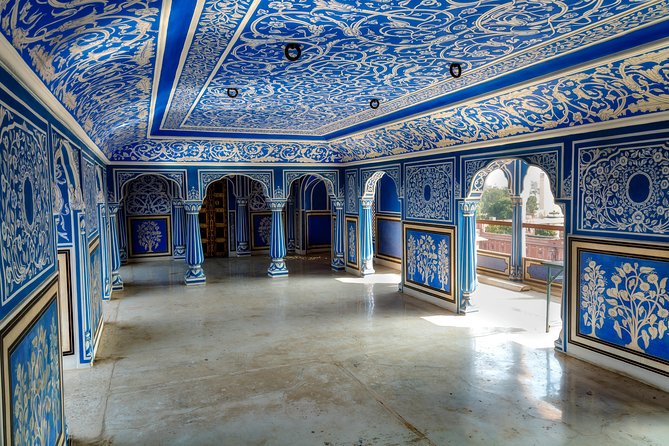
City Palace gives you the broadest look at Jaipur’s former royal world. It is not simply one palace building. The complex brings together courtyards, gates, gardens, museum rooms, and decorated spaces shaped by both Rajput and Mughal architecture.
Look closely as you move through the courtyards. The appeal is in the details: patterned surfaces, carved gateways, painted decoration, and the way each open space frames the next. The palace was designed to impress, but it also worked as a setting for court business and royal ceremony.
Inside the museum areas, you can expect displays of royal costumes, weapons, and artwork. These objects make the visit more useful than a quick walk around an ornate building. A costume shows how public appearance mattered at court. A weapon points to military power and status. Artwork helps you read the tastes and beliefs of the ruling family.
I would give City Palace the largest share of your attention if you enjoy interiors and objects. Hawa Mahal is instantly recognizable, but City Palace gives you more to examine at close range.
The drawback is simple: a palace complex can feel visually crowded with detail. If your guide moves quickly, ask to pause in the rooms or courtyards that interest you most. Since the tour is private, you have a better chance of shaping the pace than you would on a large group outing.
Monument entry is not included in the $27 price. That matters because the low headline cost does not represent the full spend. You will need to pay the applicable entrance fee separately, and the tour provider should confirm current prices and accepted payment methods.
More Private Palace Tours in India
- 2-Day Private Tour of Jaipur from Delhi: City Palace, Hawa Mahal and Amber Fort
★ 4.5 · 29 reviews - 5 Day Private Tour of Tigers, Taj Mahal and Palaces from Cochin
★ 5.0 · 18 reviews - Private Tour: Palaces of Bangalore
★ 4.0 · 15 reviews
Hawa Mahal: Jaipur’s famous wall of windows
Hawa Mahal, or Palace of Winds, is the most recognizable stop on the route. Its five-story facade contains 953 small windows, known as jharokhas. From a distance, the building looks almost like a stone screen placed along the street.
Those windows had a practical purpose. Royal women could observe city life without being seen from outside. The building therefore tells you something about both architecture and social rules. Its delicate appearance is not only decoration. The openings helped air move through the structure, giving the palace its familiar name.
This stop is likely to be shorter than City Palace or Jantar Mantar. The facade is the main event, and your guide can explain how the windows, balconies, and layered design create its unusual appearance. Bring your attention to the repeated patterns rather than treating Hawa Mahal as a quick photo background.
I like finishing here because the palace gives the tour a strong visual ending. After the larger rooms and instruments at the earlier stops, Hawa Mahal offers a compact lesson in design, privacy, and royal life.
Do not expect this visit to replace a full architectural tour of Jaipur. The provided itinerary identifies Hawa Mahal as a visit to the iconic palace, but it does not promise a long interior exploration or a special photography session. If seeing the facade is your main goal, tell the guide early so you get enough time for it.
Jantar Mantar: stone instruments that measure the sky
Jantar Mantar changes the mood of the tour. Here, the focus shifts from royal display to mathematics and astronomy.
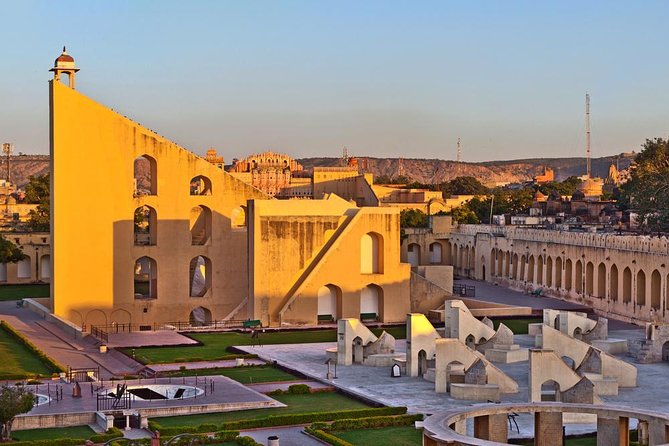
The site is a UNESCO World Heritage site and contains the world’s largest stone sundial. It also includes numerous other astronomical instruments. Their scale is the first surprise. These are not small brass tools tucked into a cabinet. They are large structures built to track time and study the movement of celestial bodies.
The value of a guide is especially clear here. Without an explanation, the curved walls, ramps, and angular surfaces can look abstract. With context, they become working instruments designed around shadows, angles, and careful observation. You begin to see the site as a scientific complex rather than an unusual collection of monuments.
Jantar Mantar also helps correct the easy assumption that Jaipur’s grandest achievements were only palaces and forts. The observatory shows the importance of astronomy in 18th-century India and gives the tour an intellectual edge.
Ask your guide to explain how the sundial works and what the other instruments were built to measure. The available information does not promise a demonstration at a particular hour, so treat any live reading or shadow explanation as dependent on timing and conditions.
If you prefer only decorative sights, this may be the least immediately obvious stop. Give it time. The instruments reward explanation, and the private format lets you ask basic questions without holding up a larger group.
Why the private car matters in a half-day tour
The package includes a private air-conditioned car with driver, pickup, and drop-off. That is more than a comfort feature in Jaipur. It gives you a fixed base between three major sights and keeps the five-hour schedule easy to follow.
You do not have to arrange separate transport for each monument or negotiate each short ride. The driver handles the transfers while the guide explains the sites. The tour listing does not specify the vehicle model, pickup zone, or exact driving times, so confirm those points if you have a tight schedule.
Air conditioning is especially useful when you are moving between outdoor courtyards and open observatory grounds. It also gives you a quiet break between stops. That can make the difference between an enjoyable half-day and a tiring one.
The private group format suits couples, families, and small parties with shared interests. If one person wants more time at the museum displays while another wants to focus on architecture, you can raise that with the guide. A shared group would usually give you less control.
The main limitation is the five-hour cap. You are getting an efficient introduction, not an unhurried full-day study of Jaipur. Keep that in mind if you want extensive shopping, extra monuments, or a long meal during the same outing.
More Rajasthan Palace Tours around India:
- Jaipur Guided City Tour: City Palace, Jantar, Hawa & Jal Mahal
★ 5.0 · 186 reviews - Full-Day Jaipur City Tour with Amber Fort and City Palace
★ 5.0 · 99 reviews - Udaipur: City Palace Museum Tour and Lake Pichola Boat Tour
★ 5.0 · 20 reviews - Jaipur Rickshaw Tour Jantar Mantar City Palace
★ 5.0 · 18 reviews
Guides, languages, and the value of explanation
Live guiding is available in English, French, German, Japanese, Russian, and Spanish. That broad language range is useful because these monuments need context. A facade alone cannot explain why Hawa Mahal was built, and the instruments at Jantar Mantar are difficult to understand without help.
Rahul is specifically identified as a Japanese-speaking guide. If you need Japanese, request him when booking, though guide assignment should be confirmed rather than assumed. His Japanese was described as easy to understand, and his careful, earnest approach received the strongest specific praise connected with this experience.
For English-speaking visitors, the tour promises a professional English-speaking guide. The supplied information does not name the English guide, so you should not expect a particular person unless the provider confirms one.
I would use the guide actively. Ask about the royal objects at City Palace, the purpose of the jharokhas, and the difference between the instruments at Jantar Mantar. A guide who simply points and moves on would waste much of the tour’s value.
What the $27 price really covers
At $27 per person, the tour is priced as a transport and guiding package rather than an all-inclusive sightseeing ticket. You receive a private air-conditioned car, driver, pickup, drop-off, professional guide, applicable taxes, and skip-the-line access.
You pay separately for monument entry, food, and personal expenses. That split can be good value if you want a private vehicle and a guide but prefer to control what you spend inside the sites. It also means you should budget beyond the advertised price.
The value is strongest for first-time Jaipur visitors who want the three headline sights handled in one booking. A private car alone can simplify the day, and the guide adds meaning to places that are easy to reduce to photographs.
The value is weaker if you already have transport, know the monuments well, or prefer to set your own schedule. In that case, the fixed five-hour tour may offer less flexibility than independent visits.
The booking terms are traveler-friendly. You can reserve now and pay later, and cancellation is free up to 24 hours before the start time for a full refund. Those terms help if your Rajasthan plans are still shifting.
Who should book this Jaipur tour?
I would choose this experience if you want an efficient first encounter with Jaipur’s central sights, private transport, and explanations in a preferred language. It is particularly suitable for visitors who value comfort between stops and do not want to organize tickets, drivers, and guides separately.
It also suits anyone interested in contrasts. City Palace gives you royal design and museum objects. Hawa Mahal shows how architecture shaped privacy and public viewing. Jantar Mantar brings in astronomy and measurement.
I would think twice if you have mobility impairments, since the tour is not suitable for people with mobility limitations. I would also look for a longer private tour if you want slow museum visits, extended photography, or several additional Jaipur sights.
Should you book it?
Book this tour if you want Jaipur’s essential trio in a manageable five-hour package and value a private car, guide, and hotel pickup over total independence. Request Rahul if Japanese guidance is important, and ask in advance about monument ticket costs.
Skip it if you want an unhurried palace visit or need an itinerary built around accessibility. For most first visits, though, the mix of royal art, the 953-window facade, and working astronomical instruments makes this a well-balanced introduction to Jaipur.
FAQ
How long does the Jaipur private tour last?
The tour lasts five hours.
What sights are included?
The tour visits City Palace, Hawa Mahal, and Jantar Mantar in Jaipur.
Are monument entrance tickets included?
No. Monument entry tickets are not included in the tour price.
Is transportation included?
Yes. A private air-conditioned car with driver, pickup, and drop-off are included.
Which guide languages are available?
Live guiding is available in English, French, German, Japanese, Russian, and Spanish.
Can I cancel the tour for a full refund?
Yes. You can cancel up to 24 hours in advance for a full refund.
Fresh palace tours around India
- Story of Mysore Silk tour from Bangalore to experience Silk Weaving & Palace★ 5.0 · 28 reviews
- Lalbagh+Bull Temple+Tipu Palace+Market+Lunch=Bangalore City Tour★ 5.0 · 9 reviews
- 2 Day Bandipur Safari and Mysore Palace Tour★ 4.5 · 4 reviews
- Private Tour: Bangalore City Tour Including LalBagh & Tipu Palace★ 4.0 · 4 reviews
- Individual Gujarat tour 2024-2025 (nature and palaces)★ 5.0 · 2 reviews
- Vadodara Palace, Champaner & Pavagad temple from Ahmedabad with guide★ 5.0 · 2 reviews
- Private Jaipur Tour: City Palace, Jantar, Hawa & Jal Mahal★ 5.0 · 2 reviews
- Overnight Pangong Tour From Leh With Thiksey & Shey Palace★ 5.0 · 4 reviews
Private Palace Tours: the shortlist.
Alhambra Private/Small Group Tour & Nasrid Palaces Skip the Line
Read our review →
Grand Palace, Wat Pho, and Wat Arun Private Tour
Read our review →
Mutianyu Great Wall&Summer Palace Excursion:Group/Private Options
Read our review →
Private Tour of Sintra, Cabo da Roca and Cascais with 2 Palaces
Read our review →
Private 4hrs Venice Tour: Doge’s Palace, Grand Canal & St Mark’s
Read our review →
Knossos Palace Skip-the-Line Ticket & Private Guided Tour
Read our review →