
Review · ITALY
Florence: Uffizi Gallery Tour with Palazzo Vecchio Entry
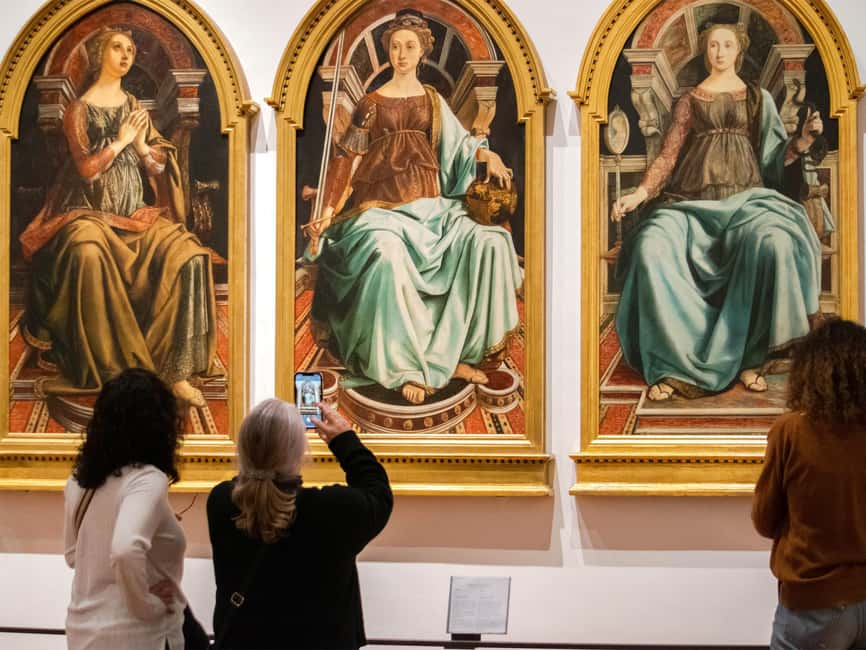
Florence’s Renaissance story makes much more sense when you connect the Uffizi, the Medici’s working offices, with Palazzo Vecchio, their political home. This tour gives you that link in a tidy package. I like the small group, limited to nine people, and the chance to focus on Botticelli, Leonardo, and Michelangelo without wandering blindly through the gallery.
I also like the two-part format. You get a live, 1.5-hour Uffizi tour with an English-speaking licensed guide, followed by priority entry to Palazzo Vecchio at no extra ticket charge. The catch is clear: Palazzo Vecchio is self-guided, so you need to set aside roughly two more hours and guide yourself through its grand rooms.
Key points to know before booking
- The Uffizi tour lasts 1.5 hours: It covers major works by Giotto, Masaccio, Botticelli, Leonardo, and Michelangelo.
- The group is limited to nine people: That gives you a better chance to hear the guide and ask questions.
- Palazzo Vecchio is self-guided: Your priority ticket is included, but no guide accompanies you inside.
- The two sites are only about two minutes apart: You can continue from the Uffizi to Piazza della Signoria on foot.
- The meeting point is specific: Look for the Florence with Locals Tours flag beneath the Leonardo da Vinci statue, opposite Door 3.
- Guide Anna S is one named guide: She is described as pleasant, interested, and competent, and communication can be handled through WhatsApp if timing changes.
Why the Uffizi and Palazzo Vecchio belong together
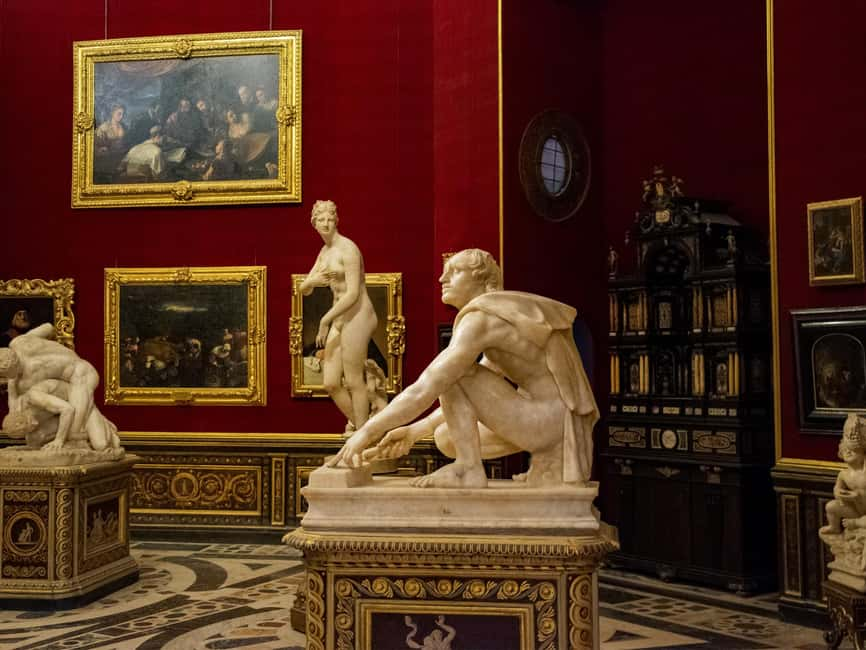
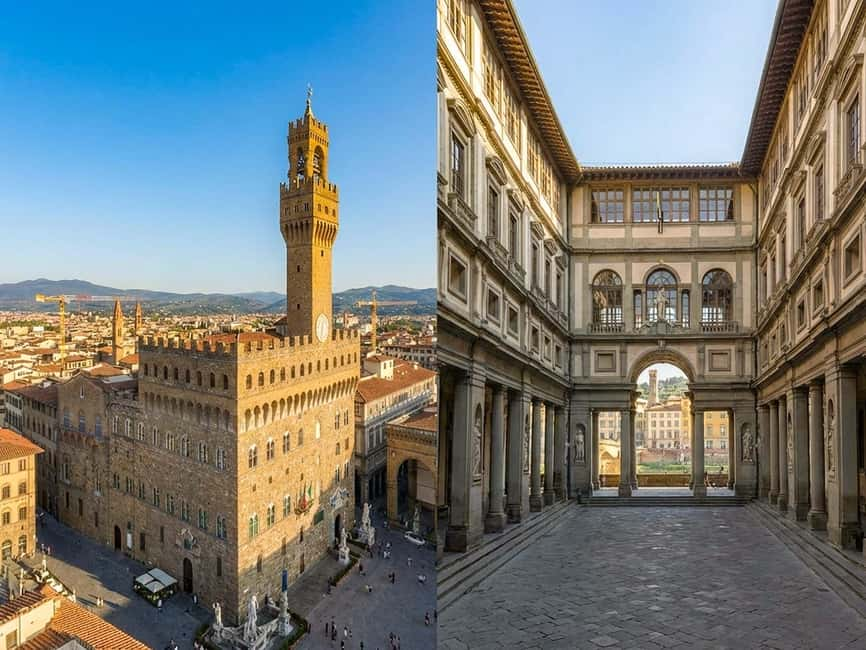
Many Florence sightseeing plans treat the Uffizi and Palazzo Vecchio as separate stops. This experience gives you a useful piece of connective tissue: both buildings were part of Duke Cosimo I de’ Medici’s plan to shape Florence into a center of art and power.
Giorgio Vasari designed the Uffizi in 1560 to house the Medici administration and art collection. At the same time, he worked on Palazzo Vecchio, the family’s seat of political authority. The buildings were later linked by the Vasari Corridor, the Medici family’s private route across the city.
You do not visit the Vasari Corridor on this tour, but knowing about it helps you read the city differently. The Uffizi represents administration and collecting. Palazzo Vecchio represents government, ceremony, and control. Together, they show how the Medici used art as both decoration and political language.
That is the main reason I like this pairing. You are not simply checking off two famous buildings. You are following one family’s movement from office to palace, from financial power to public authority.
More Palazzo Vecchio and Pitti tours around Florence:
- Florence: Palazzo Vecchio Entrance Ticket & Audioguide
★ 4.4 · 4,822 reviews - Florence: Uffizi, Pitti Palace & Boboli Combined 5-Day Pass
★ 4.5 · 1,726 reviews - Florence: Palazzo Vecchio Guided Tour
★ 4.8 · 1,260 reviews
Meeting your guide beneath Leonardo’s statue
Your guide meets you in the Uffizi courtyard at Piazzale degli Uffizi 1. The practical landmark is the Leonardo da Vinci statue, opposite Door 3 of the gallery. Look for the representative holding a Florence with Locals Tours flag.
This detail matters. The Uffizi courtyard can feel confusing, especially when several groups are gathering near the entrances. Arrive with the meeting point saved on your phone, and look for the statue and flag rather than relying only on the street address.
The experience is offered in English, with headsets supplied so you can hear the guide clearly. That is helpful in crowded rooms, where a guide speaking at normal volume can easily become lost in the general noise.
The small-group limit is nine people. I consider that a real advantage for an art museum. A large group often forces you to stand at the back, while a group this size should make it easier to see the paintings and follow the explanation. One booking with Anna S became a private experience because nobody else had joined that departure. You cannot count on that happening, but it shows that group size can sometimes be very small.
Following painting from Giotto to Piero della Francesca
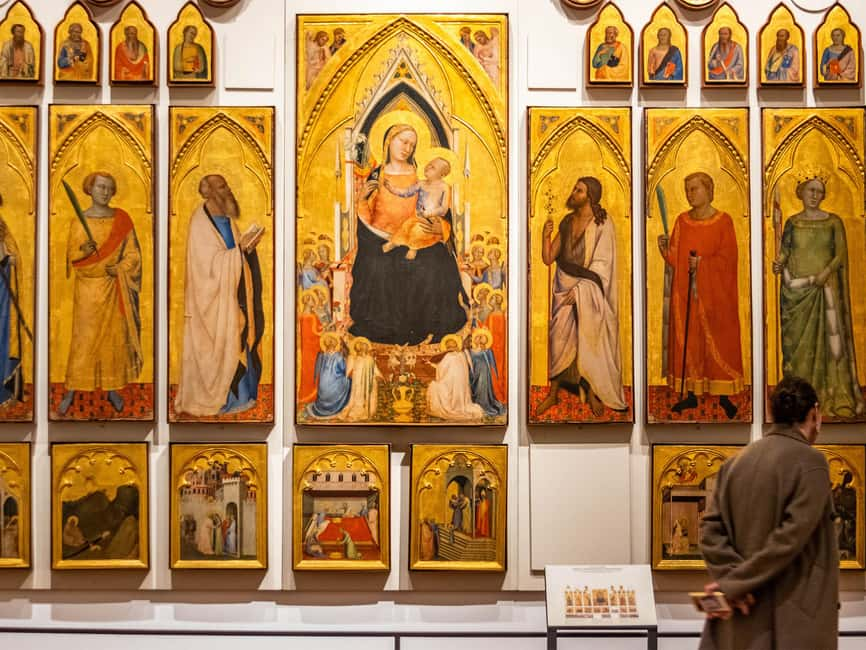
The Uffizi visit begins before the famous Botticelli rooms. You first follow the development of Italian painting, starting with Giotto.
Giotto helped move painting away from the flat, rigid Byzantine style. His figures and scenes feel more human and physically present. That change may seem basic now, but it was a major break from the conventions that came before him.
From there, the route includes Early Renaissance masters such as Masaccio and Paolo Uccello. Masaccio is important for the new sense of solid bodies and believable space. Uccello is closely tied to the period’s fascination with perspective, the system artists used to make a flat surface appear three-dimensional.
The tour also includes portraits by Piero della Francesca. His controlled use of perspective and geometry gives these works a calm, measured quality. A guide can help you notice the technical choices that are easy to miss when you are moving from room to room alone.
This part of the itinerary is valuable because it gives you a sequence. Instead of seeing a famous painting as an isolated masterpiece, you can understand what changed from one generation to the next. If you already know Renaissance art, the guide’s explanations should add useful links. If you are new to it, the chronological route keeps the museum from feeling like a pile of unrelated names.
Botticelli’s Birth of Venus and Primavera
The emotional center of the Uffizi visit is the Botticelli section. Here you see The Birth of Venus and Primavera, two of Florence’s most recognized paintings.
The Birth of Venus is famous for its graceful figure and unusual subject. Primavera is filled with figures, flowers, and symbols that have kept art historians busy for generations. Both works invite questions about beauty, mythology, love, and the intellectual world of the Medici court.
The guide explains the Neoplatonic ideas connected with the paintings and points out symbols that are easy to overlook. You also hear how a banker’s commission for a cousin’s wedding became part of the history of Western art.
The paintings are not large because they need to be. Their importance comes from the way they combine mythology, poetry, philosophy, and visual elegance. Take time to look beyond the familiar outlines. Venus’s pose, the direction of the figures, and the plants and gestures in Primavera all reward close attention.
One limitation is that the Uffizi can be crowded, and famous rooms rarely feel private. The small group and headsets help, but you should not expect long stretches of solitude in front of Botticelli’s best-known works.
More palace museums around Florence:
- Florence: Pitti Palace, Boboli Garden, Palatine Gallery Tour
★ 4.9 · 558 reviews - Florence: Pitti Palace and Palatina Gallery Ticket and Tour
★ 4.9 · 255 reviews - Florence: Palatina Gallery and Pitti Palace Guided Tour
★ 4.6 · 158 reviews - Florence: Museum Pass–David, Uffizi, Pitti Palace & Gardens
★ 4.2 · 134 reviews
Leonardo’s early Annunciation
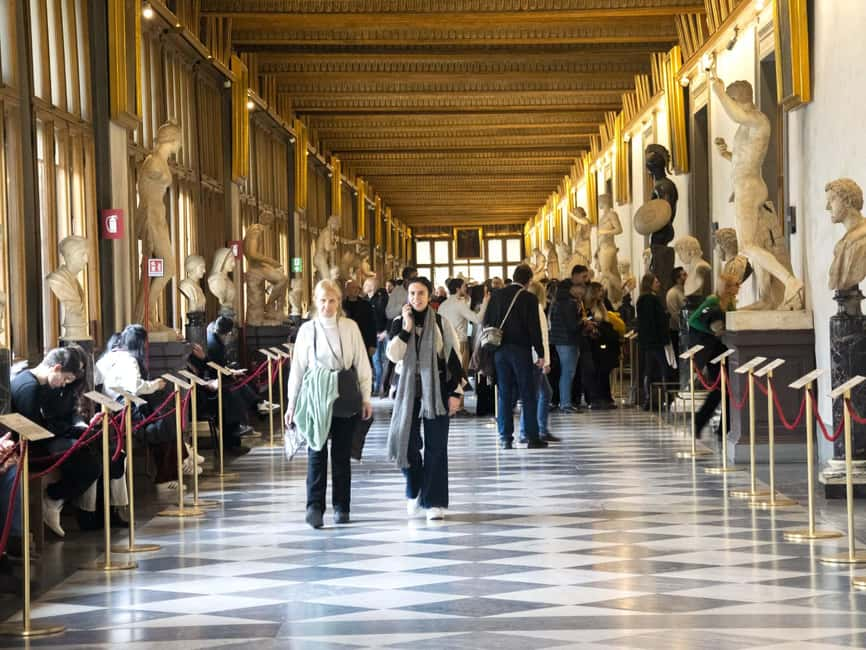
Leonardo’s Annunciation offers a different kind of experience. It was painted when Leonardo was about 20, before he became the legendary artist associated with the Mona Lisa and The Last Supper.
The guide draws your attention to the subtle optical effects in the painting. Leonardo was already testing ways to make space, light, and distance feel convincing. Those small decisions give you an early look at the habits of observation that shaped his later work.
This is a good moment to remember that famous artists did not appear fully formed. Leonardo’s early painting shows a young artist working within the traditions of his time while quietly pushing them forward.
You may find the contrast with Botticelli useful. Botticelli’s work often attracts you through line, movement, and symbolic detail. Leonardo asks you to watch the atmosphere, surfaces, and way the eye reads space. A guide can make that difference easier to see.
Michelangelo’s Tondo Doni
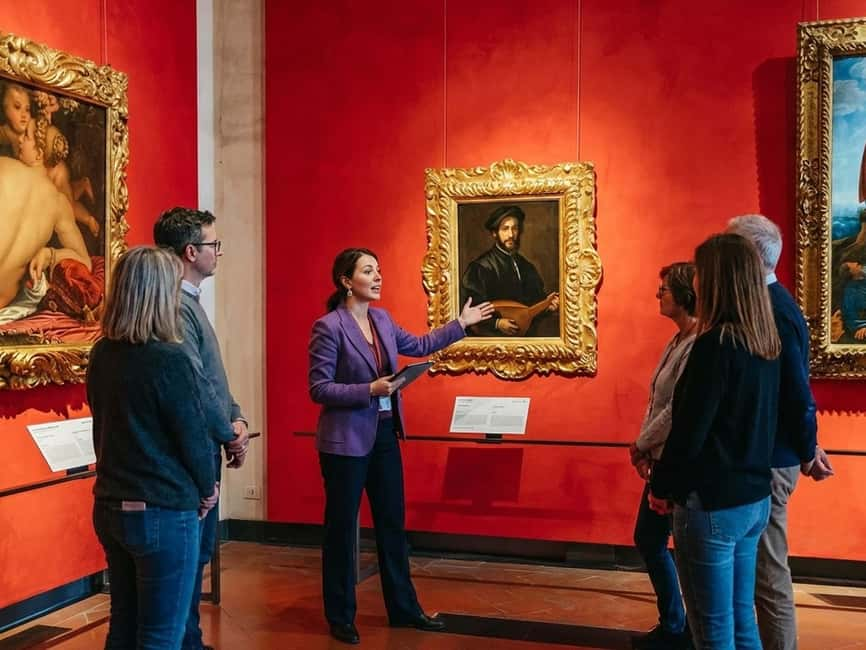
The Uffizi also holds Michelangelo’s Tondo Doni, his only easel painting in Florence. It is a round panel with vivid colors and strongly twisted figures.
The work feels more muscular and restless than many earlier Renaissance paintings. Its unusual poses and intense color anticipate the artistic style later called Mannerism. The guide explains why those choices mattered and how the painting points toward a new direction in art.
This is one of the tour’s strongest stops for understanding Michelangelo as a painter. He is often thought of first as a sculptor, but the Tondo Doni shows his command of the human body and his ability to make a flat picture feel full of pressure and movement.
Do not rush past it simply because you are waiting for sculpture or architecture elsewhere in Florence. The painting is a compact lesson in how Renaissance balance could begin to bend into something more dramatic.
The Uffizi terrace and Florence from above
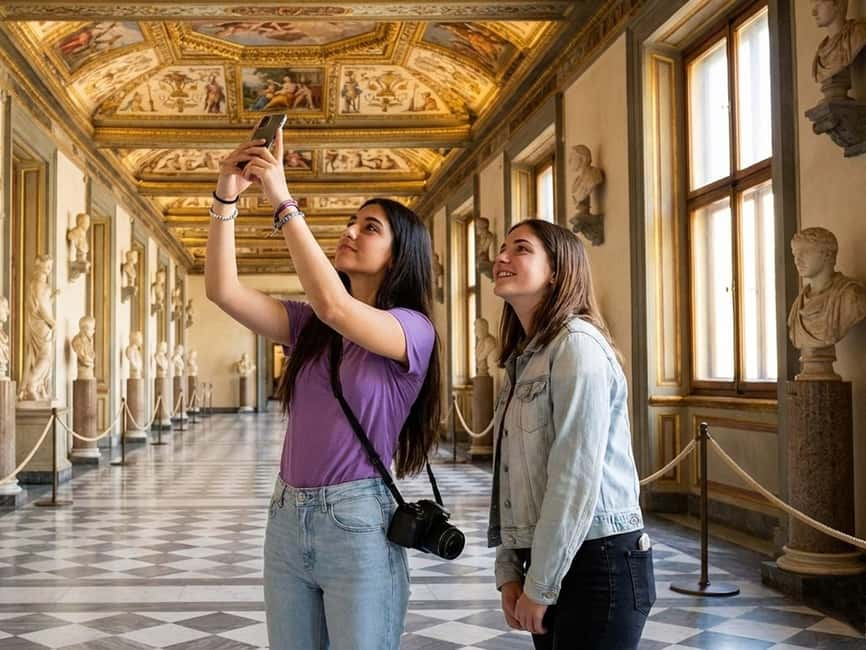
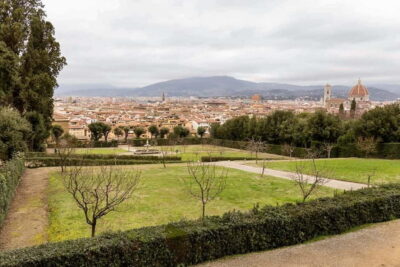
The guided visit includes time on the Uffizi’s panoramic terrace. From here, you can see Palazzo Vecchio’s tower, the Duomo, and the Tuscan hills beyond.
This is a welcome pause after the concentrated gallery route. It also prepares you for the next part of the story. From the terrace, Palazzo Vecchio is not an abstract historical name. You can see its tower and understand its position at the heart of civic Florence.
The terrace is included in the Uffizi portion, but the tour remains fairly brisk at 1.5 hours. You will see the major highlights rather than every room and painting. That is a sensible trade for a first visit, but serious art students may want a separate return visit with more time.
Crossing Piazza della Signoria to Palazzo Vecchio
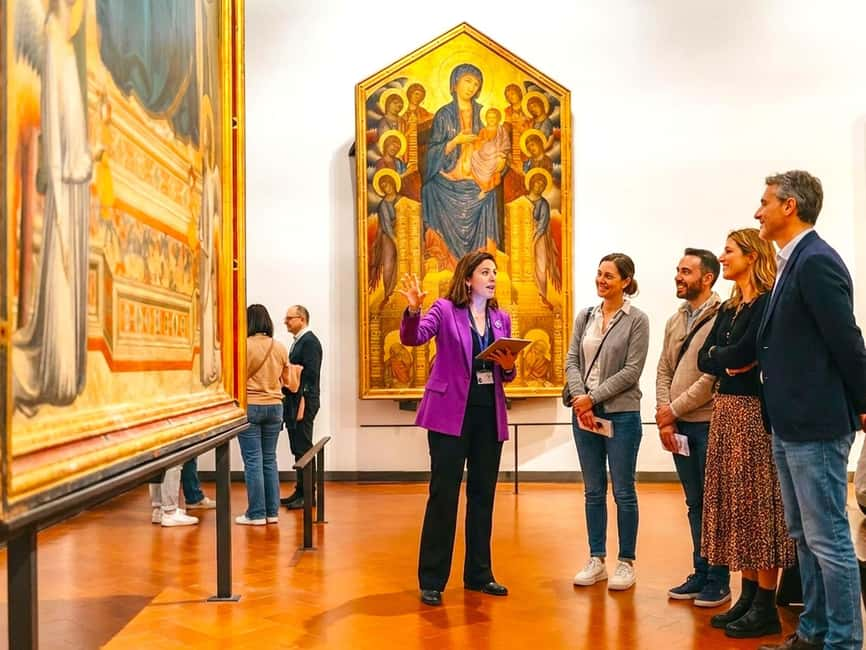
After the guided Uffizi visit, Palazzo Vecchio is about a two-minute walk across Piazza della Signoria. Your included priority ticket gives you independent access.
This is where the tour changes character. You no longer follow a guide through a selected route. Instead, you set your own pace and choose how long to spend in each room. I like that flexibility, but you need to be realistic about the time required.
Allow about two additional hours if you want to enjoy the palace properly. That means the full experience is not really 1.5 hours in practical terms. Plan for at least four hours overall, including the transition and a worthwhile self-guided visit.
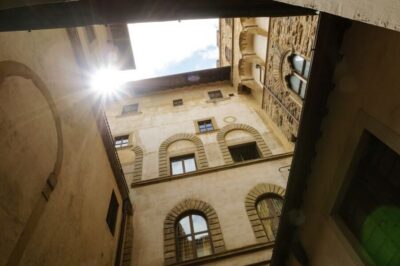
Palazzo Vecchio has dominated Piazza della Signoria since 1299. It feels more fortified and political than the Uffizi, which makes the contrast useful. The building was not created simply to display art. It was built around government, authority, and the public image of Florence.
The Hall of Five Hundred and the Medici message
The major interior highlight is the Salone dei Cinquecento, or Hall of Five Hundred. Five hundred citizens once gathered here to govern the Florentine Republic.
Under Cosimo I, Vasari transformed the hall into a grand display of Medici power. The towering frescoes celebrate military victories and present the ruling family as the natural center of Florentine authority.
The scale can be overwhelming. Rather than trying to absorb every image at once, look at the room as a political stage. The height, decoration, and battle scenes all send the same message: this is government presented as spectacle.
The room also carries one of Florence’s most famous art mysteries. Leonardo da Vinci may have painted the lost Battle of Anghiari on a wall in the hall. The work has not survived in visible form, but the possibility adds another layer to the visit.
Palazzo Vecchio also appears in Dan Brown’s Inferno. In Vasari’s Battle of Marciano fresco, look for the inscription Cerca Trova, meaning Seek and You Shall Find. It is a small detail, but it gives fans of the novel an extra reason to study the walls.
What the $91 price gets you

At $91 per person, this is not a bargain-priced museum entry. The value depends on how much help you want inside the Uffizi.
The price includes skip-the-line Uffizi entry, a 1.5-hour guided tour, a licensed English-speaking guide, headsets, reservation fees, taxes, and priority entry to Palazzo Vecchio. You are paying for access and interpretation, not simply admission.
I think the price makes the most sense for a first-time Florence visitor who wants the major Uffizi works explained in a short session. The guide helps you use limited museum time well, and the second ticket adds a connected sight without requiring another booking.
It makes less sense if you prefer to study paintings alone or already know the Uffizi well. In that case, the guided portion may feel too selective, and you may prefer a longer self-guided visit.
The palace ticket is also only part of the value if you do not have time to use it properly. Schedule it immediately after the Uffizi or leave a clear block of around two hours. The Arnolfo Tower climb is not included, so do not treat this ticket as access to every optional feature at Palazzo Vecchio.
Who should book this Florence combination
I would choose this tour for a first Uffizi visit, especially if you want a clear introduction rather than a full academic treatment. It is also a good fit for people who like a small group and want a live guide for the art but freedom inside the palace.
Families and mixed-interest groups may appreciate the structure. The Uffizi section gives you a focused route, while Palazzo Vecchio lets you slow down, move ahead, or stop when your attention fades.
I would be more cautious if you have mobility concerns, though the activity is listed as wheelchair accessible. The duration is given as 1.5 hours for the guided section, but the complete visit can take at least four hours, so plan your energy around the full day.
The cancellation policy is practical: you can cancel up to 24 hours before the experience for a full refund. You can also reserve now and pay later, which helps if your Florence schedule is still changing. Communication by WhatsApp can be useful when the timing needs to be rearranged.
Should you book this tour?
Book it if you want expert guidance at the Uffizi, a small group, and a second major Florence sight in the same plan. The best feature is the pairing of art and power: Botticelli, Leonardo, and Michelangelo first, then Medici government and ceremony across the square.
Skip it if you want a slow, independent Uffizi visit or a guided tour inside Palazzo Vecchio. The palace portion is self-guided, and the $91 price is worthwhile only when you use both entries and allow enough time. For most first-time visitors with a half-day available, this is a focused and sensible way to meet Florence’s Renaissance center.
FAQ
How long does the guided Uffizi visit last?
The guided Uffizi portion lasts 1.5 hours. You should allow about two additional hours to explore Palazzo Vecchio independently, making the full experience at least four hours.
Is Palazzo Vecchio guided?
No. The tour includes a priority entrance ticket to Palazzo Vecchio, but you visit the palace on your own without a guide.
What artworks are included in the Uffizi route?
The tour includes works connected with Giotto, Masaccio, Paolo Uccello, Piero della Francesca, Botticelli, Leonardo da Vinci, and Michelangelo. Highlights include The Birth of Venus, Primavera, Leonardo’s Annunciation, and Michelangelo’s Tondo Doni.
Where is the meeting point?
Meet in the Uffizi courtyard at Piazzale degli Uffizi 1, on the right side of the gallery entrance. Look beneath the Leonardo da Vinci statue, opposite Door 3, for a representative holding a Florence with Locals Tours flag.
What language is the tour in?
The live guided portion is in English. Headsets are provided so you can hear the guide clearly.
How large is the group?
The group is limited to nine participants. On one departure, guide Anna S led a booking with only one participant.
Is the Arnolfo Tower included?
No. The standard Palazzo Vecchio entry does not include the Arnolfo Tower climb.
Fresh palace tours around Florence
- The places of the Medici family: the Palace and the Chapels★ 4.7 · 12 reviews
- Pitti Palace and Boboli Gardens Private Tour★ 4.7 · 38 reviews
- Florence: Pitti Palace and Boboli Gardens Private Tour★ 4.8 · 46 reviews
- Palazzo Vecchio Small Group Tour★ 4.9 · 10 reviews
- Palazzo Vecchio 90-Minute Morning Guided Tour★ 4.7 · 104 reviews
- Palazzo Vecchio Secret Passages Tour & Lunch or “Gelato”★ 4.3 · 16 reviews
- Palazzo Vecchio: Magnificent Private Tour★ 4.7 · 61 reviews
- Palazzo Vecchio: Private Guided Museum Tour & Tower Tickets★ 4.7 · 18 reviews
Palazzo Vecchio and Pitti Palace Tours: the shortlist.
Uffizi, Pitti Palace & Boboli Combined 5-Day Pass
Read our review →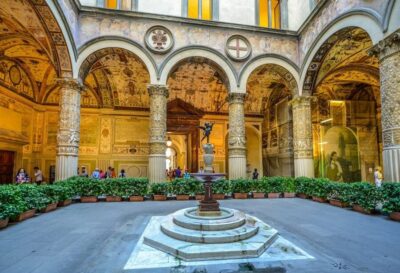
Palazzo Vecchio: Skip-the-Line Entry and Secret Passage Tour
Read our review →
Pitti Palace, Boboli Garden, Palatine Gallery Tour
Read our review →This visit also appears in