
Review · BANGALORE
Tipu Palace + Koté Vishnu + Fort + KR Market + Jain Temple = Bengaluru Pété Walk
Bengaluru’s old Pété district is not polished sightseeing. It is India in full motion, with a teak palace, carved temple walls, a half-vanished fort, flower sellers, sacred spaces, traffic, aromas, and plenty of noise packed into one walk. I like the strong mix of history and present-day life, especially the jump from Tipu Sultan’s quiet palace to the working chaos of KR Market. I also like the small-group format, capped at 10 people, which gives guides such as Vijay, Vanaja, Raghu, and Vasuki room to answer questions and help you cross the maze of streets.
The main caution is pace and timing. You cover a lot in two and a half to three hours, mostly on foot, and the market can be crowded and tiring. The Hindu temple may be closed on some afternoon departures, and temple dress rules matter: cover your legs and shoulders, and bring a scarf if you are a woman visiting the Jain temple.
Key points at a glance
- Tipu Sultan’s 230-year-old teak palace: See a rare wooden royal building shaped by Islamic design.
- Five very different stops: The walk links a palace, Hindu temple, fort, wholesale market, and Jain temple.
- KR Market is the sensory center: The flower market brings strong colors, scents, workers, bicycles, animals, and serious commerce.
- A good introduction to central Bengaluru: You get history, religion, local life, and practical orientation in one half-day outing.
- Guides make the route easier: Vijay, Vanaja, Raghu, Vasuki, and other listed guides have helped visitors with history, photos, coffee, metro directions, and onward plans.
- Dress and timing affect the experience: Temple access depends on opening hours and seasonal changes, while afternoon heat and crowds can make the walk harder.
Why this Bengaluru Pété walk works
I like tours that show a city as people actually use it, not only as a string of preserved monuments. This walk does that well. You begin with royal architecture, pass through religious buildings, then enter a market that still functions as a major part of daily commerce.
The name Pété refers to Bengaluru’s older market town area. That makes this route useful for understanding how the city began and how its historic core still operates. You are not simply looking at old walls. You are watching flower sellers sort garlands, buyers bargain, workers haul goods, and pedestrians thread through tight streets.
The route lasts roughly two hours and 30 minutes to three hours. That is long enough to give each stop some attention, but short enough to fit into a busy Bengaluru visit. The group limit of 10 is important here. In a crowded market, a giant group would be awkward and easy to lose. With fewer people, you can stay close to the guide and ask about what you are seeing.
The price is $33.55 per person. Since entry to the monuments is included, the cost is reasonable if you value a local guide and want several major sights handled in one outing. It is less attractive if you prefer to move slowly, spend a long time photographing one building, or explore markets without a set schedule. Lunch, tips, and transport are extra.
More market visits around Bangalore:
- Old Bangalore Historical Walk thro Palace, Temples, Fort & Market
★ 5.0 · 60 reviews - Bangalore: Walking Tour of Fort, Palaces, and Market
★ 5.0 · 58 reviews - Lalbagh+Bull Temple+Tipu Palace+Market+Lunch=Bangalore City Tour
★ 5.0 · 9 reviews
Tipu Sultan’s teak palace begins the story
The meeting point is Tipu Sultan’s Summer Palace at 42 Tippu Sultan Palace Road in Chamrajpet. Starting here gives the walk a clear anchor and avoids wasting the first part of the tour on a long transfer between sights.
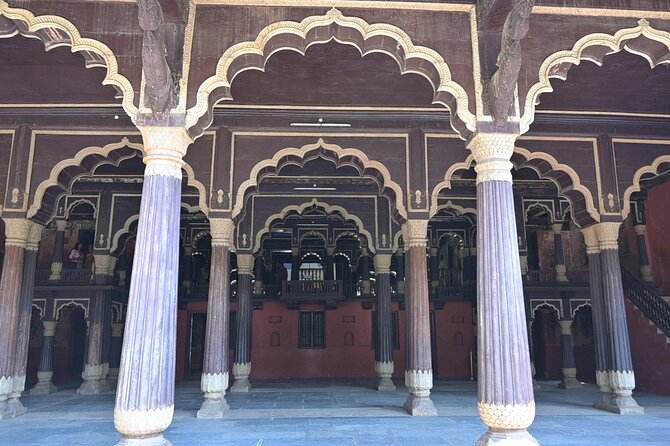
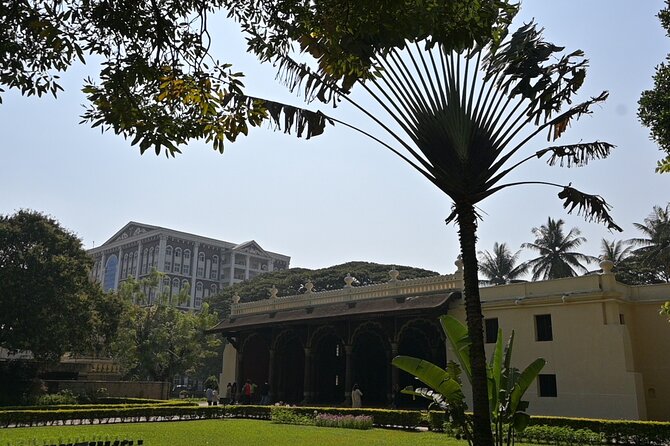
The palace is about 230 years old and made largely of teak wood. Its design reflects Islamic architectural traditions, with an elegant, restrained character that differs from the stone temples later on the route. The building is not enormous, so the 30-minute visit is well judged. You have time to understand its purpose and details without turning the stop into a lengthy lecture.
This is a good place to listen closely to the guide’s explanation of Tipu Sultan, the palace, and the changing power of the region. Guides including Vijay and Raghu have been praised for making the historical material understandable and connecting it to the city around you.
Entry is included. The palace is also a useful reminder that Bengaluru’s past cannot be reduced to its modern technology and office districts. The old city has layers of royal rule, local trade, religious practice, and military history, all within a short walk.
Kote Venkataramana Temple adds Hindu art
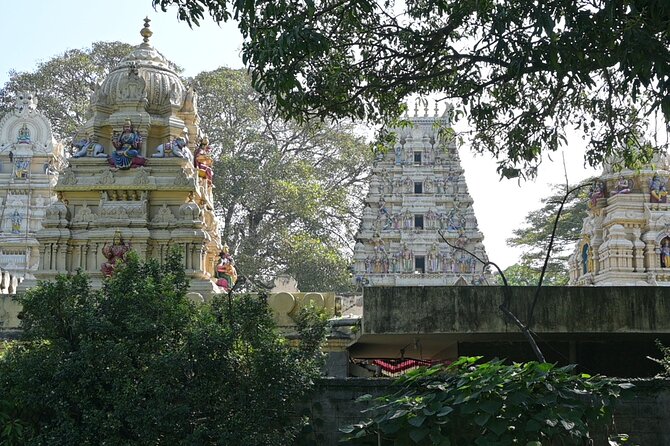
Next door is Kote Venkataramana Temple, also known as Kote Vishnu Temple. Chikkadevaraja Wodeyar built it in 1690. Its walls feature carved stone figures from Hindu mythology, giving you a very different visual experience from the wooden palace.
I like this pairing because the two buildings are close but speak in different architectural languages. The palace emphasizes wood and royal residence. The temple turns your attention to stone carving, religious imagery, and active worship.
The visit is listed at about 30 minutes, with no separate admission charge. Temple access depends on opening hours and seasonal changes, so you should not assume every departure will allow the same amount of time inside. One important practical point comes from the afternoon schedule: the Hindu temple is often closed then. If entering this temple matters to you, the morning departure is the safer choice.
Dress modestly for this stop. Your shoulders and legs should be covered. Temple rules can also involve removing footwear, so an extra pair of socks is a sensible item to carry. The socks are especially useful if you dislike walking barefoot through busy religious sites.
Bangalore Fort reveals what remains
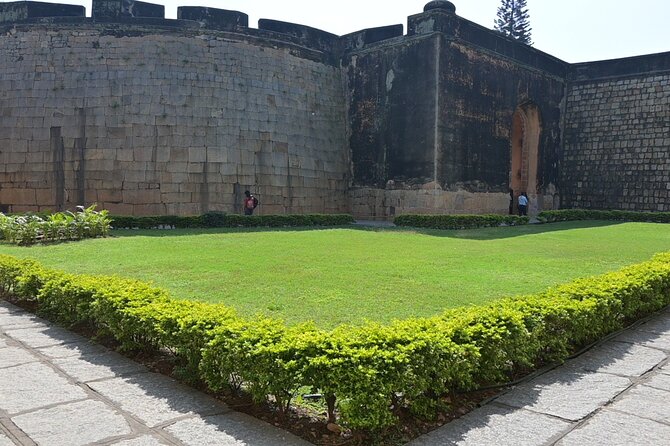
Bangalore Fort began as a mud fort built by Kempegowda, the founder of Bengaluru, in the 16th century. Hyder Ali rebuilt it in stone in the 1760s. Only about 5 percent of the original fort remains today.
That small surviving section is exactly why a guide helps. Without context, you might see a neat fragment and move on. With an explanation of the fort’s earlier size, construction, and role, the remaining gate and walls become evidence of a much larger defensive complex.
The stop lasts about 30 minutes and has no separate admission fee. It is neatly maintained, which makes it easier to examine the structure and take photographs. Do not expect a vast fort complex or a long palace-style visit. This is a compact historical stop, valuable mainly because it fits into the larger story of Bengaluru’s origins and military past.
The walk also gives you a sense of scale. The palace, temple, and fort are not isolated attractions in a distant archaeological zone. They sit inside a living part of the city, close to roads, shops, worshippers, and the market.
More shopping stops around Bangalore:
- Bangalore Walking Tour KR Flower Market,Fort,Tippu palace
★ 5.0 · 8 reviews - Versailles Palace Bike Tour with Market & Marie-Antoinette hamlet
★ 5.0 · 2,680 reviews - Versailles Bike Tour with Market, Gardens & Guided Palace Tour
★ 5.0 · 1,121 reviews - Seoul: Palace, Temple and Market Guided Foodie Tour at Night
★ 4.9 · 750 reviews
KR Market is the walk’s strongest moment
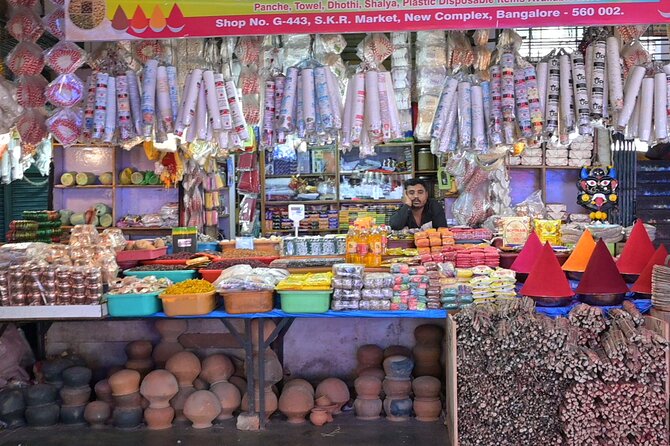
Sri Krishnarajendra Market, usually called KR Market, is where the tour shifts from monuments to movement. This is the part I would most want a guide for, especially on a first visit to Bengaluru.
The market and its surrounding streets bring together vendors, workers, porters, hawkers, buyers, bicycles, cows, dogs, and constant foot traffic. The flower market is a particular highlight. You can expect brilliant piles of flowers, strong scents, fast-moving trade, and arrangements being prepared for sale. The color and perfume make this more than a standard shopping stop.
The market is not arranged for sightseeing. You may need to watch your footing, stay close to the group, and keep your belongings secure. One visitor specifically advised carrying a mask for the flower market and nearby market streets. That is a practical suggestion, since flowers, dust, traffic, and crowded conditions can make the air feel heavy.
This is also where the tour earns much of its price. You could visit a market alone, but it would be harder to understand what you are seeing or find the most interesting sections without local help. A guide can point out the difference between a place designed for visitors and a working wholesale market. That distinction matters.
The market can be tiring, particularly later in the day. If you dislike noise, crowds, or uneven walking conditions, this may be the most demanding part of the outing. If you want to see daily Bengaluru rather than a cleaned-up version of it, it is the essential stop.
The Jain temple closes the cultural loop

The final stop is Shri Adinath Jain Shwetamber Mandir on Chickpet Road in Ragipet. The tour ends near Chickpet Metro Station, which is useful if you plan to continue exploring on your own.
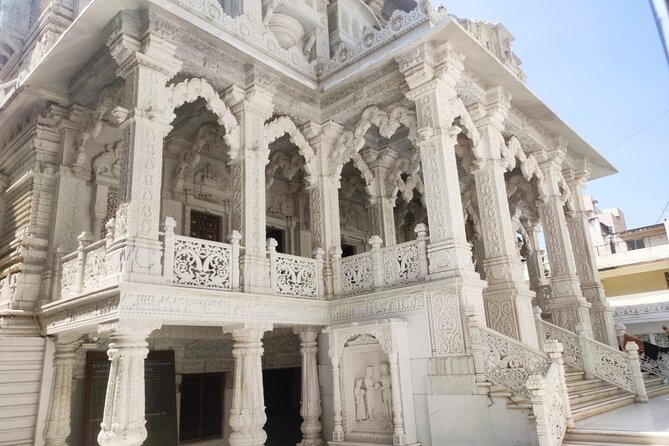
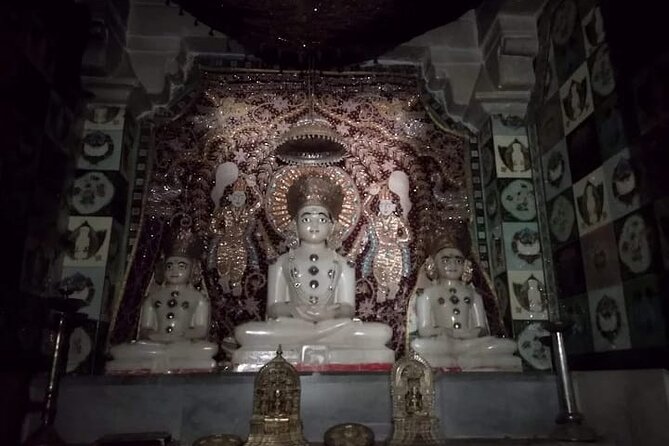
Jainism originated in India and has a history of at least 2,500 years. Its central principles include non-violence and vegetarian discipline. The temple gives the walk a quieter, more reflective ending after the market’s noise and motion.
You need covered shoulders and legs here. Women should carry a scarf, since one may be required. An extra pair of socks can again be useful if you need to remove footwear or prefer not to walk barefoot.
The temple is listed as a 30-minute stop with no separate admission fee. Access remains subject to opening hours and seasonal variation. The temple is especially worthwhile because it broadens the religious picture of the walk. You see Hindu worship at Kote Venkataramana Temple, then encounter Jain traditions in a different setting.
The end point near Chickpet Metro Station makes the route practical. It is not a forced return to the beginning, so you can continue to another part of Bengaluru, return by metro, or arrange a pickup.
The guides are part of the value
The experience uses India-approved, licensed guides, with French, Italian, and German available depending on schedule. Several guide names appear in the supplied details: Vijay, Vanaja, Raghu, Vasuki, Varun, Phaneesh, Govinda, Ramesh, and Ramakrishna Aithal.
The strongest pattern is not a single personality but the kind of help the guides provide. Vijay is noted for history, practical advice, photographs, coffee, and assistance with the metro. Varun has adjusted arrangements when a participant was unwell and tailored the walk to personal interests. Raghu has paused when someone needed a break and offered tea. Vasuki is described as attentive and careful with the group’s pace.
Those details matter because the route is not only about facts. You need someone who can explain a temple respectfully, guide you through the market, and help when the streets become confusing. A guide can also suggest places for lunch, silk, souvenirs, or other Bengaluru sights afterward.
The tour is suitable for a solo visitor as well. One woman traveling alone felt safe and received help getting to an Uber after the walk. That does not remove the need for normal city awareness, but it shows the practical value of having a local escort through this particular area.
Timing, transport, and physical demands
The walk starts at Tipu Sultan’s Summer Palace and ends at Shri Adinath Jain Shwetamber Mandir near Chickpet Metro Station. Lunch and transport are not included. You can ask about hotel pickup and return, which may be available for a small additional fee.
The route is near public transportation, but you should tell the operator where you are staying in Bengaluru. That allows them to explain whether a paid transfer is possible and helps avoid confusion on the day.
Choose a morning departure if you want a better chance of entering the Hindu temple and prefer cooler conditions with fewer people. Afternoon departures can still work, but the temple may be closed, and the market can feel more tiring.
You need a moderate level of fitness. The walk is not presented as an extreme hike, but the combination of standing, walking, crowds, heat, and market surfaces adds up. Wear comfortable shoes, bring water, dress for temple access, and keep a scarf and spare socks in your day bag.
Because the group maximum is 10, the guide can usually keep the pace manageable. Still, tell the guide if you need a pause. The route covers five stops, so it is better to slow down briefly than to lose energy before the market and Jain temple.
Is $33.55 good value?
At $33.55, this is not the cheapest way to see one Bengaluru monument. It is a fair price for a guided half-day route that combines five distinct places and includes monument entry.
I see the best value in three areas. First, you get a clear introduction to the old city without having to plan the sequence yourself. Second, you receive help in KR Market, where finding the flower section and moving through the streets can be difficult alone. Third, the guide can answer practical questions about metro travel, lunch, shopping, silk, and souvenirs after the formal walk ends.
The value drops if you only want architectural photography. The stops are timed at roughly 30 minutes each, and the market is active rather than relaxed. You are buying variety and local orientation, not a slow specialist tour of Tipu’s palace or Jain art.
Tips are not included, and lunch and transport cost extra. Entry fees are included at the monuments. Free cancellation is available when you cancel at least 24 hours before the start time. Changes or cancellations inside that window are not accepted for a refund.
Who should book this walk?
I would choose this for a first visit to Bengaluru, especially if you have limited time and want a strong introduction to the historic center. It suits solo visitors, couples, and small groups who prefer a local guide to help with history, religious etiquette, and busy streets.
It is also a good choice for people who want more than monuments. The palace and fort give you historical structure, while the temple visits and KR Market show how culture and commerce still operate in the same old district.
You may want another type of tour if you have limited mobility, dislike crowds, or need a slow pace. The route requires moderate fitness and includes a busy market. You should also skip it if you are unwilling to follow temple clothing rules.
Should you book the Bengaluru Pété Walk?
Book it if you want to feel Bengaluru’s old center rather than simply photograph it. The strongest reasons are the flower market, the contrast between palace and temples, and the help of guides who can make a crowded district easier to understand and navigate.
Choose a morning departure when possible. Wear covered clothing, bring a scarf and spare socks, carry a mask for the market if you prefer, and leave room in your schedule for a metro ride or lunch afterward. For a compact, varied introduction to central Bengaluru, this walk makes a sensible choice.
FAQ
How long does the Bengaluru Pété Walk last?
The walk lasts approximately two hours and 30 minutes to three hours.
Where does the tour begin?
It begins at Tipu Sultan’s Summer Palace, 42 Tippu Sultan Palace Road, Kamalanagar, Chamrajpet, Bengaluru.
Where does the tour end?
It ends at Shri Adinath Jain Shwetamber Mandir on Chickpet Road, near Chickpet Metro Station.
What places are included?
The route includes Tipu Sultan’s Summer Palace, Kote Venkataramana Temple, Bangalore Fort, Sri Krishnarajendra Market, and Shri Adinath Jain Shwetamber Mandir.
Is admission included?
Yes. Entry fees at all monuments are included. The Hindu and Jain temples do not list a separate admission charge.
What should I wear?
Your legs and shoulders should be covered for the temples. Women should carry a scarf because one may be required at the Jain temple.
Is transport included?
No. Lunch and transport are not included. Hotel pickup and return may be available for a small additional fee, depending on where you stay in Bengaluru.
How many people can join the tour?
The group can have a maximum of 10 participants.
Can I cancel for a refund?
You can cancel at least 24 hours before the start time for a full refund. Cancellations or changes made less than 24 hours before the start time are not accepted for a refund.
Fresh palace tours around Bangalore
- Story of Mysore Silk tour from Bangalore to experience Silk Weaving & Palace★ 5.0 · 28 reviews
- Lalbagh+Bull Temple+Tipu Palace+Market+Lunch=Bangalore City Tour★ 5.0 · 9 reviews
- 2 Day Bandipur Safari and Mysore Palace Tour★ 4.5 · 4 reviews
- Private Tour: Bangalore City Tour Including LalBagh & Tipu Palace★ 4.0 · 4 reviews
- Bangalore Walking Tour KR Flower Market,Fort,Tippu palace★ 5.0 · 8 reviews
- Bangalore City Tour: Lalbagh, Tipu Palace & Bull Temple★ 4.4 · 3 reviews
- Bangalore City Tour: Walking, Palace & Temples★ 3.6 · 7 reviews
- Private Tour: Mysore Palace and Srirangapatna Day Trip from Bangalore★ 4.5 · 13 reviews
India Palace Tours: the shortlist.
Jaipur Guided City Tour: City Palace, Jantar, Hawa & Jal Mahal
Read our review →
Full-Day Jaipur City Tour with Amber Fort and City Palace
Read our review →
Bangalore: Palace, Temples, Fort & Markets Walking Tour
Read our review →
Old Bangalore Historical Walk thro Palace, Temples, Fort & Market
Read our review →
Bangalore: Walking Tour of Fort, Palaces, and Market
Read our review →
2-Day Private Tour of Jaipur from Delhi: City Palace, Hawa Mahal and Amber Fort
Read our review →
Story of Mysore Silk tour from Bangalore to experience Silk Weaving & Palace
Read our review →
Elephant Activities Feed, Paint & Ride with Pickup
Read our review →This visit also appears in