

Review · PALACES WORLDWIDE
Walking Tour of Split and Diocletian’s Palace
Split’s old center is not a museum set apart from daily life. It is a living city built inside and around Diocletian’s Palace, where laundry, cafés, shops, churches, and homes share space with Roman stone. This 90-minute walk gives you the basic map and story without asking you to spend half a day indoors.
I like the route for two clear reasons: it covers the palace’s major public spaces and then moves beyond the Roman walls to the Riva, Fruit’s Square, and Split’s Jewish quarter. I also like the range of guides, including Antonella, Anton, Mario, Marino, and Maggie, who are described as warm, funny, and strong storytellers. The main concern is sound. Without headsets, a larger group or noisy square can make a soft-spoken guide hard to hear.
Key points at a glance
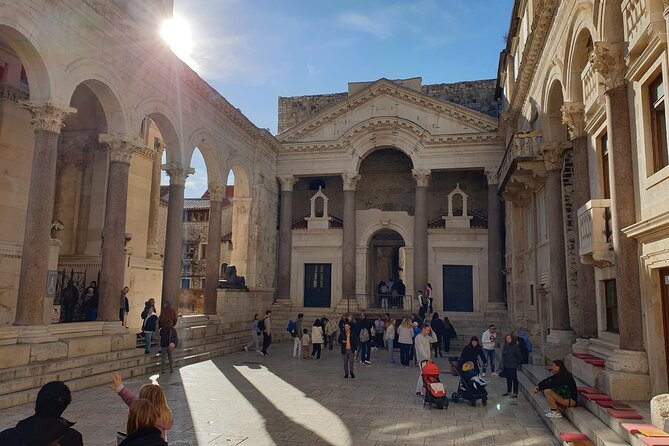
- The Peristyle is your starting map: Begin at the palace’s central square, the best place to understand how the old complex fits together.
- The tour links Roman and later Split: You move from Diocletian’s imperial rooms to Venetian defenses, Croatian literature, the Riva, and the city’s Jewish past.
- The palace substructures are only partly included: You see the lower level, but the museum section requires a separate admission.
- The guide makes the difference: Antonella, Anton, Mario, Marino, and Maggie are among the guides praised for humor, passion, and clear explanations.
- Expect steps and uneven surfaces: This is a walking tour through an old complex, not a smooth, fully accessible promenade.
- The price covers guiding, not tickets: At $48.37 per person, the value depends on how much context you want and whether you plan to visit paid areas afterward.
Why this short walk works in Split
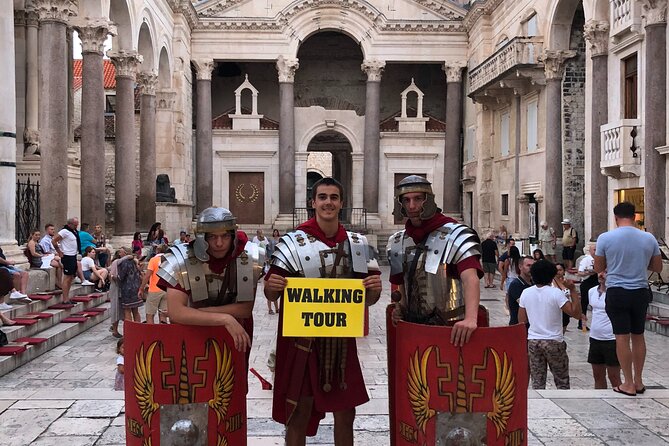
At first glance, Split can feel confusing. Roman walls meet medieval lanes, an Egyptian sphinx sits near a Christian cathedral, and modern cafés occupy spaces built for an emperor. You can wander alone and enjoy the atmosphere, but the details make more sense when someone explains how the palace changed over the centuries.
This tour is designed as an introduction rather than a complete archaeological visit. You walk through the main palace area, hear how its spaces worked, and then step into the wider historic center. That makes it particularly useful at the start of a stay, when you want a mental map before choosing which museums, towers, churches, or waterfront spots deserve more time.
The route is offered in English, with several departure times. The advertised maximum is 20 people. That is not a truly private experience, and the open squares of Split can be noisy, but it is still more manageable than a large city tour when the group stays near the stated limit.
More Diocletian's Palace Tours around Split:
- Split: Old Town and Diocletian Palace Walking Tour
★ 4.9 · 4,727 reviews - Split & Diocletian’s Palace Walking Tour
★ 5.0 · 1,125 reviews - Split: Diocletian Palace & Old Town Guided Walking Tour
★ 4.7 · 882 reviews
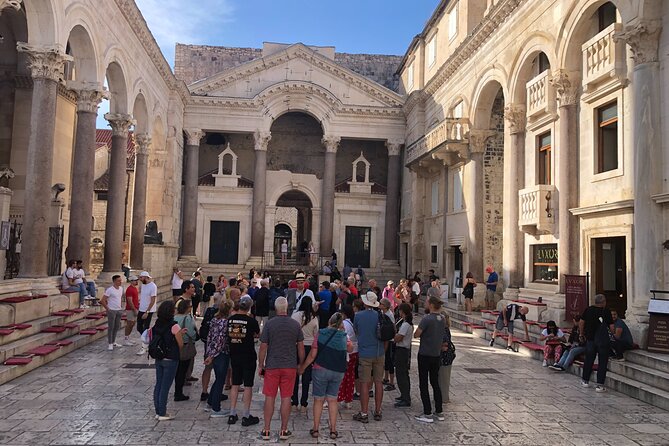
The Peristyle: Split’s great Roman stage
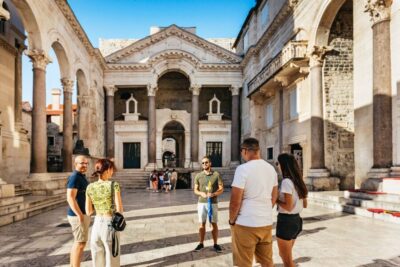
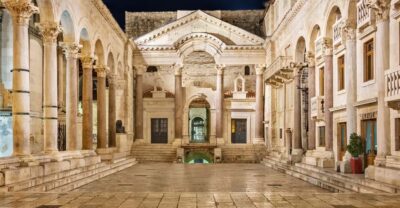
The tour begins on Peristil, the central square of Diocletian’s Palace. This is the right place to start because several important routes meet here, and you can reach much of the palace from this point.
Give yourself time to look upward and around before the explanation begins. The square brings together Roman columns, later stonework, religious buildings, and the steady movement of modern Split. Your guide uses this space to explain the palace’s layout and the role it played in the emperor’s retirement years.
The stop lasts about 15 minutes and is free to enter. That matters because the Peristyle gives you the strongest visual introduction without requiring a ticket. It also gives you a reference point for the rest of the walk. After the tour, you can return here and recognize the routes that first seemed tangled.
The drawback is sound. Several tour groups may gather in the same square, and a guide without a microphone can be difficult to follow. Stay close, especially if your guide speaks softly. This is one place where arriving early and positioning yourself near the guide will improve the experience.
The Vestibule and the sound of Dalmatia
From the Peristyle, you continue to the Vestibule, the former entrance area associated with Emperor Diocletian. The stop is brief, about five minutes, but the space has a distinct shape and atmosphere.
The guide explains the Vestibule’s role and its place within the palace plan. You might also hear traditional Dalmatian singing here. The acoustics make this a memorable moment when conditions are right, though the experience is not guaranteed and depends on what is happening at the time of your visit.
This is a good example of why a guide helps. On your own, you may notice the unusual room but miss how it connected the emperor’s formal quarters with the rest of the complex. The stop is short, so listen closely before the group moves on.
The substructures: seeing the palace from below
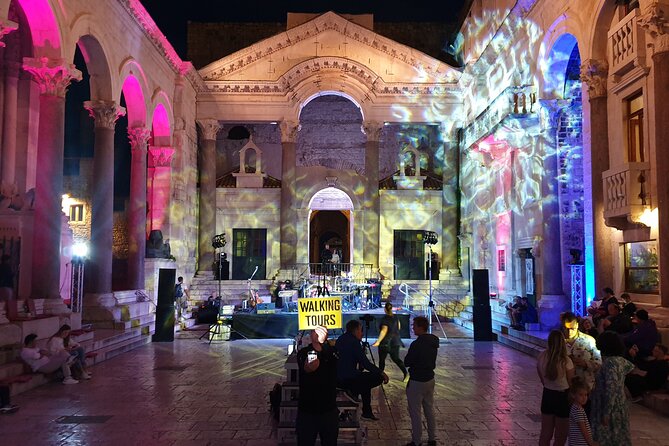
The palace substructures are among the most useful stops because they show how the upper rooms were supported. Your guide discusses their construction and how these lower spaces were used over time.
The tour does not include the museum section of the substructures. You may visit that paid area separately after the walk, but no admission tickets are included in the tour price. This distinction is important when you compare the $48.37 cost with other options.
The lower level can also mean steps and uneven surfaces. The physical demands are not extreme for most people, but the activity is not recommended if high steps are a serious problem for you. Wear shoes that handle worn stone comfortably.
The short stop gives you an overview rather than a full archaeological examination. If underground architecture is a major interest, plan extra time and budget for the museum section after the tour. If you mainly want to understand the palace’s structure, this introduction may be enough.
More Palace Walking Tours around Split:
- Diocletian’s Palace and Old Town SMALL GROUP Walking Tour
★ 5.0 · 502 reviews - Split: 1.5-Hour Walking Tour and Diocletian’s Palace
★ 4.7 · 256 reviews - Split and Diocletian’s Palace walking tour with a local guid
★ 4.9 · 36 reviews - Split: Private Walking Tour with Diocletian’s Palace
★ 5.0 · 30 reviews
The Golden Gate and Gregory of Nin
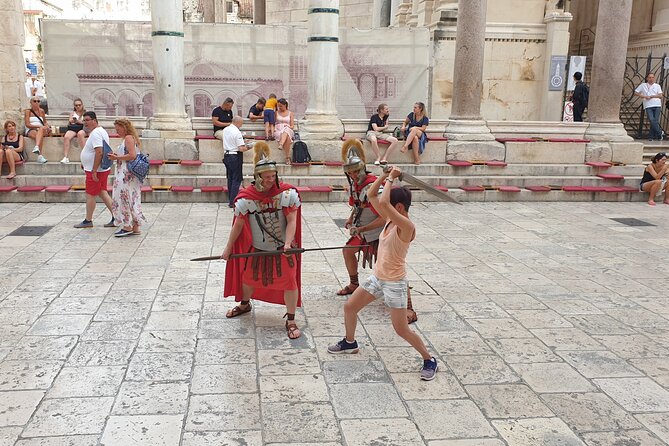
The Golden Gate was the palace’s main entrance, and the tour uses it to explain how people entered the imperial complex. The scale of the gate helps you picture the palace as a fortified residence rather than simply a collection of picturesque lanes.
You also see the statue of Gregory of Nin and learn why he matters to Croatian history and language. This adds a later national and cultural layer to the Roman story. The palace is not only about Diocletian. Its meaning has shifted with each period of Split’s past.
The stop takes about 10 minutes and is free. It is also a useful orientation point if you plan to explore on your own afterward. From here, you can better understand how the palace’s walls relate to the surrounding city.
As with the Peristyle, the gate can be crowded and noisy. Stand where you have a clear view of both the guide and the statue. If your guide is giving a detailed explanation, do not drift too far toward the edge of the group.
The Riva: from palace wall to waterfront life

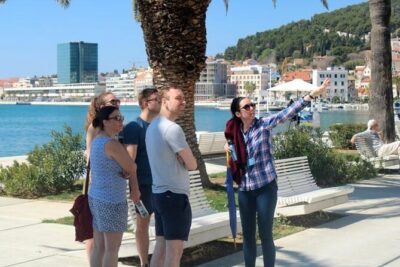
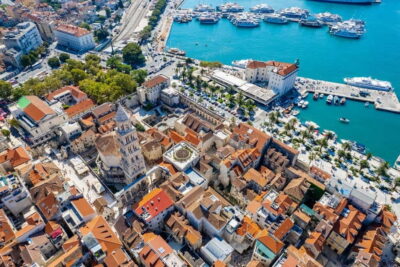
The walk then reaches Split’s Riva Harbor, the broad waterfront promenade. Here you see a bronze model of Diocletian’s Palace and hear about the history of the Riva.
This is a welcome change of setting after the narrow stone passages inside the palace. The model can help you understand the overall shape of the complex, especially after seeing individual gates and rooms from ground level.
The Riva also shows how Split functions today. You are no longer looking only at Roman remains. The waterfront is part of the city’s daily social life, and the contrast helps explain why Split feels lived in rather than preserved behind glass.
The stop lasts about 15 minutes. It is one of the more relaxed parts of the route, though the open space can expose you to sun and general waterfront noise. The guide’s explanation is the main reason to stay close.
Fruit’s Square and the Venetian chapter
Fruit’s Square, officially Trg Braće Radić, brings you into another period of Split’s story. You learn about the 15th-century Venetian citadel and the importance of Marko Marulić, often called the father of Croatian literature.
This stop is valuable because it moves the tour beyond the Roman emperor. You see how later rulers shaped the city and how Croatian cultural identity developed within this Adriatic setting.
The square is a compact place to pause and look at the surrounding architecture. The explanation connects military history with literature, giving you a broader sense of Split than a palace-only walk would provide.
The stop lasts about 10 minutes. It is also a good point to ask questions, particularly if you want help deciding what to see next. Guides such as Antonella and Anton are praised for answering questions and adding personal insight beyond a list of dates.
Split Synagogue and a less visible part of the city
The final listed stop is the 16th-century Split Synagogue. The tour passes by and explains the history of the Jewish community in Split.
This is a brief outside visit, not a full synagogue tour. Admission is not included, and the information provided focuses on the place within the city’s wider story. It is an important reminder that Split’s past includes communities and traditions that are easy to miss if you focus only on Roman monuments and waterfront views.
The stop rounds out the walk well. You have moved from an emperor’s palace to medieval and Venetian Split, Croatian literature, the modern harbor, and the city’s Jewish history. That range is one of the tour’s strongest features.
Guides, group size, and the sound problem
The guide is the heart of this experience. Some guides who have led the walk include Antonella, Anton, Mario, Marino, and Maggie. The strongest descriptions focus on humor, passion, clear English, and the ability to make dates and political changes easier to follow.
A guide with a teacher’s background can be especially effective here. Split’s story is complicated, and the best explanations connect Roman construction with later changes rather than treating each monument as an isolated stop.
Still, the guide quality can vary. One or two accounts describe soft speech, unclear English, or a talk that wandered away from the palace. One guide was also described as spending too much time on subjects unrelated to the tour. That does not define the experience, but it is a fair reason to keep expectations practical.
The bigger issue is audio. Several tour groups may operate in the same areas, and no headsets are provided. If hearing every word matters to you, stay near the front and ask the guide to repeat anything you miss. A group close to 20 can feel quite different from a small family group of four.
Is $48.37 a fair price?
At $48.37 per person, this is not the cheapest way to walk around Split. The price pays for a guided introduction, but it does not cover admission to paid sections of the palace.
I see the value in booking it if you have one day in Split, are arriving by cruise, or want the city’s main story explained quickly. A good guide can save you from wandering past important details and can show you how the Roman, Venetian, Croatian, Jewish, and modern parts of the city connect.
The value is weaker if you prefer independent wandering or plan to spend several hours visiting paid palace sites. In that case, you may want to compare the cost of a shorter orientation with the separate admission fees you already expect to pay.
Group discounts are available, though the exact savings are not specified. Confirmation arrives at booking, and free cancellation is allowed up to 24 hours before the start time. Within 24 hours, cancellation changes are not accepted and the payment is not refunded.
Who should book this Split walk?
I would choose this tour for a first visit, a short port call, or anyone who wants a clear starting point before exploring alone. It suits people who enjoy history told through places rather than a formal museum lecture.
It is also a good fit for families and mixed-age groups, provided everyone can manage steps and uneven stone. Service animals are allowed, public transportation is nearby, and most people can take part.
I would be more cautious if you need a fully accessible route, want guaranteed entry to the palace museum, or find it frustrating to follow a guide in a noisy crowd. You should also think twice if you need every explanation delivered through a headset.
FAQ
Where does the walking tour begin?
The tour begins on Peristil ulica, at Peristil in Split, Croatia.
Where does the tour end?
The activity ends back at the meeting point.
How long does the tour last?
The stated duration is approximately 1 hour and 30 minutes. One account describes a tour lasting less than that, while another reported a much longer experience, so the timing may vary by guide and circumstances.
What language is the tour offered in?
The tour is offered in English.
What is included in the tour price?
The price includes an educated guide who explains the sites around Diocletian’s Palace.
Are admission tickets included?
No. Admission tickets are not included.
Can I visit the palace substructures?
The tour passes through the substructures and explains their construction and uses. The museum section of the substructures is not included, but you can visit it separately after the tour.
How large can the group be?
The maximum group size is 20 people.
Is the tour suitable for people with mobility concerns?
Most people can participate, but the tour is not recommended for people who have difficulty with high steps. Uneven surfaces are part of the historic setting.
What is the cancellation policy?
You can cancel up to 24 hours before the local start time for a full refund. Cancellations or changes made less than 24 hours before the start time are not refunded or accepted.
Should you book it?
Book this walk if you want a fast, guided introduction to Split’s layered past, especially at the start of your visit. The route covers the palace’s essential spaces and adds the Riva, Fruit’s Square, Marko Marulić, and the Split Synagogue, which gives you more context than a palace-only stroll.
The main tradeoff is clear: you pay $48.37 for the guide, not for entry to the paid palace sections, and you may need to work to hear the commentary in crowded squares. Stay close, choose a time that fits your schedule, and treat the walk as your orientation to Split rather than the final word on Diocletian’s Palace. For most first-time visitors, that is a useful way to begin.
Fresh palace tours around Split
- Split: Private Walking Tour and Diocletian’s Palace★ 5.0 · 3 reviews
- Split: Diocletian’s Palace Private walking tour★ 5.0 · 3 reviews
- Split: Diocletian’s Palace Virtual Reality Experience★ 4.4 · 308 reviews
- Split: Jewish Heritage & Diocletian’s Palace Walking Tour★ 5.0 · 3 reviews
- Split and Diocletian’s Palace walking tour with a local guid★ 4.9 · 36 reviews
- Split: 1.5-Hour Walking Tour and Diocletian’s Palace★ 4.7 · 256 reviews
- Split: Private Walking Tour with Diocletian’s Palace★ 5.0 · 30 reviews
- Split: Old Town and Diocletian’s Palace Walking Tour★ 3.3 · 3 reviews
Diocletian's Palace Tours: the shortlist.

Game of Thrones Tour with Diocletian’s Palace Cellar
Read our review →
Essential Diocletian’s Palace Tour for First-Time Visitors
Read our review →
Split and Diocletian’s Palace walking tour with a local guid
Read our review →This visit also appears in