
Review · PALACES WORLDWIDE
Essential Diocletian’s Palace Tour for First-Time Visitors
Diocletian’s Palace is not a quiet monument sealed behind museum doors. It is the living center of Split, with homes, cafés, shops, churches, and alleyways built into the remains of a Roman emperor’s retirement palace. This 90-minute small-group tour helps you make sense of that wonderfully confusing mix. I especially like Jelena’s clear storytelling and the way she links ancient events to daily life in modern Split. The group selfie beneath the Vestibule dome is a cheerful extra, not just another date-and-name history stop.
The main consideration is scope. You see the essential sights and get a guided look at the cellars, but you do not enter the Cathedral’s interior or mausoleum, and the tour does not include the museum section of the substructures or the bell tower. If you want a full archaeological visit, plan extra time and admission costs separately.
Key points at a glance

- Roman palace turned city center: Walk through the Golden Gate, Peristyle, Vestibule, cellars, and other spaces still woven into Split’s daily life.
- Jelena’s approachable style: Expect history, humor, clear answers, and useful context about present-day Split.
- Small group of up to 10: The size makes questions easier and avoids the feel of a large crowd.
- A practical first look: The route covers major landmarks without asking you to commit half a day.
- Local help after the walk: You receive personalized suggestions for food, sights, and local experiences, plus access to restaurant and bar vouchers.
- Important limits: Cathedral interiors, the bell tower, and the museum part of the substructures are not included.
Why this tour works well on your first morning in Split
The best city walks give you a mental map before you start exploring on your own. This one does that by moving from the palace’s northern entrance through its central spaces, then out toward the Riva waterfront. You learn what belongs to Roman Split, what was added later, and how people still use the old buildings today.
That matters here because Diocletian’s Palace can feel like a maze. A narrow lane may lead to an ancient wall, a medieval square, or a modern restaurant occupying a former palace room. Without context, you can appreciate the stone but miss the story. Jelena’s job is to connect the pieces.
She also brings a regional point of view. Originally from Bosnia and Herzegovina and resident in Split for many years, she can place the city within the wider Balkans rather than treating it as an isolated Adriatic postcard. That wider view is useful if you want more than dates and architectural labels.
The tour is conducted in English and is limited to 10 people. That is a meaningful advantage. You can ask about the palace layout, local customs, or what to see next without trying to catch a guide’s attention across a group of 30 or more.
More Diocletian's Palace Tours around Split:
- Split: Old Town and Diocletian Palace Walking Tour
★ 4.9 · 4,727 reviews - Walking Tour of Split and Diocletian’s Palace
★ 5.0 · 2,588 reviews - Split & Diocletian’s Palace Walking Tour
★ 5.0 · 1,125 reviews
Starting beside Gregory of Nin and the Golden Gate
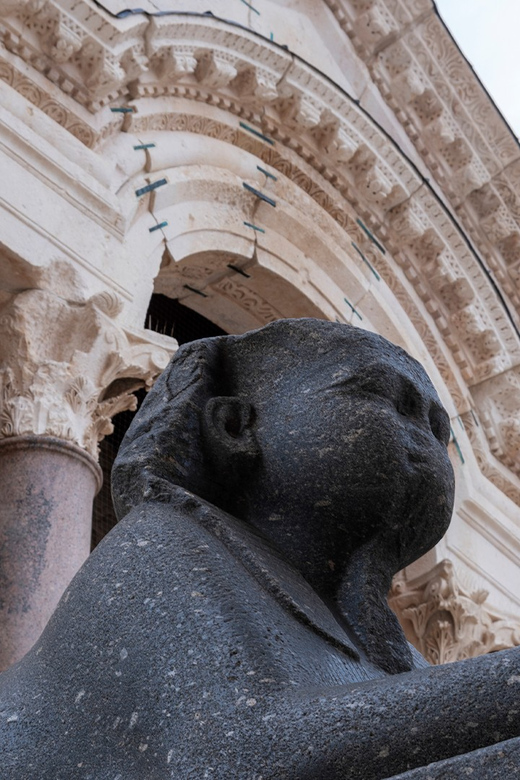
Meet in front of the large statue of Bishop Gregory of Nin, beside the north entrance to the palace. Look for the black umbrella. The meeting point is easy to identify once you know what you are seeking, but the old town can be busy, so arrive with enough time to locate the statue rather than searching at the last minute.
The statue itself is a useful introduction to Split. It gives you a sense of how history, public memory, and local identity overlap in the city. From there, you enter through the Golden Gate, the grand northern entrance to Diocletian’s Palace.
The gate is an excellent first stop because it shows the palace as a fortified imperial residence. Jelena explains the layout and purpose before leading you onward, which helps you understand that this was not simply a decorative villa. It was a planned complex with defensive walls, ceremonial spaces, living quarters, and service areas.
Pjaca and the everyday side of old Split
From the palace area, the route reaches People’s Square, known locally as Pjaca. This is one of the places where Split’s later civic life becomes more visible. The square helps show how the Roman structure became part of a working town rather than remaining frozen in antiquity.
I like this part of the route because it keeps the tour from becoming a procession of ancient stones. You are not only hearing about Emperor Diocletian. You are also getting a sense of how the old center functions now, including its public spaces and social life.
The square can be active, and city noise may occasionally compete with the guide. Jelena’s English is clear and easy to follow, and the small group helps, but this is still a public urban setting rather than a silent museum. If you have trouble hearing in crowded places, stay close to the guide.
Jupiter’s Temple and the palace’s changing beliefs
Jupiter’s Temple offers a compact lesson in how religious buildings can change meaning over time. The stop connects the Roman period with the Christian history that followed, helping you see how Split’s old structures were reused rather than discarded.
This is one of the places where a guide adds real value. On your own, you can admire the proportions and stonework, but it is harder to understand why this small temple matters within the palace plan. Jelena explains its role in a way that keeps the story moving instead of burying you under architectural terms.
The stop is also a reminder that the palace is not a single-period site. Roman, medieval, later European, and modern layers all sit close together. You do not need a specialist background to follow the explanation.
More palaces to tour around Split:
- Split: Diocletian Palace & Old Town Guided Walking Tour
★ 4.7 · 882 reviews - Split Old Town and Diocletian’s Palace Tour
★ 4.8 · 716 reviews - Split: Game of Thrones Tour with Diocletian’s Palace Cellar
★ 4.8 · 545 reviews - Diocletian’s Palace and Old Town SMALL GROUP Walking Tour
★ 5.0 · 502 reviews
Peristyle, the palace’s grand central stage
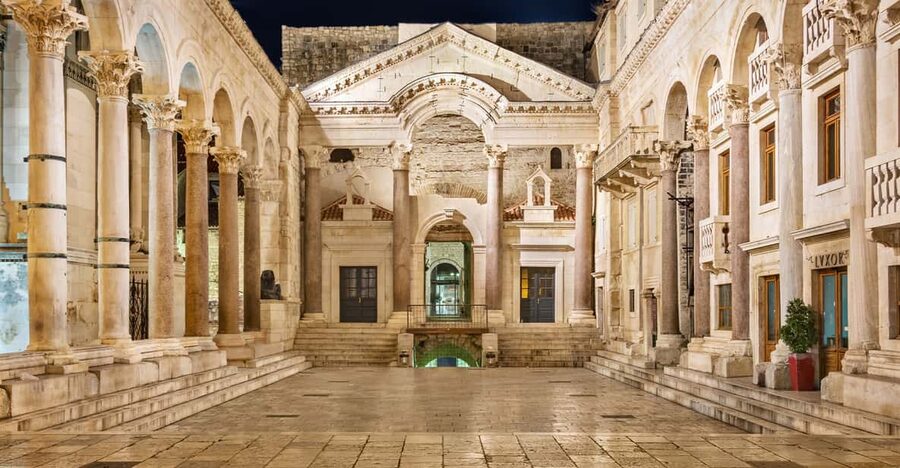
Peristyle is the dramatic center of the route. This open square was designed for imperial ceremony, and its scale and surrounding columns make the original purpose easier to picture. It is also one of Split’s most photographed spaces, so expect people moving through and stopping for pictures.
This is where the tour’s storytelling approach matters most. The space can look like a collection of columns until someone explains how it worked as part of the palace. Jelena gives you the layout and the historical setting, then answers questions about what you are seeing.
The Peristyle can be crowded, especially during the main sightseeing hours. That does not ruin the stop, but it affects how long you can stand in one position and how clearly you can take photographs. Keep your expectations practical: you are visiting the heart of a living city, not an empty ruin.
Saint Domnius Cathedral and the boundary of the tour
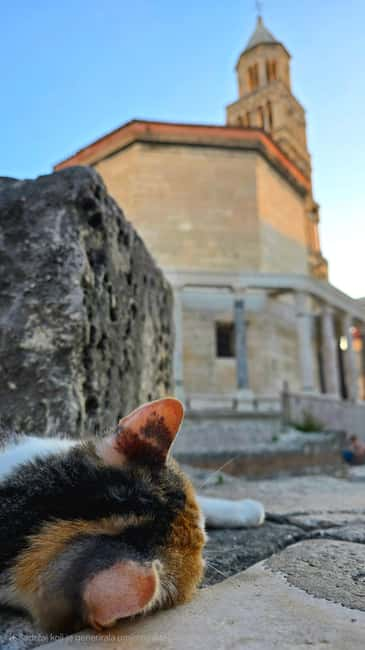
The Cathedral of Saint Domnius is one of Split’s major landmarks and an important part of the palace story. The tour explains the cathedral and its setting from the outside, but it does not include entry into the cathedral’s interior, monastery, or mausoleum.
That distinction is worth knowing before booking. If you specifically want to see the inside, you will need to arrange that separately. The same applies to the bell tower, which is not part of this walking experience.
Even with that limit, the exterior stop is useful because it shows how an imperial mausoleum became part of a Christian cathedral complex. It is another clear example of Split’s buildings being adapted across centuries.
The Vestibule and the promised group selfie
The Vestibule is one of the tour’s most memorable spaces. Its circular form and domed roof create a strong sense of height, and the acoustics add to the effect. This is also where Jelena takes the group selfie.
The photo is a small touch, but it suits the tour’s tone. You get a keepsake from the visit without turning the whole experience into a photo session. It also gives the group a natural pause after the denser historical explanations.
Take a moment to look upward. The Vestibule is easy to rush through because it is compact, but the shape is part of what makes it special. The stop works well for families and younger visitors because it offers a physical, visual change from the more formal explanations at the temple and cathedral.
The cellars, with an important distinction
The route includes Diocletian’s Cellars, also called the palace substructures. These underground spaces help you understand the engineering and layout of the building above. They are among the clearest places to see how the palace was supported and organized.
You should know exactly what is included. The tour provides a guided visit to the cellar area, but it does not include the museum section of the substructures. The experience also does not include separate access to every archaeological area below the palace.
That is not a problem if your goal is a first orientation. The cellars give you a strong sense of the palace’s scale and construction. If underground archaeology is your main reason for visiting Split, plan a separate visit and check current admission details.
Ending on the Riva with useful next steps
The tour finishes on the Riva, Split’s famous waterfront promenade. Ending here makes practical sense. You are near cafés, restaurants, and the next part of your day, rather than being left in an unfamiliar corner of the old town.
This is also when Jelena’s recommendations become especially useful. She provides personalized suggestions about where to eat, what to see, and which local experiences to consider. You also receive access to vouchers for selected Split restaurants and bars, giving the price a little more value if you plan to use them.
Treat the suggestions as a starting point, not a fixed schedule. If you have dietary needs, a short stay, or a specific interest, ask direct questions before the group disperses. The small-group format makes that kind of conversation easier.
How good is the $41 price?
At $41 per person, this is not the cheapest way to walk around Split, but the price is reasonable for a licensed guide, a 90-minute route, and a group capped at 10. You are paying for explanation and orientation, not just access to a monument.
The value is strongest if this is your first visit. A good introduction can save you time later because you learn which parts of the palace deserve a longer look and where to continue exploring. The restaurant and bar vouchers may also add practical value, depending on whether you use them.
The price is less attractive if you already know the palace well or mainly want paid entry to the cathedral, bell tower, or archaeological museum. Those are separate priorities and are not covered here.
A lively guide for history beginners
Jelena’s strongest quality is her ability to make complicated history easy to follow. She uses humor, answers questions patiently, and connects the palace to modern life in Split. That balance matters because a 90-minute history talk can become tiring if it is only a list of rulers and dates.
The feedback attached to this experience repeatedly praises her organization, English, warmth, and ability to keep the group interested. One family specifically noted that even a 13-year-old enjoyed the tour. That is a good sign for mixed-age groups, although no guide can guarantee every child’s attention in a historic center.
You can also expect practical care during the walk. Jelena has been noted for being attentive to water, shade, and bathroom needs. Those details matter in Split’s warmer months, when a short route can still feel tiring under the sun.
Who should book this walk?
I would choose this tour for:
- First-time visitors who want a clear introduction before exploring alone
- Solo visitors who prefer a small social group
- Families seeking a shorter walk with humor and visual highlights
- Cruise or short-stay visitors with limited time
- History beginners who want context without a university lecture
- Visitors who want food and sightseeing suggestions from someone based in Split
I would look elsewhere, or add a separate visit, if you need wheelchair access, want to climb the bell tower, or expect entry into every interior and archaeological section. The tour is explicitly not suitable for wheelchair users, and the historic center contains old surfaces and restricted spaces.
Wear comfortable shoes and bring water. The route is short, but it includes old-town paving, standing stops, and busy public areas. Stay near the guide at the Golden Gate and Riva, where it is easy to lose sight of a small group.
Book it or keep exploring alone?
Book this tour if you want the palace to make sense quickly. The strongest reasons are Jelena’s clear and funny delivery, the small group, the route through the main landmarks, and the useful advice at the end. You get a solid foundation without spending half a day in a formal museum setting.
Skip it if you prefer to read plaques at your own pace or already have detailed knowledge of Split. Also skip it if your main aim is interior access to Saint Domnius Cathedral, the bell tower, or the museum section of the substructures.
For most first-time visitors, I would take it early in a Split stay. The route gives you the city’s basic map, and the recommendations can shape the rest of your time.
FAQ
How long does the tour last?
The tour lasts 90 minutes.
What language is the tour conducted in?
The live guided tour is conducted in English.
How many people can join the group?
The group is limited to 10 participants.
Where is the meeting point?
Meet in front of the large statue of Bishop Gregory of Nin, beside the Golden Gate, the north entrance to Diocletian’s Palace. Look for the guide with a black umbrella.
What sights are included?
The route includes the Golden Gate, People’s Square, Jupiter’s Temple, Peristyle, Cathedral of Saint Domnius, Vestibule, Diocletian’s Cellars, and the Riva promenade.
Does the tour include the inside of Saint Domnius Cathedral?
No. The tour explains the Cathedral of Saint Domnius from outside and does not include the cathedral’s interior, monastery, or mausoleum.
Does the tour include the bell tower?
No. The bell tower is not included.
Does the tour include the museum section of the cellars?
No. You receive a guided visit to the cellar area, but the museum part of the substructures is not included.
Is the tour suitable for wheelchair users?
No. The activity is not suitable for wheelchair users.
Can I cancel for a refund?
Yes. You can cancel up to 24 hours before the tour for a full refund.
Do I have to pay when I book?
No. The reserve-now, pay-later option lets you hold a place without paying immediately.
Fresh palace tours around Split
- Split: Private Walking Tour and Diocletian’s Palace★ 5.0 · 3 reviews
- Split: Diocletian’s Palace Private walking tour★ 5.0 · 3 reviews
- Split: Diocletian’s Palace Virtual Reality Experience★ 4.4 · 308 reviews
- Split: Jewish Heritage & Diocletian’s Palace Walking Tour★ 5.0 · 3 reviews
- Split and Diocletian’s Palace walking tour with a local guid★ 4.9 · 36 reviews
- Split: 1.5-Hour Walking Tour and Diocletian’s Palace★ 4.7 · 256 reviews
- Split: Private Walking Tour with Diocletian’s Palace★ 5.0 · 30 reviews
- Split: Old Town and Diocletian’s Palace Walking Tour★ 3.3 · 3 reviews
Diocletian's Palace Tours: the shortlist.
Walking Tour of Split and Diocletian’s Palace
Read our review →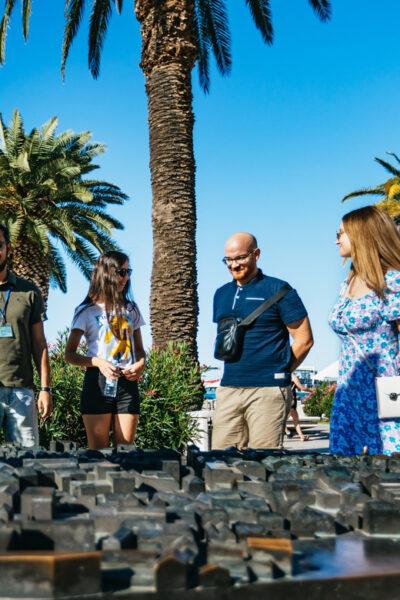
Game of Thrones Tour with Diocletian’s Palace Cellar
Read our review →
Split and Diocletian’s Palace walking tour with a local guid
Read our review →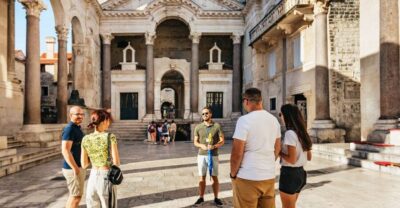
This visit also appears in