
Review · TOKYO
Tokyo: Imperial Palace with Nostalgic Alley Kagurazaka tour
Tokyo’s past comes into focus on this walk, which links the grand stone walls of the Imperial Palace with the narrow lanes of Kagurazaka. You begin at Tokyo Station, pass through the former grounds of Edo Castle, and finish in a district once known for geisha houses and tea houses.
I like the small group of up to eight, which gives you room to ask questions. I also like the route’s unusual second half: after the palace, you visit Tokyo Daijingu and old Kagurazaka lanes that many first-time visitors miss. The main drawback is that this is a walking tour with several outdoor stops, and the inner Imperial Palace is not open to the public.
Key points to know before you book
- Edo Castle is the thread linking the whole walk: Palace walls, Ninomaru Garden, castle ruins, and old gates all fit into one story.
- Kagurazaka brings a different side of Tokyo: Its narrow lanes recall a former entertainment district and now hold local shops and restaurants.
- The English-speaking guides add the context: Hiro and Shuntaro have been praised for answering questions and tailoring the experience to the group.
- Coffee, tea, and a snack are included: The break at Aomi Coffee Kudanshita lasts about 25 minutes, though the snack stop can change with shop opening days.
- The pace is efficient but not effortless: The tour lasts 210 minutes and finishes at a convenience store in Kagurazaka, with comfortable shoes essential.
From Tokyo Station to the heart of Edo
The tour begins outside the Shin-Marunouchi Building, near the cafe called STAND T. Look for the BEAMS sign on the second floor. The Marunouchi Central Exit of Tokyo Station is the closest station exit, about a two-minute walk from the meeting point.
This is a useful starting place because Tokyo Station gives you an immediate sense of the city’s modern scale. The route then turns toward the Imperial Palace, where the glass towers and busy streets give way to moats, walls, gardens, and broad open grounds.
The guide uses this change in scenery to explain the connection between present-day Tokyo and Edo, the city that grew around the Tokugawa Shogunate. You are not simply moving from one photo stop to another. You are learning why this area became the political center of Japan and how the castle grounds shaped the city around them.
You spend about 10 minutes around Tokyo Station for photographs and an introduction. That is long enough to get your bearings without using up too much of the tour’s walking time.
More Royal Palace Tours around Tokyo:
- Tokyo: Imperial Palace and Shogun Historical Walking Tour
★ 5.0 · 2,251 reviews - Tokyo Castle & Imperial PalaceーShogun Walking Tour
★ 4.7 · 1,068 reviews - Tokyo: Imperial Palace Japanese History Walking Tour
★ 4.9 · 987 reviews
Imperial Palace grounds and the scale of Edo Castle
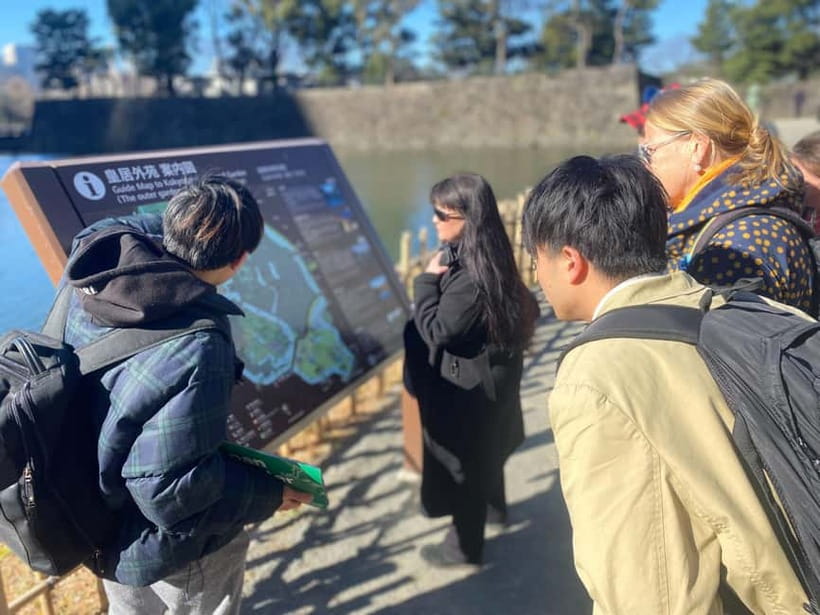
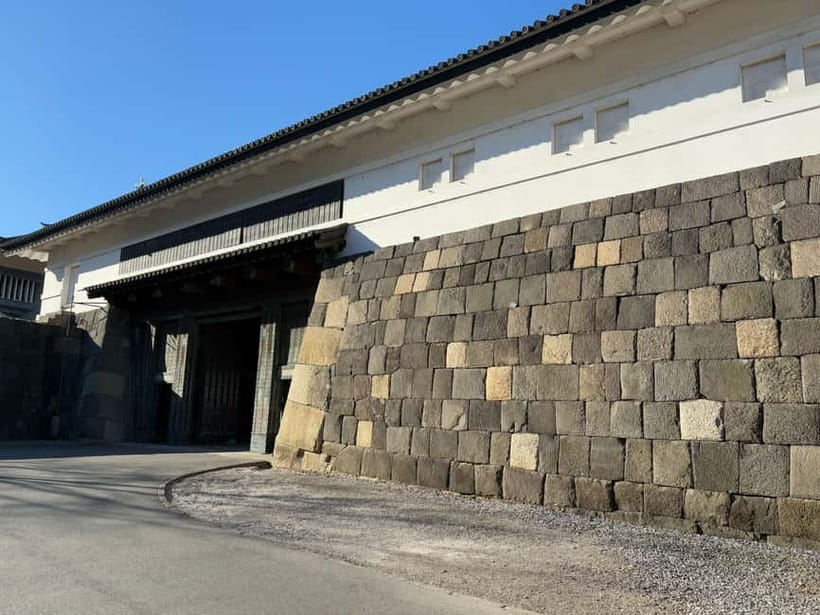
The Imperial Palace portion takes about an hour. It is the main historical section of the tour, with time at the Imperial Palace, Ote-Mon Gate, Ninomaru Garden, and the Edo Castle ruins.
Ote-Mon Gate gives you a clear sense of how carefully the castle was protected. The massive stone construction is one of the most memorable parts of this area, especially when your guide explains that the site was once part of a much larger castle complex.
Ninomaru Garden offers a calmer contrast. The garden setting helps you picture the courtly and political world that existed inside the castle grounds. Your guide can connect the garden, walls, and gates to the lives of the shoguns and the officials who governed Japan from Edo.
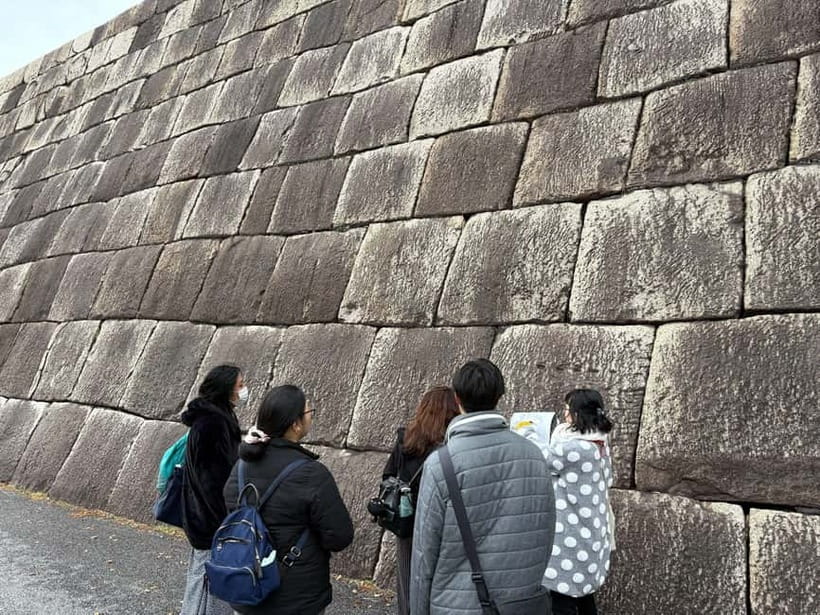
At the Edo Castle ruins, the important detail is scale. There is no fully preserved castle building to enter here, so you should not expect an indoor palace visit or a grand castle interior. Instead, the remains and open grounds help you understand how large and influential the former castle was.
The Imperial Palace itself is still an active imperial site, and the inner palace is not open to the public on this tour. That limitation is worth keeping in mind. You are seeing public areas and historic sections of the grounds, not touring private palace rooms.
The guide makes this part more rewarding than a quick self-guided walk. One of the tour’s stated aims is to explain the Shogun period while you are looking at the walls and gardens. That historical link is the main reason to choose a guided visit instead of simply taking photographs and moving on.
Nippon Budokan and a well-timed coffee break
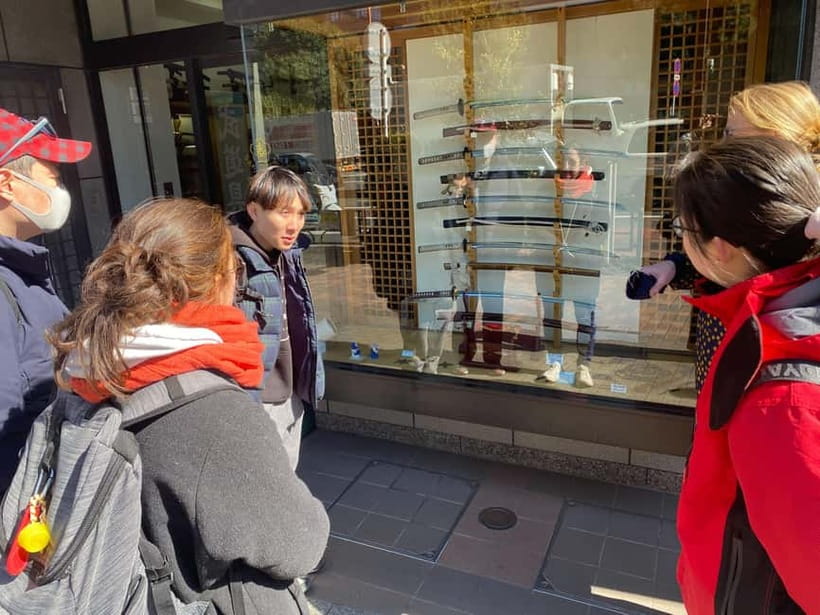
The route continues toward Nippon Budokan, where you stop briefly for photographs and a short explanation. The visit here lasts about five minutes, so think of it as a passing landmark rather than a full visit.
After the palace area, the 25-minute break at Aomi Coffee Kudanshita gives your feet a chance to recover. Coffee or tea is included, and this pause also breaks up the historical walk before the group heads toward Kagurazaka.
I like this pause because the tour covers several hours on foot. It gives you time to sit, ask the guide a question, and reset before the second half. It also makes the schedule feel less like a continuous march from one monument to the next.
The included snack is connected to the local shopping and food stops. The exact shop can change if the planned business is closed or operating on a different day. You should treat the snack as a pleasant part of the outing, not as a guaranteed visit to one particular shop.
Tokyo Daijingu and a quieter shrine visit
Tokyo Daijingu is one of the tour’s more personal stops. The group spends about 20 minutes here, learning about the shrine and its connection with love and good relationships.
This stop changes the tone of the day. The palace section focuses on national power, political history, and the shoguns. Tokyo Daijingu brings you into a more everyday side of Japanese religious life, where visitors come with personal hopes and wishes.
The guide’s role matters here because shrine customs can be easy to overlook if you walk through alone. You receive context for why the site matters and how it fits into local life. The stop is not presented as a long religious ceremony, so it works well for visitors who want cultural background without committing to a separate shrine tour.
The tour then continues toward the remains of Ushigome Gate. Like the Edo Castle ruins, this is a place where the past is visible through traces rather than a complete building. These remains help connect the newer streets of Tokyo with the old castle town that once occupied the area.
More palaces to tour around Tokyo:
- Tokyo: Imperial Palace and Shogun Walking Tour
★ 4.9 · 935 reviews - Tokyo Castle & Imperial PalaceーShogun Walking Tour
★ 5.0 · 724 reviews - Tokyo: Imperial Palace East Gardens Walking Tour
★ 4.8 · 353 reviews - Tokyo: Imperial Palace, Sensō-ji Temple, & Tokyo Tower Tour
★ 4.5 · 339 reviews
Kagurazaka’s old lanes and former geisha district

The final section takes place in Kagurazaka, a neighborhood with a strong local character. Around 200 years ago, this area was known as a red-light district, with tea houses where maiko and geisha performed. Today, traditional-style restaurants, small businesses, and narrow lanes give the neighborhood a different but still distinctive feel.
You visit Geisya Komichi Alley, Hyogo Yokocho Alley, and Kakurenbo Yokocho. Each alley is a short photo and walking stop, so you should expect atmospheric streets rather than major monuments or formal attractions.
These lanes are the tour’s most unusual feature. Asakusa and Shibuya are easier for first-time visitors to find, but they offer a more familiar version of Tokyo’s sightseeing circuit. Kagurazaka gives you a chance to see a neighborhood shaped by older entertainment traditions and local commerce.
The lanes can be narrow and visually subtle. You may not immediately know what you are looking at, which is exactly where the guide helps. A good explanation can turn a simple alley into a lesson about geisha culture, old Tokyo, neighborhood businesses, and the way the former castle city developed.
The route ends at FamilyMart Kagurazaka Sanchome. This is practical because you finish near shops and city streets rather than at an isolated site. The end time can run about 15 minutes late because of traffic or route conditions, so avoid scheduling a tight appointment immediately afterward.
What the guides add to the experience
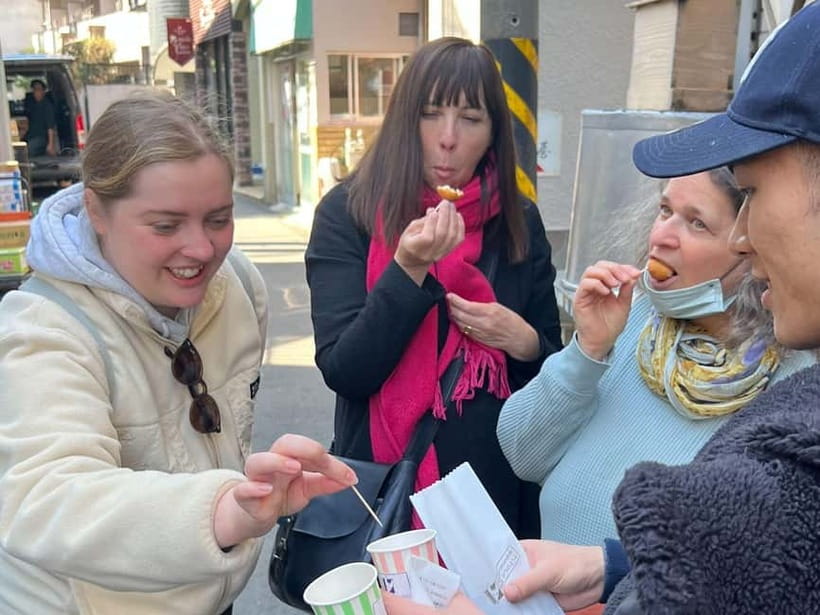
The guide is central to the value here. You are not only being led between well-known points. You are getting the story that connects them.
Hiro has been praised for local knowledge and for offering useful suggestions for exploring more of Tokyo. Shuntaro has been described as fun, well informed, and willing to explain more than the basic stops. Another guide received praise for answering follow-up questions and adapting strongly to the group’s wishes and ideas.
That last point is important for a small-group tour. With only eight participants, you have a better chance of asking about a particular wall, shrine custom, neighborhood detail, or period of Shogun history. The tour is conducted in English, and the guide can shape the amount of explanation around the group’s interests.
You should still be clear about what you want from the walk. If you prefer a silent photo outing with little historical commentary, the guide-led format may feel talk-heavy. If you want to understand what you are seeing, especially around Edo Castle, the explanations are the reason to pay for the tour.
Is $51 a fair price?
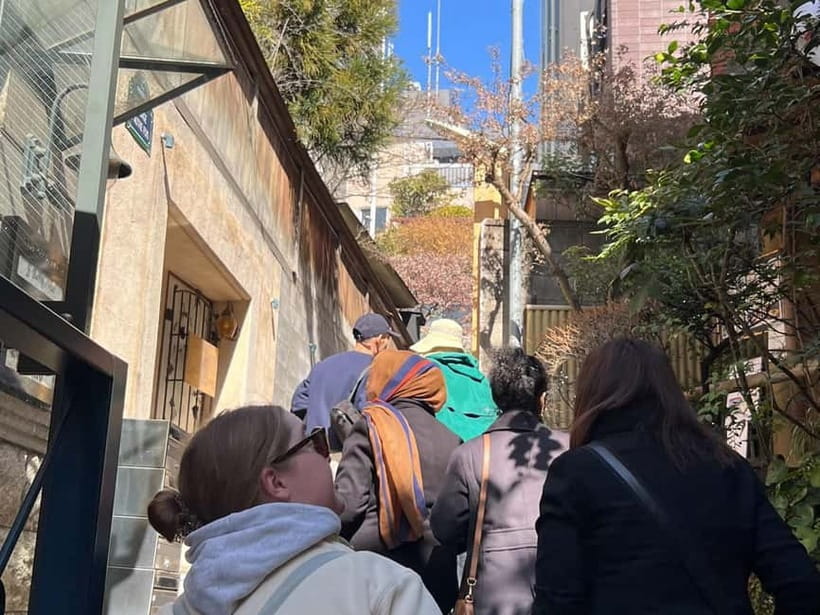
At $51 per person, the tour sits in a sensible range for a 210-minute small-group walking experience in central Tokyo. You are paying for an English-speaking guide, a planned route, coffee or tea, a snack, and the convenience of linking several areas without working out the route yourself.
The value is strongest if you are new to Tokyo or have limited time. In three and a half hours, you cover Tokyo Station, the Imperial Palace grounds, several Edo Castle remains, Tokyo Daijingu, and three Kagurazaka lanes. Doing that independently would be possible, but you would need to research the history and connect the locations on your own.
The price is less compelling if you want a detailed palace interior visit. That is not part of the experience, and the inner palace is closed to the public. You are buying access to a guided outdoor history walk, not entry to private imperial rooms.
The included food and drink are modest additions rather than the main reason to book. The real value is the route and the guide’s interpretation, especially in the less obvious areas around the old castle grounds and Kagurazaka.
Walking demands and practical planning
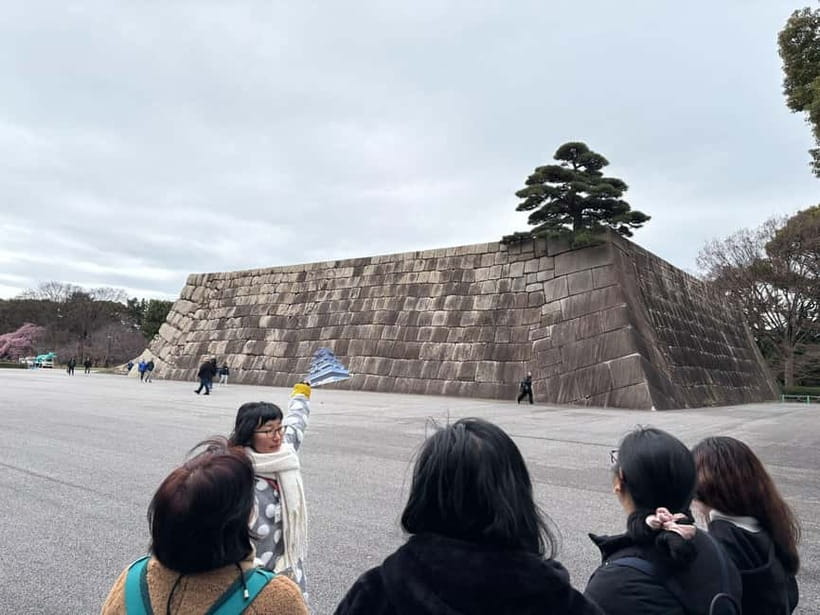
Wear comfortable shoes and clothes. The route includes several outdoor stops, city walking, gardens, historic remains, and narrow back streets. The tour is not suitable for pregnant women, according to the activity information.
Because the experience lasts 210 minutes, plan for a steady half-day outing. The coffee break helps, but it does not remove the need for comfortable footwear. You should also allow an extra 15 minutes at the end in case traffic or route conditions slow the group.
The meeting point deserves careful attention. Start outside Shin-Marunouchi Building, in front of STAND T. The BEAMS sign on the second floor is a useful landmark, and Marunouchi Central Exit is the closest exit from Tokyo Station.
Smoking, drones, alcohol, drugs, weapons, and sharp objects are not allowed. These rules are straightforward, but they matter in a central Tokyo walking setting with historic and religious sites along the way.
Free cancellation is available up to 24 hours before the start time, and you can reserve without paying immediately. Those options help if your Tokyo schedule is still changing.
Who will enjoy this Tokyo walking tour?
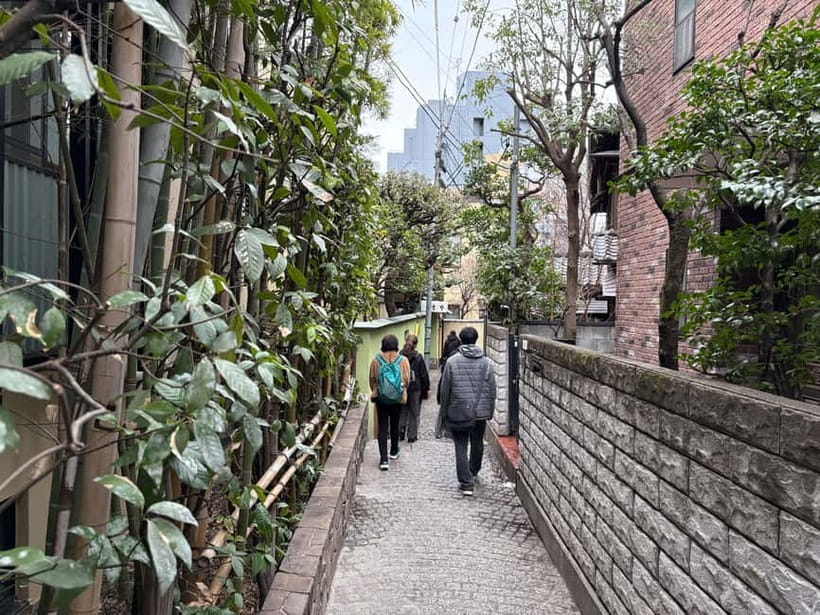
I would choose this for a first or second visit to Tokyo when you want more than the standard Shibuya and Asakusa circuit. It suits anyone interested in Edo, Shogun history, Japanese gardens, shrines, and old neighborhood streets.
It also works well for visitors who want a compact introduction to several connected parts of the city. The small group makes it easier to ask questions, and the guides appear comfortable adding extra detail when participants show interest.
You may want a different activity if you need wheelchair-free, low-walking access, since the route is built around walking and no accessibility details are provided. You should also look elsewhere if your main goal is entering the Imperial Palace or visiting a preserved castle interior.
Should you book the Imperial Palace and Kagurazaka tour?
Book it if you want Tokyo’s history explained as you walk through it. The strongest part is the combination of the Imperial Palace grounds and Kagurazaka’s old lanes. One shows the scale of political power in Edo, while the other gives you a closer look at neighborhood life and former entertainment streets.
The tour is especially useful for visitors who value a guide’s local knowledge. Hiro and Shuntaro are named examples of guides who can make the experience more personal, answer questions, and add suggestions for the rest of your time in Tokyo.
Skip it if you want a slow garden visit, a palace interior, or a food-focused tour. For a balanced half-day route with historical context, a coffee break, a snack, and a less familiar part of Tokyo, $51 is a reasonable price.
FAQ
How long does the Tokyo Imperial Palace and Kagurazaka tour last?
The tour lasts 210 minutes, or three and a half hours. The end can be delayed by about 15 minutes because of traffic or route conditions.
Where does the tour begin?
The meeting point is outside Shin-Marunouchi Building, in front of STAND T cafe. Marunouchi Central Exit at Tokyo Station is the closest exit, and the meeting point is about a two-minute walk away. A BEAMS sign on the second floor helps you identify the building.
Where does the tour finish?
The tour finishes at FamilyMart Kagurazaka Sanchome in the Kagurazaka area.
Is the inner Imperial Palace open during the tour?
No. The tour does not include the inner palace because it is not open to the public. The route visits public areas and historic sites connected with the former Edo Castle grounds.
What is included in the price?
Coffee or tea during a short break, a snack, photo opportunities, and an English-speaking local guide are included.
Is this a small-group tour?
Yes. The group is limited to eight participants, and the tour is conducted in English. Comfortable shoes and clothes are recommended.
Fresh palace tours around Tokyo
- Tokyo: Imperial Palace East Gardens Walking Tour★ 4.8 · 353 reviews
- Tokyo walking tour around Imperial Palace and Tokyo Station★ 5.0 · 3 reviews
- Tokyo: Imperial Palace, the history of Japan (ENGLISH GUIDE)★ 5.0 · 77 reviews
- Tokyo: Pvt. Tour – Edo Castle & Imperial Palace East Gardens★ 4.8 · 63 reviews
- Tokyo: Edo Castle Ruins & Imperial Palace East Garden Tour★ 4.4 · 13 reviews
- Tokyo: Imperial Palace East Gardens and Tokyo Station Tour★ 5.0 · 16 reviews
- Tokyo: Edo Castle & East Garden of the Imperial Palace Tour★ 4.7 · 112 reviews
- Tokyo: Edo Castle and Imperial Palace Guided Walking Tour★ 5.0 · 6 reviews
Royal Palace Tours: the shortlist.


Royal Palace Expert Guided Tour with Skip-the-Line
Read our review →
Dubai To Abu Dhabi: Grand Mosque, Royal Palace & Etihad Towers
Read our review →
Madrid Essential: Historic Center, Plaza Mayor & Royal Palace
Read our review →

Abu Dhabi Day-Trip Grand Mosque, Royal Palace & Lunch
Read our review →
Louvre Entry & Etihad Tower/Royal Palace Options
Read our review →This visit also appears in