
Review · TOKYO
Tokyo: Edo Castle Ruins & Imperial Palace East Garden Tour
Edo Castle was once the seat of Japan’s shoguns, and this tour lets you read that past in stone walls, gates, guardhouses, and garden paths. I like the way it links samurai defense with the later Imperial Palace, rather than treating the site as just another city park. I also like the modest $37 price for a small-group or private option and a full two hours with an English-speaking guide.
The main catch is simple: you do not enter the Imperial Palace buildings or its inner grounds. The tour is best for you if you want history explained as you walk, but it may feel light if you prefer a long, lecture-style account of Japanese politics and palace life.
Key points at a glance
- Otemon Gate sets the scene: You enter through the principal gate area and learn how castle defenses worked.
- Samurai guardhouses survive in place: Doshin Bansho and Hyakunin Bansho make the old security system easier to picture.
- The castle keep is gone, but its scale remains: See the Tenshu-dai and a restoration model for a clearer sense of Edo Castle’s size.
- Wadakura Fountain adds a modern royal link: Your guide explains its connection to a royal wedding before the walk begins.
- Ninomaru Garden slows the pace: The pond, koi, and carefully arranged garden give you a quiet finish.
- Guide quality matters here: Mari and Isao are praised for warmth and patience, but one quiet tour received criticism for offering too little explanation.
What you are really visiting
This is not a palace interior tour. It is a guided walk through the former Edo Castle grounds, now part of the Imperial Palace East Gardens and surrounding public areas.
That distinction matters. The Imperial Family still lives at the palace, so the inner grounds and palace buildings are not open to this experience. You will instead see the remains of the old castle, the gardens, defensive gates, and open spaces where major parts of Edo Castle once stood.
I find that setting more useful than a quick look at a closed palace facade. The surviving walls and gates show how the site functioned. The guide can point out where people passed, where guards waited, and how visitors were controlled before reaching the castle center.
The walk lasts two hours and returns to the Wadakura Free Rest Area. That is enough time to cover the main points without turning the visit into an all-day commitment. You should still expect steady walking and outdoor exposure, with comfortable shoes and water in your bag.
More Palace Gardens and Grounds in Tokyo:
- Tokyo: Imperial Palace East Gardens Walking Tour
★ 4.8 · 353 reviews - Tokyo: Edo Castle & East Garden of the Imperial Palace Tour
★ 4.7 · 112 reviews - Tokyo: Pvt. Tour – Edo Castle & Imperial Palace East Gardens
★ 4.8 · 63 reviews
Meeting at Wadakura Fountain
You meet outside the entrance to the Wadakura Free Rest Area. Look for a guide holding a yellow sign. This detail is useful in a busy central Tokyo area, where a clear meeting point can save several minutes of anxious searching.
The tour begins around Wadakura Fountain National Park. The fountain was built to commemorate a royal wedding, giving your guide an early chance to connect modern Japan with the Imperial family.
You then pause at Wadakura Moat. It is a short stop, but the moat helps you understand that Edo Castle was designed as a defended stronghold, not simply as a residence. Water, gates, guard stations, and controlled routes all worked together.
This opening section is also a good test of the tour’s style. A strong guide will use the fountain and moat to establish the story before you reach the main ruins. A less talkative guide may make these first stops feel like a simple walk from one place to another.
Passing through Otemon Gate
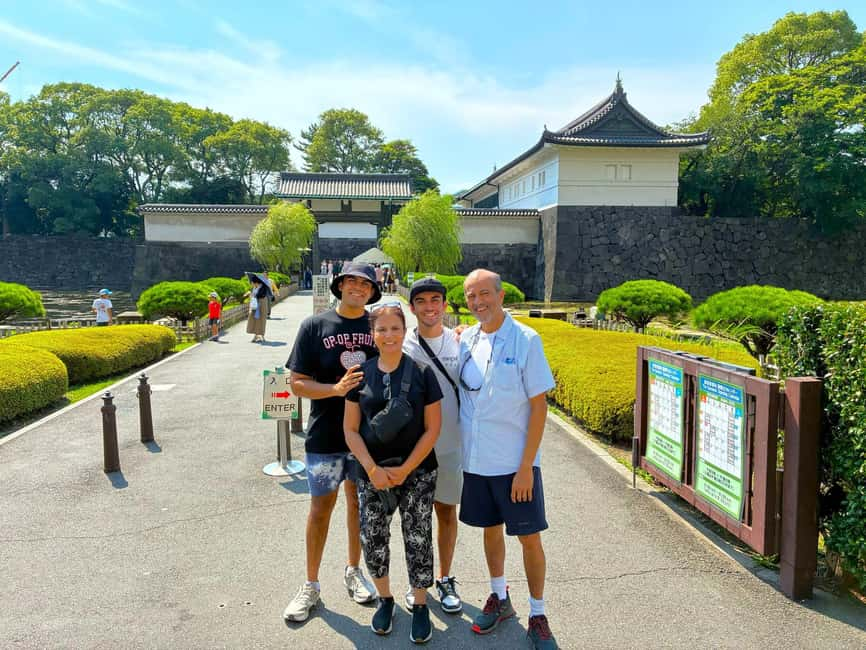
Otemon Gate is the tour’s first major historical stop. It gives you a strong sense of arrival and introduces the layered defenses used at Edo Castle.
The gate area is valuable because it is easy to look at a large entrance and miss its purpose. Your guide explains how castle gates controlled movement and protected the people and buildings beyond them. The story becomes more concrete when you see the route in person instead of only reading about it.
From here, the tour continues to the Ote San-no-mon Gate Ruins. These remains mark another part of the approach into the castle complex. You will not see a complete castle rising above the trees, but the stonework and surviving layout help you imagine how restricted the route once was.
I like this part of the experience because it avoids a common problem with castle ruins: a pile of stones with no explanation. The guide gives those fragments a job and a place in the larger defense system.
Doshin Bansho and Hyakunin Bansho
The Doshin Bansho and Hyakunin Bansho guardhouses are among the most useful stops for understanding daily castle security. They are not flashy buildings, but they make the samurai heritage of the site feel practical.
Doshin Bansho was connected with guards who watched the approach. Hyakunin Bansho, whose name refers to one hundred guards, points to the scale of protection required at a castle of this importance. Your guide explains how these positions fit into the movement toward the inner sections.
For you, the value is in seeing that defense depended on people and procedures as much as thick walls. Guards watched, checked, and controlled access. A castle was a working institution, not just a grand residence for the shogun.
These stops also show why a guide can improve the visit. Without explanation, a guardhouse may look like a plain old structure. With context, it becomes part of a system of rank, caution, and controlled entry.
More Royal Palace Tours around Tokyo:
- Tokyo: Imperial Palace and Shogun Historical Walking Tour
★ 5.0 · 2,251 reviews - Tokyo Castle & Imperial PalaceーShogun Walking Tour
★ 4.7 · 1,068 reviews - Tokyo: Imperial Palace Japanese History Walking Tour
★ 4.9 · 987 reviews - Tokyo: Imperial Palace and Shogun Walking Tour
★ 4.9 · 935 reviews
The open spaces of Edo Castle
The Edo Castle Ruins section gives you a broader view of the old compound. The open spaces can be peaceful today, but they once formed part of the main seat of shogunal power.
You then reach the site of Edo Castle Honmaru, the main hall area. Honmaru was the castle’s central section, so this stop helps place the political heart of the complex within the modern garden setting.
The contrast is one of the best parts of the walk. Tokyo continues around you, yet the former castle center is largely open. You can appreciate the scale of what has disappeared while still seeing the foundations of the site’s importance.
Do not expect a reconstructed palace interior here. The experience is about reading the remains and listening to the explanation. If you want rooms, furnishings, and formal palace ceremonies, this tour will not provide them.
The Tenshu-dai and the castle keep model
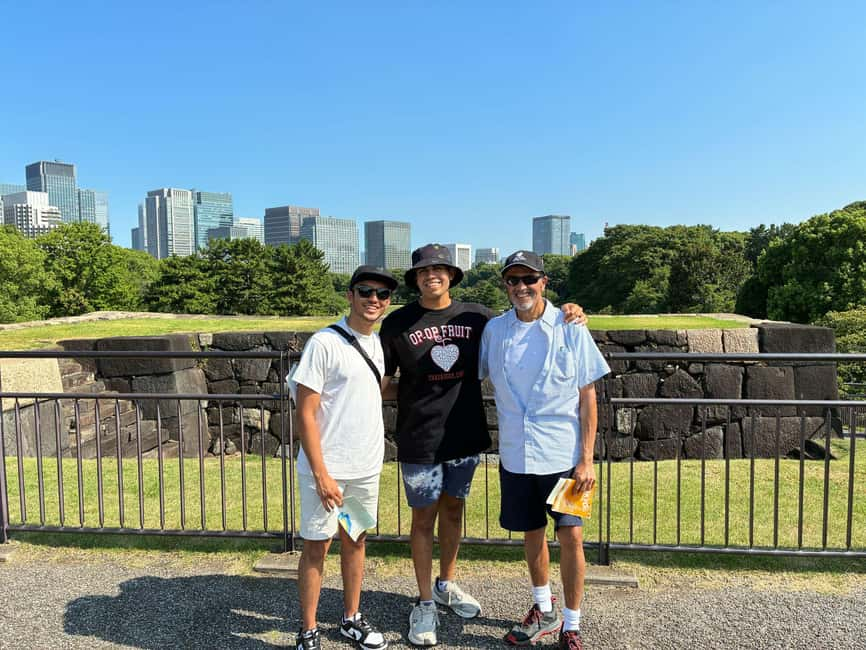
The Tenshu-dai is the stone base connected with Edo Castle’s main keep. From here, you get panoramic views of the surrounding area and a sense of how the castle once dominated its setting.
The keep itself is not standing today. That can disappoint visitors who arrive expecting a complete tower, but the site handles the gap with a castle keep restoration model. The model gives you a more useful visual reference for the structure that once rose above the grounds.
I especially like having both the real base and the model. The base gives you physical scale, while the model supplies the missing shape. Together, they make the ruins easier to understand than either one would alone.
This is also a good point to take photographs. Bring a camera, but remember that flash photography is not allowed. The tour includes a commemorative photo opportunity, giving you a simple record of the visit without adding a separate photo package.
From the prefectural trees to Suwa no Chaya
The route includes a stop identified as 都道府県の木, or the prefectural trees. The name may appear in Japanese on signs, so keeping it in mind helps you recognize the stop as you move through the grounds.
This portion offers a change from gates and stonework. You are looking at the planted setting and the way the garden grounds are organized. Your guide can connect the greenery to the wider design of the East Gardens, though the amount of explanation may depend on who leads your group.
The tour also visits Suwa no Chaya. It adds a traditional architectural note to a route otherwise focused on castle remains, guardhouses, and open lawns. The stop is brief, so treat it as part of the changing scenery rather than a separate tea ceremony or food experience.
Food and drinks are not included. You should carry water, especially in warm or humid weather, since the tour spends much of its time outdoors.
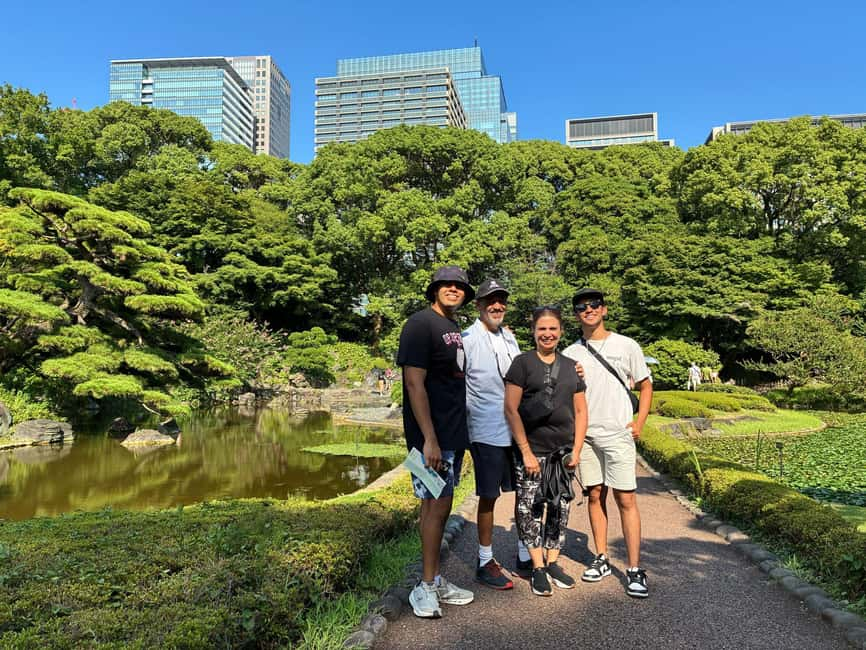
Ninomaru Garden and the koi pond
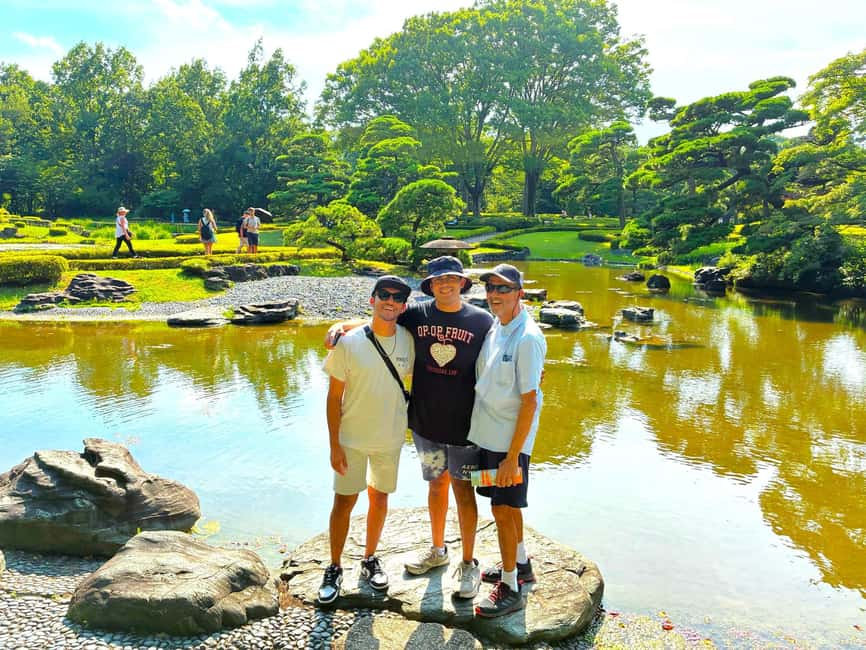
The final major section is Ninomaru Garden, where the pace becomes calmer. Here you can relax beside the pond and watch the koi fish while your guide explains the garden setting.
Ninomaru is a welcome change after the military details of the gates and guardhouses. You move from controlled entrances and castle power to a carefully shaped garden meant for quiet enjoyment.
I like ending here because it gives the two-hour walk a gentle finish. You get history, views, and a little breathing room rather than ending abruptly at a stone wall.
The garden is also where your own pace matters. You may want to stop for photographs or simply look at the pond. A private or small group format should make questions easier, but the stated experience does not promise unlimited time at every stop.
How much history will your guide explain?
Guide quality is important on this tour because the physical remains need interpretation. Some guides have been praised for answering questions patiently and explaining the palace and country with enthusiasm. Mari and Isao are two names connected with especially warm, helpful experiences, and one guide was described as taking extra time with the history.
The feedback is not uniformly positive. One quiet tour was described as little more than a walk through the park, with too few historical explanations. Another assessment suggested the route could be done independently.
That is a fair concern. The East Gardens are accessible to explore on your own, and the route does not include a rare interior or an exclusive viewing area. You are paying mainly for the guide’s interpretation, not for a hard-to-obtain ticket.
For that reason, I would ask questions early. Ask how the guide plans to explain the shoguns, emperors, castle defenses, and the change from Edo Castle to the Imperial Palace. If the answers are detailed, the tour can turn familiar ruins into a clear story. If the guide stays quiet, the value drops quickly.
Is $37 a fair price?
At $37 per person, this is a reasonable paid walk if you want structure and English-language help. Admission to Edo Castle and the Imperial Palace East Gardens is included, along with the live guide and a commemorative photo opportunity.
The price is strongest for a private or small group. You can ask about the meaning of a gate, the role of a guardhouse, or the difference between the old castle and the present palace without waiting through a large crowd.
The price is weaker if you are comfortable reading signs and walking the grounds alone. Since palace buildings are not open to the public through this tour, you are not paying for an interior access advantage.
I would judge the value this way: book it for interpretation, not for exclusivity. A lively guide who answers questions can make the $37 worthwhile. A silent guide leaves you with a route you could have followed yourself.
Who should book this two-hour walk?
I would recommend it to first-time visitors who want a clear introduction to the shoguns, emperors, Edo Castle, and the Imperial Palace setting. It also suits you if you have only a short window in Tokyo and want a guided outdoor activity rather than a long museum visit.
History fans will appreciate the sequence from moat to gate, guardhouse, Honmaru, Tenshu-dai, and garden. Photographers will find stonework, open views, planted areas, the moat, and koi in the pond.
You should think twice if you want to enter palace buildings, see the Imperial Family’s private grounds, or spend most of the time inside. You should also skip it if you have mobility impairments or use a wheelchair, since the experience is not suitable for those needs.
Children under six are not accepted. Older children may enjoy the gates and castle model, but the amount of spoken history could be a lot for anyone who prefers a more active attraction.
The tour is offered in English, with private or small-group options available. Free cancellation is allowed up to 24 hours before the start, and you can reserve now and pay later, which helps if your Tokyo schedule is still changing.
Should you book the Edo Castle ruins tour?
Book this tour if you want the old castle grounds to make sense, especially if you value a guide who will answer questions. The best version of the experience pairs the surviving gates and guardhouses with the quiet Ninomaru Garden, giving you both political history and a peaceful garden walk.
Skip it if you mainly want palace interiors or a dramatic rebuilt castle tower. The main strength is explanation, and guide quality can vary, so I would choose a small-group or private format when available and arrive ready to ask questions.
For $37 and two hours, it is a sensible introduction to one of Tokyo’s most important historic sites. Just keep your expectations focused on ruins, gardens, and guided context, not access behind the palace walls.
FAQ
Where does the tour meet?
Meet outside the Wadakura Free Rest Area, in front of the entrance. Your guide will be holding a yellow sign.
How long does the tour last?
The tour lasts two hours and returns to the Wadakura Free Rest Area at the end.
Is the tour conducted in English?
Yes. The live tour guide speaks English.
Can I enter the Imperial Palace buildings?
No. The palace buildings and inner grounds are not open to this tour. The experience focuses on the East Gardens and the historic remains of Edo Castle.
Is the tour suitable for wheelchair users?
No. The experience is not suitable for people with mobility impairments or wheelchair users.
What should I bring?
Bring comfortable shoes, water, and a camera. Smoking and flash photography are not allowed.
Fresh palace tours around Tokyo
- Tokyo: Imperial Palace East Gardens Walking Tour★ 4.8 · 353 reviews
- Tokyo walking tour around Imperial Palace and Tokyo Station★ 5.0 · 3 reviews
- Tokyo: Pvt. Tour – Edo Castle & Imperial Palace East Gardens★ 4.8 · 63 reviews
- Tokyo: Imperial Palace, the history of Japan (ENGLISH GUIDE)★ 5.0 · 77 reviews
- Tokyo: Imperial Palace with Nostalgic Alley Kagurazaka tour★ 4.3 · 8 reviews
- Tokyo: Imperial Palace East Gardens and Tokyo Station Tour★ 5.0 · 16 reviews
- Tokyo: Edo Castle & East Garden of the Imperial Palace Tour★ 4.7 · 112 reviews
- Tokyo: Edo Castle and Imperial Palace Guided Walking Tour★ 5.0 · 6 reviews
Palace Gardens and Grounds: the shortlist.

Versailles Palace and Gardens Full Access Ticket
Read our review →
Skip-the-Line Tour of Palace and Gardens Access
Read our review →
Schönbrunn Palace & Gardens Skip-the-Line Tour
Read our review →
Alhambra & Gardens Tour w/Nasrid Palaces Option
Read our review →
Versailles Palace & Gardens with Transportation
Read our review →
Versailles Palace Guided Tour & Gardens Access
Read our review →
Versailles Palace and Gardens Tour from Paris
Read our review →
Versailles Full Day Bike Tour with Palace, Gardens, & Picnic
Read our review →This visit also appears in